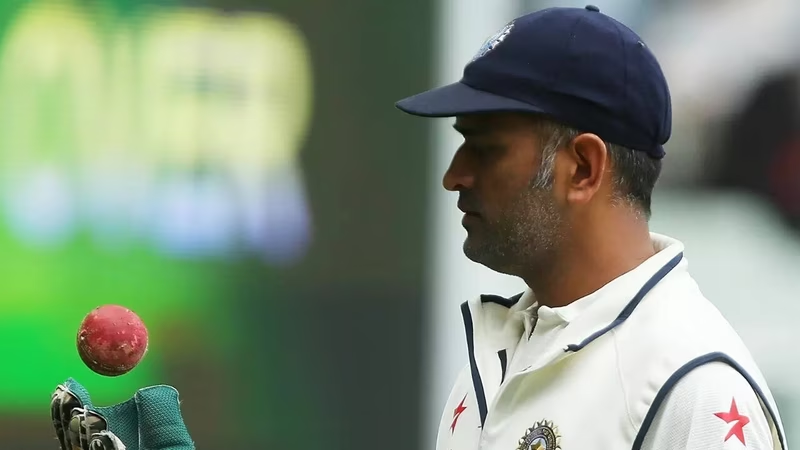
Imagine this: You’ve just captained your team to a hard-fought draw in one of the world’s most hostile cricketing arenas—the Melbourne Cricket Ground. It’s Boxing Day. The crowd is roaring. Your team, battered but unbowed, has just avoided defeat in Australia for the first time in over a decade. You walk into the press conference, calm as ever, and answer questions with your trademark brevity.
And then—without telling a soul—you vanish from Test cricket forever.
This isn’t fiction. This is the true story of **MS Dhoni Test retirement**, one of the most abrupt, mysterious, and emotionally resonant exits in cricket history. On December 30, 2014, the cricketing world woke up to a BCCI press release that changed everything—and left millions of fans heartbroken, confused, and in awe.
Table of Contents
- The Day Everything Changed: December 30, 2014
- Why the Melbourne Test Was a Turning Point
- The Shock Announcement: No Warning, No Goodbye
- What Dhoni Said (and Didn’t Say) in His Last Press Conference
- The Real Reasons Behind His Sudden Exit
- How the Cricket World Reacted
- Dhoni’s Legacy as India’s Most Successful Test Captain
- Conclusion: The Retirement That Defined a Leader
- Sources
The Day Everything Changed: December 30, 2014
It was a Tuesday. India had just drawn the second Test against Australia at the MCG—a result that may seem modest today but was historic then. Before this match, India had lost 10 of its previous 13 Tests in Australia, with only three draws. Surviving on a seaming MCG pitch against Mitchell Johnson, Peter Siddle, and Nathan Lyon was no small feat .
Dhoni himself scored 28 and 4, modest returns. But his leadership—keeping Virat Kohli, Cheteshwar Pujara, and a young Murali Vijay steady—was crucial. After the match, he walked into the post-game press conference, answered questions about the pitch, team balance, and future selections… and never hinted at what was coming next.
Why the Melbourne Test Was a Turning Point
For years, India had crumbled in Australian conditions. The 2011–12 tour was a whitewash. The 2014 series, though still ultimately lost 2–0, showed resilience. The MCG draw proved India could compete overseas—a core goal of Dhoni’s captaincy philosophy.
More importantly, Dhoni had been signaling fatigue. He’d already stepped down as ODI captain after the 2011 World Cup win (though later reversed that decision). By late 2014, he was managing chronic back pain, waning reflexes behind the stumps, and mounting pressure on his batting form. According to ESPNcricinfo, he’d privately told close associates he was “ready to pass the baton” .
The Shock Announcement: No Warning, No Goodbye
At 4:44 PM local time—just **44 minutes after finishing his press conference**—the BCCI issued a terse statement:
“Mahendra Singh Dhoni has decided to retire from Test cricket with immediate effect. The decision has been made keeping in mind his workload and to give youngsters a chance.”
There was no prior announcement. No farewell speech. Not even a tweet from Dhoni himself. Teammates like Ravichandran Ashwin and Virat Kohli found out via media alerts. Kohli, who was named Test captain hours later, admitted he was “completely taken by surprise” .
This lack of ceremony wasn’t oversight—it was pure Dhoni. The man who walked into international cricket with a six and left Tests with a whisper.
What Dhoni Said (and Didn’t Say) in His Last Press Conference
Re-watching that Melbourne press conference is eerie in hindsight. Dhoni was asked if he’d consider retirement. His reply: “I’m not thinking about it right now.” He also praised Kohli’s leadership potential—calling him “the obvious choice” if something were to happen to him .
Yet he gave no hint of imminent departure. Analysts now believe he’d already made the decision before the match, possibly after India’s loss in Brisbane. The draw in Melbourne gave him a dignified exit point—one that didn’t feel like surrender.
The Real Reasons Behind His Sudden Exit
While the BCCI cited “workload management,” insiders reveal a more layered truth :
- Physical strain: Constant wicketkeeping in Test matches was taking a toll on his back and knees.
- Strategic succession: Dhoni wanted Kohli—a natural Test batsman—to lead a younger, more aggressive team.
- Focus on white-ball cricket: With the 2015 World Cup just two months away, he prioritized ODIs and T20s where his impact was greater.
- Personal philosophy: Dhoni has always believed in leaving “before people ask you to.”
As he later told Wisden, “I didn’t want my last memory to be of struggling at the crease or missing catches” .
How the Cricket World Reacted
The news sent shockwaves. Australian captain Michael Clarke called it “a huge loss for world cricket.” Ricky Ponting said, “He changed how India played overseas.” Even rivals like Kevin Pietersen tweeted, “Respect to MSD—one of the greats.”
In India, fans lit candles outside stadiums. News channels ran 24-hour tributes. For many, it felt like the end of an era—not just a career.
Dhoni’s Legacy as India’s Most Successful Test Captain
Let’s not forget: **MS Dhoni Test retirement** closed the book on a legendary captaincy record :
- 60 Tests as captain (most for India at the time)
- 27 wins (highest win count by an Indian Test captain until surpassed by Kohli)
- Series wins in New Zealand, West Indies, Sri Lanka, and a historic No. 1 ICC ranking in 2009
- First Indian captain to win all three ICC trophies (T20 World Cup 2007, ODI World Cup 2011, Champions Trophy 2013)
His calm demeanor, tactical acumen, and ability to back young talent (Ishant Sharma, Ravindra Jadeja, Kohli) reshaped Indian cricket’s DNA.
Conclusion: The Retirement That Defined a Leader
There was no guard of honor. No final walk across the pitch. Just a press release and a man walking away into the Melbourne twilight.
But that silence spoke volumes. In an age of grand exits and farewell tours, **MS Dhoni Test retirement** was refreshingly authentic—a quiet acknowledgment that greatness doesn’t need fanfare to be remembered.
Today, as we look back on December 30, 2014, we don’t mourn the absence of ceremony. We celebrate the man who redefined leadership by knowing exactly when to step aside—and let the next generation begin.
For more on iconic cricket retirements, see our feature on the most emotional exits in cricket history.
Sources
- Times of India: On This Day: Retirement that stunned Indian cricket
- ESPNcricinfo: MS Dhoni’s Test Career Stats & Analysis
- BCCI Official Statement, December 30, 2014
- Wisden Almanack: Interview with MS Dhoni on Leadership and Exit
- ICC Archives: Dhoni’s Captaincy Record