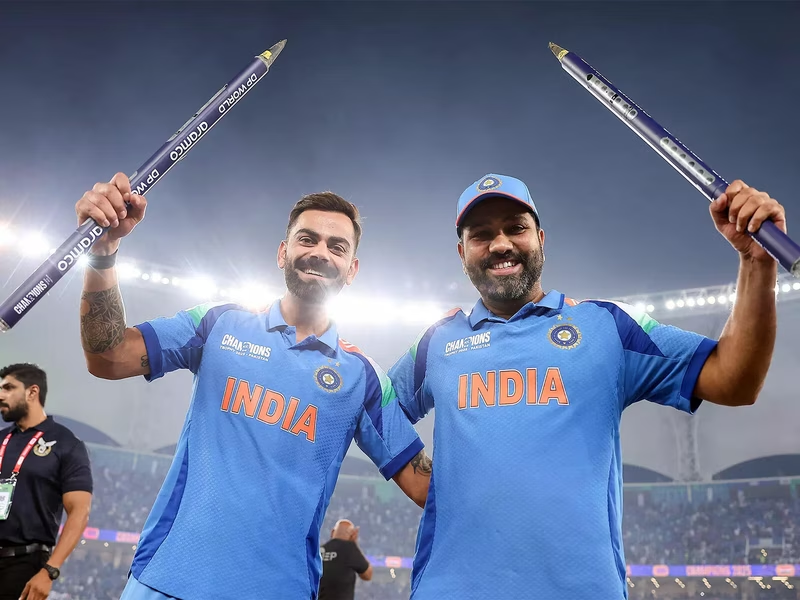
The cricketing world is holding its breath. In a candid and sobering assessment, veteran spinner and strategic mastermind Ravichandran Ashwin has sounded the alarm bells for the 50-over game. His verdict? ODI cricket is on a path to a ‘slow death,’ and its survival beyond the 2027 World Cup is far from guaranteed .
This isn’t just another offhand comment from a player. It’s a stark warning from a man known for his deep understanding of the game’s structure and its evolving ecosystem. With the era-defining duo of Virat Kohli and Rohit Sharma likely to hang up their boots on the ODI stage after the next World Cup, Ashwin fears a massive void that the format may not be able to fill .
Table of Contents
- Ashwin’s Chilling Prediction: The ‘Slow Death’ of ODI Cricket
- The Kohli-Rohit Void: Why Are They So Crucial?
- The 2027 World Cup: A Last Stand for the 50-Over Game?
- Beyond the Stars: What Ails ODI Cricket?
- Can ODI Cricket Be Saved? Possible Solutions
- Conclusion: Is There Hope for the 50-Over Format?
- Sources
Ashwin’s Chilling Prediction: The ‘Slow Death’ of ODI Cricket
Speaking on his popular YouTube channel ‘Ash Ki Baat,’ Ashwin didn’t mince his words. “I am not sure about the future of ODI after the 2027 World Cup. I am a little worried about it,” he confessed . He went on to describe the potential trajectory of the format as a ‘slow death’ .
Ashwin’s concern stems from the format’s fragile ecosystem. He pointed out that while domestic 50-over tournaments like the Vijay Hazare Trophy are running, they lack the glamour, audience, and narrative that international matches provide. The magic of ODI cricket, Ashwin suggests, is intrinsically tied to its global superstars and the pinnacle event—the World Cup.
His analysis highlights a critical vulnerability: ODI cricket’s future is not just about the rules of the game, but about its marketability and fan engagement in an era dominated by faster, flashier formats.
The Kohli-Rohit Void: Why Are They So Crucial?
Why single out Virat Kohli and Rohit Sharma? For over a decade, they have been the twin pillars of India’s—and by extension, global—ODI batting. Their records are staggering, their fan followings are massive, and their presence on the field guarantees eyeballs.
Both legends have already retired from T20Is after their triumphant 2024 T20 World Cup win . All signs point to them making the 2027 ODI World Cup their final swansong in the 50-over format [[30], [36]]. Rohit Sharma’s childhood coach has even confirmed that the 38-year-old captain is targeting the 2027 tournament as his last major goal .
Their departure won’t just be a loss of runs; it will be a loss of a massive chunk of the casual audience that tunes in primarily to watch these icons. The concern is that the next generation, while talented, may not have the same cross-generational appeal or the ability to single-handedly fill stadiums for bilateral ODI series that often see sparse attendance even for Team India .
The 2027 World Cup: A Last Stand for the 50-Over Game?
The 2027 ICC Men’s Cricket World Cup isn’t just another tournament; it’s potentially the last, great hope for the 50-over format. Scheduled to be hosted across South Africa, Zimbabwe, and Namibia from October to November 2027, it will be a massive global event .
If the tournament is a roaring success—filled stadiums, record-breaking viewership, and a compelling narrative—it could buy ODI cricket more time and force administrators to rethink its place in the calendar. However, if it fails to capture the public imagination in a post-Kohli-Rohit landscape, Ashwin’s ‘slow death’ prediction could accelerate into a swift demise.
For many fans, this World Cup is already being framed as a farewell tour for the legends, which ironically, might be the very thing that saves the format, if only for one last hurrah.
Beyond the Stars: What Ails ODI Cricket?
While the star-power vacuum is a major issue, it’s not the only one. The format itself is caught in a tough spot, struggling to find its unique identity.
- The T20 Tsunami: The explosive growth of franchise leagues like the IPL, PSL, and BBL has captured the attention of fans, broadcasters, and players alike. The fast-paced, high-drama nature of T20 is a tough competitor for the more strategic, but often slower, 50-over game.
- The Identity Crisis: ODI cricket is no longer the primary limited-overs format; that crown belongs to T20. It’s also not the ultimate test of a player’s skill and endurance—that’s Test cricket, which Ashwin notes has a ‘special place’ and a loyal, if niche, following . ODI cricket is stuck in the middle, often seen as a less exciting version of T20 and a less pure version of the longer game.
- Calendar Congestion: With so many T20 leagues and a packed international schedule, bilateral ODI series are often de-prioritized, leading to a lack of context and public interest.
Can ODI Cricket Be Saved? Possible Solutions
Ashwin himself has proposed a radical, yet practical, solution. He suggests that to preserve its prestige, ODI cricket should be limited to just one major global event every four years—the World Cup . This would mirror the Olympic model, where the scarcity of the event increases its value and significance.
Other potential ideas to secure the ODI cricket future include:
- Rebranding the Format: Introducing innovations like a 40-overs-per-side game with new powerplay rules to increase the tempo.
- Creating an ODI Super League: A franchise-based ODI league with city-based teams could provide a consistent, high-quality product outside of the World Cup cycle.
- Giving it a Clear Pathway: Clearly positioning ODI cricket as the essential bridge between the raw power of T20 and the technical mastery of Test cricket for player development.
The onus is now on the ICC and national boards to act. Relying solely on nostalgia and past heroes is a losing strategy.
Conclusion: Is There Hope for the 50-Over Format?
R Ashwin’s warning is a necessary wake-up call. The ‘slow death’ of ODI cricket is not a foregone conclusion, but a very real possibility if the sport’s custodians continue with a business-as-usual approach. The 2027 World Cup is the critical juncture. It must be more than just a tournament; it must be a statement of intent to innovate, adapt, and give the 50-over game a compelling reason to exist in the modern cricketing world. The legacy of Kohli and Sharma deserves a format that thrives long after they are gone.
Sources
- Times of India: ‘Slow death’ – R Ashwin’s chilling warning on ODI cricket after Kohli-Rohit era
- Sportstar: Ashwin foresees bleak future for ODI cricket after 2027 World Cup
- ESPNCricinfo: ICC Men’s Cricket World Cup 2027 to be held in South Africa, Zimbabwe, Namibia
- ICC: ODI World Cup 2027 Hosts Confirmed