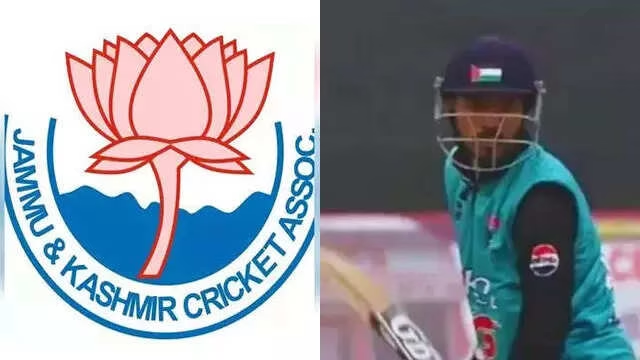
Cricket is often called more than a sport in South Asia—it’s a religion, a unifier, a national obsession. But what happens when the sacred pitch becomes a canvas for global political statements? That’s the uncomfortable question facing the cricketing world after a local match in Jammu, where a cricketer’s helmet bore a bold emblem: the Palestine flag.
The image, captured on social media, quickly went viral, sparking a firestorm of debate. Was it a simple act of humanitarian solidarity? Or a deliberate provocation in a region already fraught with tension? The Jammu and Kashmir Police have now stepped in, launching a formal investigation into the Palestine flag cricket match incident, summoning both the player and the organiser of the unauthorised tournament for questioning .
This event has thrown a spotlight on the thin, often blurry line between personal expression and political messaging in a sport governed by strict neutrality rules. Let’s break down what happened, why it matters, and what it could mean for the future of the game.
Table of Contents
- The Incident: What Happened in Jammu?
- The Official Response: J&K Police and Cricket Bodies React
- The ICC Rulebook: Can Players Make Political Statements?
- A Global Debate: Politics Creeping into Sports
- What Does This Mean for Local Cricket in J&K?
- Conclusion
- Sources
The Incident: What Happened in Jammu?
The controversy unfolded during a privately organised T20 league match in Jammu. According to reports, a local cricketer took to the field wearing a helmet on which the Palestinian flag—a black, white, green, and red tricolor—was clearly visible . The league itself is not recognised by the Jammu and Kashmir Cricket Association (JKCA), operating in a grey area of the sport’s administrative structure .
Photos and videos of the player quickly spread online, drawing both praise from supporters of the Palestinian cause and sharp criticism from others who viewed it as an inappropriate mixing of sport and geopolitics, especially in the sensitive region of Jammu and Kashmir .
The Official Response: J&K Police and Cricket Bodies React
In response to the public uproar, the Jammu and Kashmir Police initiated a formal probe. “We are investigating the circumstances and intent behind the display of the foreign flag,” a senior police official told the media, confirming that both the player and the tournament organiser have been questioned .
Meanwhile, the official cricketing bodies in the state have distanced themselves from the event. A spokesperson for the JKCA clarified that the league was “not sanctioned by us and has no affiliation with the official cricket ecosystem in the UT” . This raises questions about the oversight of such local tournaments and who is responsible for ensuring they adhere to broader sporting and legal norms.
The ICC Rulebook: Can Players Make Political Statements?
This incident directly collides with the International Cricket Council’s (ICC) long-standing policy on political neutrality. The ICC’s Code of Conduct for Players and Player Support Personnel explicitly prohibits “personal, political, religious, or racial comments or gestures” on the field of play .
While this rule is most often enforced at the international level, it sets a powerful precedent. For example, in 2020, Afghanistan’s Mohammad Nabi was reprimanded for wearing a shirt with a political slogan during a match . The ICC’s stance is clear: the cricket field is a place for sport, not for political campaigning.
However, this Jammu case is more complex. The match was local and unofficial. Does the ICC’s code apply here? Legally, perhaps not. But the spirit of the rule is widely accepted as a cornerstone of the sport’s integrity. The ICC’s official Code of Conduct can be referenced as the global standard.
A Global Debate: Politics Creeping into Sports
The Jammu incident is not happening in a vacuum. Across the globe, athletes are increasingly using their platforms to make political statements. From Colin Kaepernick’s kneeling protest in the NFL to various athletes wearing rainbow armbands in support of LGBTQ+ rights, the debate over “shutting up and dribbling” is louder than ever .
Supporters argue that athletes are citizens first and have a right to their opinions. Critics counter that international sports events are meant to foster unity and should remain free from divisive political agendas. The Palestine flag cricket match has become a local flashpoint in this much larger, ongoing global conversation.
What Does This Mean for Local Cricket in J&K?
Beyond the headlines, this probe could have lasting implications for grassroots cricket in Jammu and Kashmir. The authorities may now look to tighten regulations on privately organised tournaments, ensuring they are registered and their participants are briefed on conduct policies .
For aspiring young cricketers, the message is a cautionary one: while passion for the game is encouraged, actions on the field—no matter how well-intentioned—can have serious consequences, especially when they intersect with geopolitics. It’s a tough lesson in the responsibility that comes with being in the public eye, even at a local level.
For fans, it’s a reminder to engage with these debates thoughtfully. We’ve explored the fine line between sport and society in our piece on [INTERNAL_LINK:sport-as-a-mirror-of-society].
Conclusion
The Palestine flag cricket match in Jammu is a microcosm of a much bigger struggle. It’s about the tension between an individual’s right to express solidarity and a sport’s institutional need for neutrality and order. As the J&K Police investigation continues, the cricketing community must grapple with how to handle such incidents in the future. The goal should be to protect the sanctity of the game while fostering an environment where empathy and awareness can exist—just not on the field of play itself.
Sources
- Jammu and Kashmir Police official statement and investigation details , .
- JKCA’s statement on the unauthorised nature of the tournament .
- ICC Code of Conduct for Players and Player Support Personnel .
- Historical context of political gestures in international cricket .
- Global discourse on athlete activism .