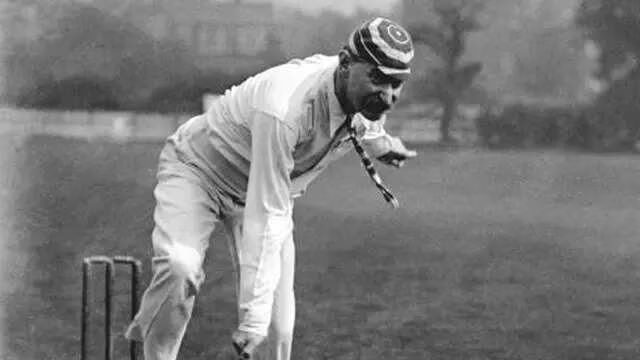
Imagine a time when the very idea of a ‘hat-trick’ in Test cricket was pure science fiction. There was no precedent, no blueprint, no one to follow. Then, on January 2, 147 years ago, a man known as ‘The Demon Bowler’ stepped onto the hallowed turf of the Melbourne Cricket Ground and conjured magic that would define a new benchmark for bowling brilliance. His name was Fred Spofforth, and he claimed the first Test hat-trick in history, a feat that remains one of the sport’s most iconic origin stories.
Table of Contents
- The Historic Moment: The First Test Hat-Trick is Born
- Who Was Fred Spofforth: The Demon Bowler
- The Match That Made History: Australia vs England 1879
- The Evolution of the Hat-Trick in Test Cricket
- Why Spofforth’s First Test Hat-Trick Still Matters Today
- Conclusion: A Legacy Cast in Stone
- Sources
The Historic Moment: The First Test Hat-Trick is Born
It was the second and final Test of England’s 1878-79 tour of Australia. In just his second Test appearance, the fiery 23-year-old Fred Spofforth was about to make history. On the final day of the match, January 2, 1879, he clean-bowled Tom Emmett, before trapping George Ulyett leg before wicket (LBW), and then castled the next batsman, Billy Midwinter, all in consecutive deliveries . This devastating sequence wasn’t just a wicket-taking over; it was the birth of a legend—the first Test hat-trick.
The feat was so extraordinary that it became the cornerstone of a dominant Australian victory. Spofforth’s figures for the match were a staggering 13 for 110, a masterclass in fast bowling that demolished the English batting lineup and secured a commanding 10-wicket win for the hosts .
Who Was Fred Spofforth: The Demon Bowler
Frederick Robert Spofforth wasn’t just a one-trick pony. Nicknamed ‘The Demon’ for his fearsome pace and aggressive, almost theatrical, bowling action, he was a pioneer of the sport . He was the first bowler in Test history to reach the milestone of 50 wickets, a testament to his sustained dominance over a decade .
His career stats are a testament to his greatness: 94 wickets from just 18 Test matches at a remarkable average of 18.41 . In an era of uncovered pitches and a less forgiving ball, these numbers are nothing short of phenomenal. He was known for his ability to generate extreme pace and bounce, a style that often left the best batsmen of his time bewildered and beaten.
The Match That Made History: Australia vs England 1879
The context of the match made Spofforth’s achievement even more significant. This was only the fourth Test match ever played. The nascent format was still finding its footing, and a performance of this magnitude provided a massive boost to its popularity and legitimacy.
Australia, having lost the first Test, was desperate for a win. Spofforth delivered in spades. After England was bowled out for 113 in their first innings, largely thanks to Spofforth’s early breakthroughs, Australia built a solid lead. In the second innings, England looked to be mounting a fight before Spofforth’s historic spell ripped through the middle order, effectively ending the contest .
The Batsmen in the Hat-Trick
While the exact sequence of the dismissals has been a subject of minor historical debate, the most widely accepted order of victims for Spofforth’s first Test hat-trick is:
- William (Billy) Midwinter (bowled)
- Tom Emmett (bowled)
- George Ulyett (LBW)
This sequence, as recorded by many historical accounts, showcases his variety—using pace to knock over the stumps and then sharp turn or seam to trap a batsman plumb in front .
The Evolution of the Hat-Trick in Test Cricket
Since Spofforth’s groundbreaking feat in 1879, the hat-trick has become one of cricket’s most celebrated achievements. It’s a rare and electrifying moment that can shift the momentum of a game in an instant. As of today, there have been only 44 instances of a hat-trick in Test cricket history, a testament to its difficulty .
Legends like Harbhajan Singh, who took a hat-trick against Australia in 2001, and more recently, Kagiso Rabada and Naseem Shah, have all joined this exclusive club. Yet, they all stand on the shoulders of the original pioneer, Fred Spofforth. His achievement set the gold standard and created a dream for every fast bowler who has followed.
Why Spofforth’s First Test Hat-Trick Still Matters Today
Spofforth’s legacy is more than just a statistic. His first Test hat-trick was a pivotal moment that helped elevate the role of the fast bowler in the game. Before him, bowling was often seen as a supporting act to batting. Spofforth, with his aggression and skill, proved that a bowler could be the main event, the match-winner.
For modern fans, this piece of history connects us to the raw, foundational days of our beloved sport. It’s a reminder that the game’s most thrilling traditions had humble, yet spectacular, beginnings. His feat at the MCG is a cornerstone of cricket folklore, a story as relevant today as it was in 1879.
Conclusion: A Legacy Cast in Stone
On this day, 147 years ago, Fred Spofforth didn’t just take three wickets; he created a new chapter in cricket’s rulebook of greatness. His first Test hat-trick was a moment of pure, unadulterated genius that announced his arrival as a force of nature and gave the cricketing world a new benchmark for bowling excellence. While countless bowlers have since walked in his footsteps, the Demon of Melbourne remains the original, the one who started it all. His story is not just a historical footnote; it’s the beating heart of a tradition that continues to thrill fans across the globe.
Sources
- Times of India: “On this day, 147 years ago…”
- ESPNcricinfo & Wisden Archives on Fred Spofforth’s career [[3], [6], [8]]
- Historical match records and dismissal details [[7], [10]]
- Australian Dictionary of Biography: “Frederick Robert (Fred) Spofforth”
- ESPNcricinfo