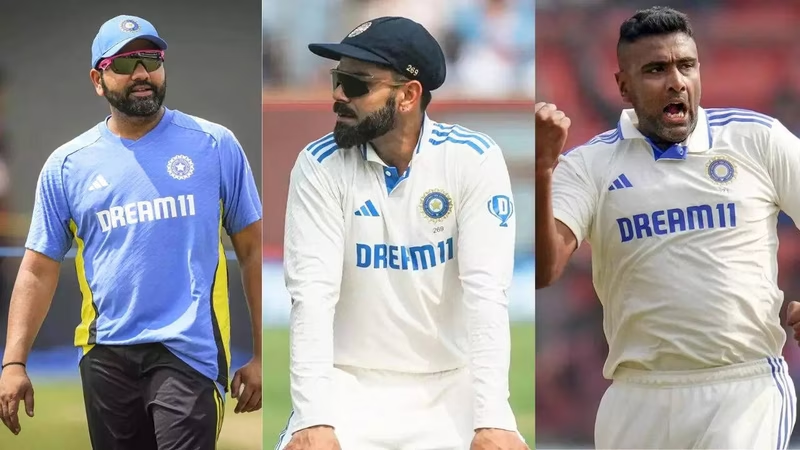
How do you say goodbye to giants? In the world of cricket, where legacy is written in runs, wickets, and moments of pure brilliance, the final chapter deserves a stage worthy of the story. Yet, as three of India’s most decorated modern legends—Virat Kohli, Rohit Sharma, and Ravichandran Ashwin—enter the twilight of their Test careers, a growing chorus of voices is asking: where is their proper farewell? Former England spinner Monty Panesar has become the latest and loudest critic, slamming the BCCI for what he sees as a profound lack of respect, directly comparing India’s approach to England’s grand send-offs for icons like Stuart Broad and James Anderson.
Table of Contents
- Monty Panesar’s Scathing BCCI Farewell Test Critique
- The English Blueprint: Broad and Anderson’s Grand Exits
- The Indian Trio: A Legacy Without a Ceremony
- Why a Farewell Test Matters More Than Just a Game
- The BCCI’s Stance and the Future of Indian Legend Send-offs
- Conclusion: Honoring the Past to Inspire the Future
- Sources
Monty Panesar’s Scathing BCCI Farewell Test Critique
Monty Panesar, who shared many an intense on-field battle with the Indian trio, didn’t hold back. “Rohit, Kohli, and Ashwin deserved that respect,” he stated emphatically, his words carrying the weight of a former competitor who now sees the bigger picture of legacy and honor . His criticism cuts deep because it comes from outside the often-insular Indian cricket ecosystem, offering an objective, global perspective.
His core argument is simple yet powerful: the contributions of these three players to Indian and world cricket are on par with, if not greater than, many of their global counterparts who have been given the ultimate honor of a pre-announced, celebratory farewell Test. To deny them this is, in his view, to diminish their service to the sport.
The English Blueprint: Broad and Anderson’s Grand Exits
Panesar’s comparison to England’s farewell strategy is particularly stinging. In 2023, the England Cricket Board (ECB) orchestrated a masterclass in honoring its legends. Stuart Broad’s final Test at The Oval was a national event. He walked out to a guard of honor from his teammates, was lauded by fans and former players alike, and fittingly took his 600th wicket in his last over, securing a win against India .
Similarly, when James Anderson is ready to call it a day, a similar grand ceremony is all but guaranteed. These are not just games; they are carefully curated national moments of gratitude. The ECB understood that these farewells are not just for the players, but for the fans who have supported them for decades, and for the young players who look up to them as heroes.
The Indian Trio: A Legacy Without a Ceremony
Contrast this with the situation for India’s own titans:
- Virat Kohli: Over 8,800 Test runs, 29 centuries, a former captain who redefined fitness and aggression in Indian cricket. His last Test was a quiet affair in Cape Town, with no official send-off.
- Rohit Sharma: The current Test captain, holder of the record for most T20I centuries, and a key architect of India’s white-ball dominance, with over 3,600 Test runs to his name. His future in the longest format is uncertain, with no farewell planned.
- Ravichandran Ashwin: With over 500 Test wickets and 3,000+ runs, he is one of the greatest all-rounders in history. His last Test was in Dominica in 2023, and his omission from subsequent squads left his international career in limbo without a final goodbye.
Their potential final matches have been or will be just another game on the calendar, devoid of the ceremonial closure their careers so richly deserve.
Why a Farewell Test Matters More Than Just a Game
A farewell Test is far more than a marketing stunt. It serves several crucial purposes in the cricketing ecosystem:
- Cultural Continuity: It connects generations of fans, allowing older supporters to share their heroes with the new generation in a live, emotional setting.
- Institutional Gratitude: It’s the board’s formal way of saying “thank you” for decades of service, sacrifice, and national pride.
- Player Closure: It provides the player with a definitive, dignified endpoint to their career, allowing them to walk away on their own terms.
- National Celebration: It becomes a moment of national unity and celebration, a rare positive event that transcends the usual divisions.
The BCCI’s Stance and the Future of Indian Legend Send-offs
The BCCI has historically been ambivalent about official farewell matches. Their argument often centers on competitive integrity—that a pre-announced farewell might compromise team selection or the intensity of the contest. They point to players like Sachin Tendulkar, who had a grand farewell in 2013, as proof they do it when the time is right .
However, critics argue that the Tendulkar farewell was a unique, once-in-a-generation event and should not be the only benchmark. The current trio has, collectively, defined an entire era of Indian cricket. To treat their departures as mere administrative footnotes is a missed opportunity and, as Panesar suggests, a sign of disrespect. The pressure is now mounting for the BCCI to reconsider its approach before it’s too late.
Conclusion: Honoring the Past to Inspire the Future
Monty Panesar’s criticism is a wake-up call. The question of a BCCI farewell Test for Kohli, Rohit, and Ashwin is not just about three individuals; it’s about the values the board wants to project. Does Indian cricket celebrate its history with the same grandeur as its future? The global cricketing community, led by voices like Panesar’s, is watching. Granting these legends a proper, emotional farewell isn’t just the right thing to do—it’s an investment in the soul of the sport in India, showing every young aspirant that a lifetime of dedication will be remembered and honored with the ultimate respect.