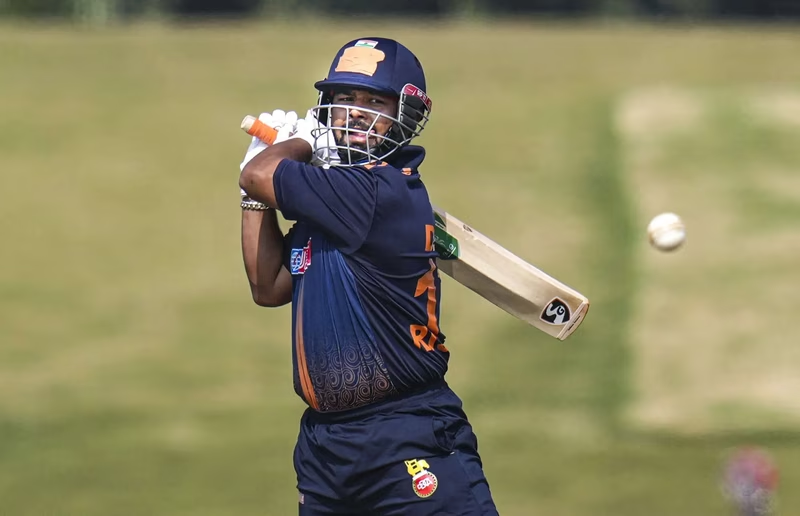
Rishabh Pant has pulled off miracle chases, bailed India out of impossible situations, and earned the love of millions with his fearless, unorthodox batting. Yet, here we are again—staring down the barrel of a familiar dilemma: should he be in India’s ODI squad?
Ahead of the upcoming India vs New Zealand ODI series, Pant’s name is at the center of a fierce selection debate. His recent omission from white-ball squads has raised eyebrows, especially given his proven ability to change games in a matter of overs. But with a new captain, a fresh coaching philosophy, and the 2027 ODI World Cup on the horizon, the selectors seem to be sending mixed signals—a dangerous game that could cost India dearly.
Table of Contents
- The Pant Paradox: A Match-Winner on the Sidelines?
- New Leadership, New Philosophy: Why Flexibility Might Be Backfiring
- What Former Players Are Saying: A Warning from History
- The Wicketkeeper Conundrum: Who’s Plan B?
- So, What Should India Do? A Clear Path Forward
- Conclusion: Stop the Drift—Back Pant or Move On
- Sources
The Pant Paradox: A Match-Winner on the Sidelines?
Let’s be clear: Rishabh Pant ODI selection shouldn’t be this complicated. His strike rate of over 100 in ODIs, his ability to accelerate in the death overs, and his knack for rescuing India from 100/5 are well-documented. Remember his 125* off 113 balls against South Africa in 2022? Or his 89* in the 4th ODI against England in 2021? These weren’t flukes—they were statements.
Yet, despite this explosive potential, Pant has been in and out of the ODI side, often without a clear explanation. His recent focus has been on Test cricket, where he’s undeniably India’s first choice. But the white-ball gap is widening—and with it, doubts about his ODI future.
New Leadership, New Philosophy: Why Flexibility Might Be Backfiring
Under the new leadership of Rohit Sharma as captain and Rahul Dravid (now succeeded by Gautam Gambhir) as coach, India has emphasized a more structured, role-based approach in ODIs. The idea is to have players who fit specific templates—anchor openers, middle-order stabilizers, finishers, etc.
Pant, with his high-risk, high-reward style, doesn’t easily slot into a rigid box. Selectors might be leaning toward more ‘dependable’ options like KL Rahul or even Sanju Samson, who offer slightly more consistency behind the stumps and in the middle order. But this pursuit of ‘flexibility’ is creating inflexibility elsewhere—by not committing to a primary wicketkeeper-batsman, India is leaving a crucial role in limbo.
What Former Players Are Saying: A Warning from History
Former India players aren’t staying quiet on this. Legends like VVS Laxman and Irfan Pathan have publicly urged the BCCI to show consistency in selection, especially for a talent like Pant.
They point to past mistakes—like the repeated chopping and changing of players before the 2019 World Cup—as cautionary tales. “You can’t treat a match-winner like an experiment,” one former player was quoted as saying . The consensus is clear: either fully back Pant in ODIs or decisively move on and build around someone else. The current middle ground serves no one.
The Wicketkeeper Conundrum: Who’s Plan B?
This debate isn’t just about Pant—it’s about India’s entire wicketkeeping strategy for the next World Cup cycle. Right now, the options are:
- KL Rahul: A solid batsman who keeps part-time, but not at the level of a specialist in high-pressure games.
- Sanju Samson: Elegant batsman with improving glovework, but his ODI temperament under pressure is still unproven.
- Ishan Kishan: Aggressive in T20s, but his ODI numbers (avg. under 30) don’t inspire confidence yet.
None of these players bring the same game-changing X-factor that Pant does. More importantly, without a settled first-choice keeper, India risks entering the 2027 World Cup with a question mark in one of its most critical roles.
So, What Should India Do? A Clear Path Forward
India’s selectors need to make a bold call—and stick to it. Here’s a realistic path forward:
- Commit to Pant in ODIs: Give him a 10–15 match window to cement his place. Protect him from early axing if he has a quiet game.
- Develop a true backup: Use A tours and bilateral series to test and groom a long-term alternative, not just rotate names.
- Clarify roles: If Pant is in, define whether he’s a No. 4 finisher or a No. 5 accelerator—and build the batting order around that.
Half-measures will only lead to confusion and missed opportunities on the global stage.
Conclusion: Stop the Drift—Back Pant or Move On
The Rishabh Pant ODI selection saga is more than just a team-sheet issue—it’s a test of India’s cricketing vision. In a format where momentum and confidence are everything, constantly questioning a proven match-winner sends the wrong message. As former players warn, inconsistency in selection has cost India before. With the World Cup just three years away, now is the time for clarity, not caution.
For more on India’s ODI strategy, check out our deep dive into [INTERNAL_LINK:india-odi-world-cup-2027-preparation] or our player comparison: [INTERNAL_LINK:pant-vs-samson-keeping-abilities].
Sources
- Times of India: IND vs NZ: Rishabh Pant at the heart of a fierce selection debate
- ICC Official Stats: ICC ODI Player Rankings & Career Stats (High-authority source for performance data)