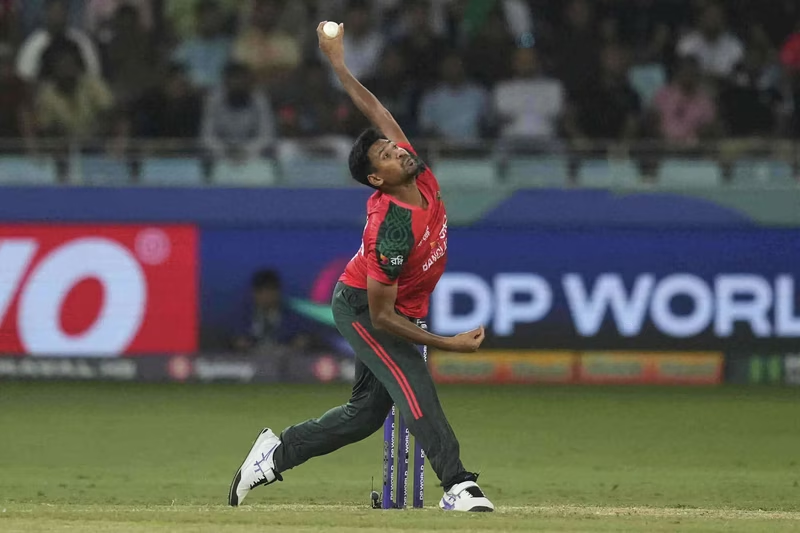
In a dramatic turn of events that blurs the line between sport and statecraft, the BCCI has officially asked Kolkata Knight Riders (KKR) to release Bangladeshi fast bowler Mustafizur Rahman from their IPL 2026 roster. The decision—driven not by performance or injury, but by escalating political and religious backlash—has sent shockwaves through the cricketing world and raised urgent questions about the autonomy of India’s premier T20 league.
Mustafizur, a fan favorite and one of the most economical death bowlers in IPL history, was retained by KKR during the 2025 auction cycle. But following recent civil unrest in Bangladesh and strained diplomatic relations between New Delhi and Dhaka, several political and religious groups launched vocal campaigns against his participation, citing “national sentiment” and security concerns. Faced with mounting pressure, the BCCI chose to intervene—prioritizing political harmony over sporting merit.
Table of Contents
- Mustafizur Rahman KKR: The Controversial Decision Explained
- What Sparked the Political Backlash?
- BCCI’s Official Stance and Internal Dilemma
- How KKR and Mustafizur Are Responding
- Has This Happened Before in IPL History?
- Impact on IPL 2026 and KKR’s Campaign
- Broader Implications for Global Cricket
- Conclusion: When Politics Overshadows the Spirit of the Game
- Sources
Mustafizur Rahman KKR: The Controversial Decision Explained
The directive from the BCCI is clear: KKR must formally release Mustafizur Rahman before the IPL 2026 player window closes. While framed as a “mutual understanding,” sources within the board confirm it was a non-negotiable order issued after high-level consultations with government advisors .
This marks a significant escalation from past seasons, where foreign players from Pakistan or China were excluded due to longstanding policy—but never a star from a neighboring cricketing nation already active in bilateral series with India. Mustafizur had played in India as recently as the 2023 ODI World Cup without incident, making this reversal all the more jarring.
What Sparked the Political Backlash?
The controversy stems from recent civil unrest in Bangladesh, including protests and violence linked to religious and political tensions. Some Indian right-wing groups and social media influencers began circulating old, decontextualized clips of Mustafizur, falsely linking him to anti-India rhetoric. Though he has never made such statements, the narrative gained traction.
Memorandums were submitted to the Ministry of External Affairs and BCCI by fringe organizations demanding his exclusion, citing “national security” and “public sentiment.” While mainstream political parties remained silent, the cumulative pressure created an environment where the BCCI felt compelled to act—despite clear IPL regulations allowing Bangladeshi players.
BCCI’s Official Stance and Internal Dilemma
Officially, the BCCI has not issued a public statement. However, a senior board official, speaking on condition of anonymity, told reporters: “This was not a cricketing decision. It was made to ensure the smooth and secure conduct of the IPL without external disruptions.”
Internally, the move has caused division. Some administrators argue that caving to political pressure sets a dangerous precedent, while others believe it was necessary to avoid protests or venue security issues during matches—particularly in sensitive regions.
How KKR and Mustafizur Are Responding
Kolkata Knight Riders have issued a brief, diplomatic statement: “We respect the BCCI’s guidance and remain committed to the integrity of the IPL.” Privately, however, franchise insiders are devastated. Mustafizur was a cornerstone of their bowling attack, with 68 wickets in 58 matches at an economy of 7.89 .
Mustafizur himself has not commented publicly, but close associates say he is “deeply disappointed but understanding of the complexities involved.” He is now eligible for the replacement draft, though few teams may risk signing him under the current climate.
Has This Happened Before in IPL History?
This is the first time a duly contracted foreign player has been removed mid-cycle due to political pressure. Historically:
- Pakistani players have always been barred due to government policy.
- Chinese players were excluded after the 2020 border clash.
- Players from Sri Lanka, Afghanistan, and the West Indies have participated without issue, even during domestic crises in their home countries.
The Mustafizur case breaks new ground—and not in a good way. For more on IPL’s foreign player policies, see [INTERNAL_LINK:ipl-foreign-player-rules-explained].
Impact on IPL 2026 and KKR’s Campaign
Losing Mustafizur is a massive blow to KKR’s title hopes. His ability to bowl yorkers at will in the death overs is nearly irreplaceable. The franchise will now scramble to find a like-for-like replacement—likely another left-arm pacer—but the chemistry and match awareness he brought cannot be replicated overnight.
Beyond tactics, the decision risks alienating fans who see cricket as a unifying force. Social media is already flooded with #BringBackMustafizur, highlighting the disconnect between policymakers and the public.
Broader Implications for Global Cricket
If geopolitical tensions can override sporting contracts in the IPL—the richest and most powerful T20 league—what does this mean for future tours, multi-nation tournaments, or even the ICC? Cricket’s governing bodies have long prided themselves on keeping sport separate from politics. This incident threatens that fragile boundary.
Conclusion: When Politics Overshadows the Spirit of the Game
The forced exit of Mustafizur Rahman from KKR is more than a roster change—it’s a watershed moment. It signals that even in the glitzy, commercial world of the IPL, cricket remains vulnerable to the tides of geopolitics. While the BCCI may have avoided short-term controversy, it has opened a Pandora’s box that could haunt Indian cricket for years to come.