Introduction: A Century, A Snub, and A Veteran’s Verdict
Scoring a century for India is the dream of every young cricketer. For Ruturaj Gaikwad, it was a statement—a powerful, elegant 100 against a quality South African attack that should have cemented his place in the ODI side. Instead, he was handed a massive surprise: a place on the sidelines for the upcoming ODI series against New Zealand. The selectors opted for the wicketkeeping prowess and left-handed balance of Rishabh Pant over the pure batting form of Gaikwad [1].
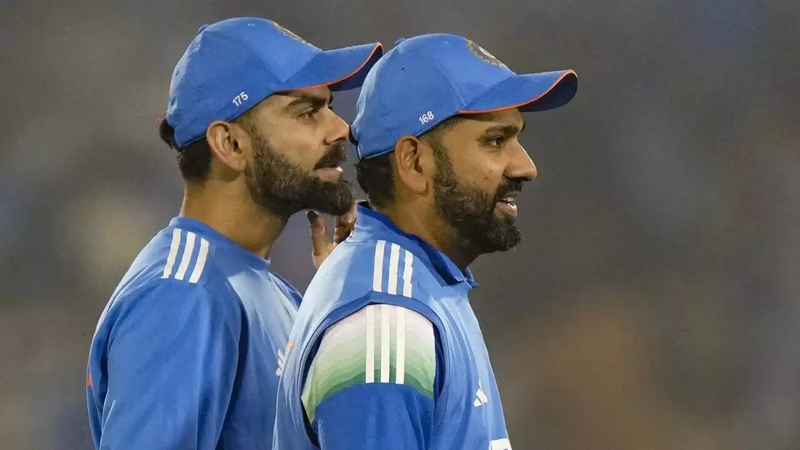
Now, the snub has drawn the attention of one of Indian cricket’s most astute minds. In a refreshingly candid assessment, veteran off-spinner Ravichandran Ashwin didn’t just question the decision—he laid bare the harsh reality of Gaikwad’s situation. His verdict? “Only after Kohli and Rohit retire…” Ashwin’s comment has sparked a fresh debate about generational transition, team balance, and the agonizing wait for India’s next batting star.
Table of Contents
- The Gaikwad Snub: Breaking Down the Selection Decision
- Ashwin’s Bold Take on Ruturaj Gaikwad India Selection
- The Kohli-Rohit Legacy: A High Bar to Clear
- Is Left-Hand Balance Really Worth a Form Batsman?
- What’s Next for Gaikwad and India’s Future Top Order?
- Conclusion: The Painful Patience of a Future Star
- Sources
The Gaikwad Snub: Breaking Down the Selection Decision
The decision to omit Ruturaj Gaikwad from the ODI squad was met with widespread confusion. Fresh off a match-winning century, he was arguably in the best batting form among the available openers. However, the selection committee, led by Ajit Agarkar, appeared to prioritize team composition over individual form.
By bringing in Rishabh Pant as a specialist batsman (he won’t be keeping wickets in the ODIs, with KL Rahul on duty), the panel gains a crucial left-handed option in the top and middle order. This is seen as a tactical counter to the angle offered by New Zealand’s quality seamers like Tim Southee and Matt Henry [2]. In their eyes, the team balance provided by Pant’s left-handedness outweighed Gaikwad’s right-handed brilliance, at least for this specific series.
Ashwin’s Bold Take on Ruturaj Gaikwad India Selection
It was during a recent podcast that Ashwin, never one to shy away from an honest opinion, delivered his now-famous line. While praising Gaikwad’s “fantastic” batting temperament and technique, Ashwin admitted the young opener’s path to a permanent spot is “crowded” [1].
“He’s a fantastic player of the ball, a class act. But let’s be honest about the situation,” Ashwin is reported to have said. “The opportunities at the top for him are limited. **Only after Kohli and Rohit retire** will there be a real, sustained opening for someone like Ruturaj [1].”
This statement from a senior, respected figure in the game is significant. It moves the conversation beyond the immediate selection headache and into the broader strategic challenge facing Indian cricket: managing a smooth transition from its golden generation.
The Kohli-Rohit Legacy: A High Bar to Clear
Ashwin’s comment points to an undeniable truth. Virat Kohli and Rohit Sharma are not just players; they are institutions in Indian cricket. Their records, experience, and leadership are invaluable to the team. However, their prolonged presence at the crease creates a bottleneck for the next generation of top-order talent.
Historically, Indian cricket has struggled with this transition. The gap between the retirement of legends like Tendulkar, Dravid, and Laxman and the full establishment of the current generation was a period of significant flux. The current selectors are clearly trying to avoid a similar scenario, but in doing so, they may be inadvertently delaying the inevitable.
As one analyst noted, “You can’t keep waiting for a legend to retire to blood your next star. You have to create a bridge, not a gap.”
Is Left-Hand Balance Really Worth a Form Batsman?
This is the heart of the tactical dilemma. While left-hand/right-hand combinations are a valid strategic tool, is it a good enough reason to bench a batsman in peak form?
Let’s consider the options:
- With Gaikwad: A settled, in-form opening pair with Shubman Gill, providing a rock-solid foundation with two specialist openers.
- With Pant: A more flexible, albeit less orthodox, batting order with an extra left-hander, but at the cost of a specialist opener and a player not in his best ODI rhythm.
Many fans and experts argue that in the long run, building a team around its best players, regardless of their batting hand, is a more sustainable strategy than forcing balance. Gaikwad’s century was a clear signal of his readiness; ignoring it for a theoretical advantage is a risky gamble.
What’s Next for Gaikwad and India’s Future Top Order?
For Ruturaj Gaikwad, the path forward is one of patience and continued excellence. He must keep scoring heavily in domestic cricket and for his IPL franchise, Chennai Super Kings, to ensure he remains impossible to ignore. His time will come, but as Ashwin starkly pointed out, it may be tied to events beyond his control—the eventual retirement of two of the game’s greats.
For the Indian selectors, this episode is a wake-up call. The team needs a clear, public roadmap for its future. How will they integrate the likes of Gaikwad, Yashasvi Jaiswal, and Shreyas Iyer into a core that still relies heavily on its 30-something veterans? Without a transparent plan, more talented players may find themselves in the same frustrating holding pattern.
Conclusion: The Painful Patience of a Future Star
Ashwin’s blunt assessment of the Ruturaj Gaikwad India selection scenario, while harsh, is a necessary truth. It highlights the difficult balancing act between honoring legendary careers and nurturing the next generation. Gaikwad’s century was a promise of a brilliant future, but that future is currently on hold, waiting in the wings behind two colossal figures in Indian cricket. The selectors now face a critical choice: manage the transition proactively, or risk a future where the next Gaikwad’s talent is wasted in the shadow of the past.
Sources
[1] “‘Only after Virat Kohli and Rohit Sharma retire…’: R Ashwin makes bold Ruturaj Gaikwad claim after India’s ODI squad snub”, Times of India
[2] Analysis of India’s ODI squad composition for the New Zealand series
[3] Commentary on left-hand/right-hand balance in international cricket strategy