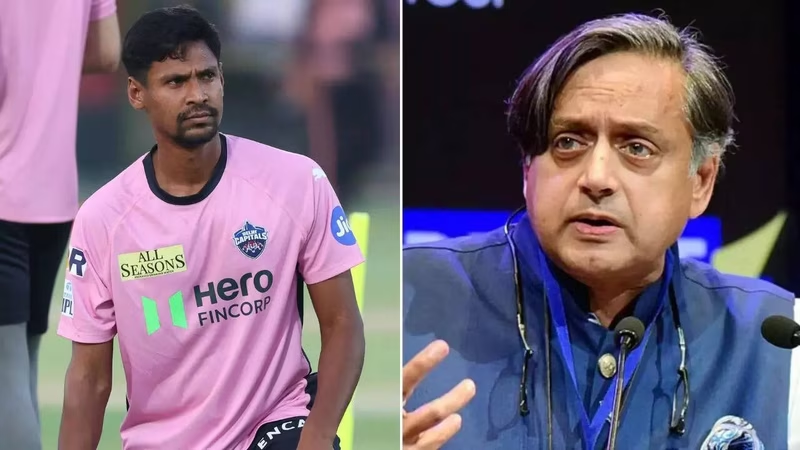
The cricketing world is reeling from a bombshell that’s as much about geopolitics as it is about the game. Bangladesh refuses to play T20 World Cup in India, citing serious concerns over player safety. This unprecedented decision, stemming from the controversial release of star pacer Mustafizur Rahman from the IPL, has not only thrown the ICC’s plans into chaos but has also ignited a fierce political debate at home.
Table of Contents
- The Trigger: Mustafizur Rahman’s IPL Release
- Bangladesh Refuses to Play T20 World Cup in India: The Official Stance
- Tharoor’s Scathing Response: A ‘Self-Inflicted Embarrassment’
- What This Means for the T20 World Cup 2026
- Broader Implications for India-Bangladesh-ICC Relations
- Conclusion: A Sporting Crisis Fueled by Politics
- Sources
The Trigger: Mustafizur Rahman’s IPL Release
The entire crisis can be traced back to a single, controversial directive from the Board of Control for Cricket in India (BCCI). In a move that raised eyebrows across the cricketing fraternity, the BCCI advised the Kolkata Knight Riders (KKR) to release their newly acquired Bangladesh pacer, Mustafizur Rahman.
While the BCCI did not publicly detail its reasoning, multiple reports confirm the advice was a “preventive measure” driven by escalating diplomatic tensions between India and Bangladesh, specifically concerning the safety of the Hindu minority in Bangladesh .
This decision effectively ended Mustafizur’s IPL 2026 campaign before it began, a significant blow to both the player and his franchise, who had invested heavily in him.
Bangladesh Refuses to Play T20 World Cup in India: The Official Stance
In a swift and decisive retaliation, the Bangladesh Cricket Board (BCB) has formally communicated to the International Cricket Council (ICC) that its national team will not travel to India for its scheduled group-stage matches in the T20 World Cup 2026 .
The BCB has cited “player safety concerns” as the primary reason for this drastic step, a direct response to the BCCI’s handling of the Mustafizur Rahman situation . The board has even requested that the ICC relocate all of Bangladesh’s matches to a neutral venue, with Sri Lanka being a potential alternative .
Bangladesh was slated to play its matches at some of India’s most iconic stadiums, including the Eden Gardens in Kolkata and the Wankhede Stadium in Mumbai . This refusal now puts the ICC in a massive logistical and financial bind just weeks before the tournament’s kickoff.
Tharoor’s Scathing Response: A ‘Self-Inflicted Embarrassment’
Congress MP and noted cricket aficionado, Shashi Tharoor, has launched a fierce critique of the BCCI’s role in this escalating fiasco. He has described the situation as a “self-inflicted embarrassment” for India .
Tharoor’s frustration is palpable. He believes that by allowing political tensions to seep into the sporting arena, the BCCI has not only jeopardized a major international event on home soil but has also severely damaged India’s reputation as a reliable and apolitical host for global cricket. He has openly questioned the wisdom of the BCCI’s advice to KKR, suggesting it was a short-sighted move with far-reaching consequences .
What This Means for the T20 World Cup 2026
The implications for the tournament are severe:
- Logistical Nightmare: The ICC must now scramble to find new venues for all of Bangladesh’s fixtures, which could involve complex schedule changes and financial losses.
- Competitive Integrity: Playing matches in a neutral venue, far from the original plan, could impact the competitive balance and fan experience for all teams in the group.
- Financial Fallout: The BCCI, as a co-host, stands to lose significant revenue from ticket sales, broadcasting, and sponsorships related to the high-profile Bangladesh matches.
This crisis also casts a shadow over other bilateral sporting ties, making future tours between the two nations highly uncertain.
Broader Implications for India-Bangladesh-ICC Relations
This incident is a stark reminder of how fragile the intersection of sports and politics can be. The BCCI’s attempt to make a political statement through a sporting channel has backfired spectacularly. It has:
- Alienated a key neighboring cricket board, potentially setting back years of sporting diplomacy.
- Put the ICC in an extremely difficult position, forcing it to mediate a dispute that is fundamentally political, not sporting.
- Damaged India’s image as a premier cricket destination, a reputation that has been carefully built over decades.
For a deeper look at the history of India-Bangladesh cricketing relations, see our analysis on [INTERNAL_LINK:india-bangladesh-cricket-rivalry-history].
Conclusion: A Sporting Crisis Fueled by Politics
The story of Bangladesh refusing to play T20 World Cup in India is a cautionary tale. It underscores that while cricket can be a powerful tool for diplomacy, it can also become its biggest casualty. Shashi Tharoor’s label of a “self-inflicted embarrassment” seems painfully accurate. The BCCI’s decision to involve itself in a geopolitical dispute has not only cost a player his dream but has also put a global tournament at risk and tarnished India’s standing in the international cricket community. The onus is now on all parties—the BCCI, BCB, and ICC—to find a swift and amicable solution before the beautiful game suffers an even greater loss.
Sources
[1] Shashi Tharoor slams BCCI after KKR releases Mustafizur. Times of India.
[2] Shashi Tharoor on Bangladesh refusing to play T20 World. India Today.
[4] ‘Embarrassment Upon Ourselves’: Shashi Tharoor Reacts. NDTV.
[12] Bangladesh will not play T20 World Cup games in India. ESPNcricinfo.
[15] BCB formally requests ICC to relocate Bangladesh’s World. Cricbuzz.
[24] Bangladesh will not play T20 World Cup games in India. The Hindu.
[28] After BCCI directive, KKR release Bangladesh cricketer. Hindustan Times.
International Cricket Council (ICC) Official Site