For over a decade, Indian cricket fans grew accustomed to dominance in the longest format. Under the leadership of MS Dhoni, Virat Kohli, and Rohit Sharma, India wasn’t just competitive—they were feared overseas, unbeatable at home, and consistent contenders for the ICC World Test Championship (WTC) final.
But that era now appears to be crumbling. The recent **whitewash in New Zealand**—a series India was expected to at least contest—wasn’t just a loss. It was a symbolic end to a legacy. And the follow-up **defeat against South Africa** at home has pushed the team to the brink of missing the **WTC 2025 final altogether**.
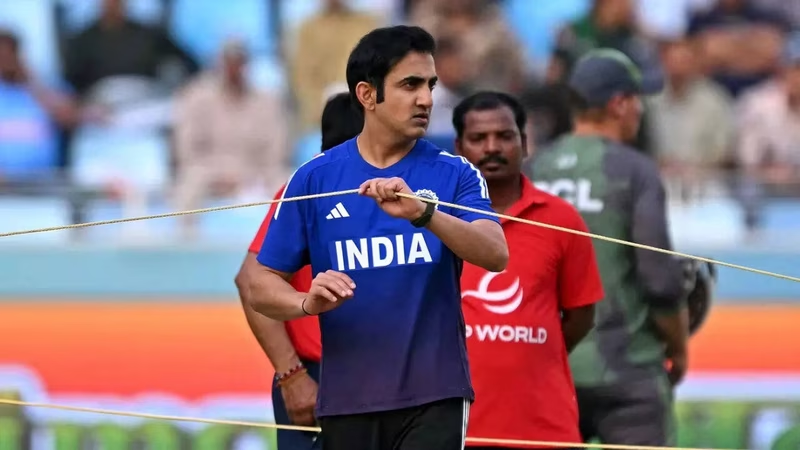
Amid this turmoil, former spinner Harbhajan Singh has weighed in on the controversial **split coaching model**, where Gautam Gambhir oversees white-ball cricket while Test duties fall to another coach. “Nothing wrong with that,” Harbhajan said—but is this structure part of the problem or the solution?
Table of Contents
- The Fall of a Test Giant: India Test Crisis Explained
- How the WTC 2025 Race Is Unfolding
- Gautam Gambhir and the Split Coaching Debate
- Why India’s Test Core Is Collapsing
- Historical Context: India’s Test Dominance (2013–2023)
- Can India Recover in Time for WTC 2025?
- Conclusion: A New Era or a Midlife Crisis?
- Sources
The Fall of a Test Giant: India Test Crisis Explained
The India Test crisis isn’t about one bad series—it’s about a systemic unraveling.
In New Zealand, India was bowled out for 46 in the first innings—a historic low. They lost all three Tests by massive margins, exposing a fragile batting lineup and a bowling attack missing its bite without Jasprit Bumrah for parts of the tour. The team looked disoriented, lacking the tactical cohesion that once defined them.
Back home, against a resurgent South Africa, hopes were high for redemption. Instead, India collapsed in the third Test, handing the Proteas a series win on Indian soil—a rare feat. The batting order, once anchored by Kohli, Pujara, and Rahane, now looks adrift, with inconsistent performances from Shubman Gill, Yashasvi Jaiswal, and even captain Rohit Sharma.
How the WTC 2025 Race Is Unfolding
The ICC World Test Championship cycle runs from June 2023 to December 2025. India entered the New Zealand tour with a solid points percentage, but the **0-3 whitewash cost them dearly**.
As of January 2026, the WTC 2025 standings show:
- Australia – Leading with 68% win rate
- South Africa – Surging after India win, now at 61%
- India – Dropped to 49%, outside the top two
Only the **top two teams** qualify for the final at Lord’s in June 2026. With upcoming series against England and Australia, India’s margin for error is now zero .
Gautam Gambhir and the Split Coaching Debate
Enter Gautam Gambhir. Appointed as **head coach for T20Is and ODIs**, he was never officially assigned Test duties—a deliberate “split coaching” model by the BCCI. The Test side remains under the guidance of a separate support staff, though the lines have blurred.
Harbhajan Singh defended the arrangement: “Nothing wrong with that. Different formats need different mindsets. Gambhir’s aggression suits white-ball cricket.” But critics argue that **fragmented leadership** is eroding team identity.
Unlike the unified vision under Ravi Shastri or Rahul Dravid, the current setup lacks a single strategic voice—especially in high-stakes Test environments where consistency is key.
Why India’s Test Core Is Collapsing
Several factors are converging:
- Leadership Vacuum: Rohit Sharma, while experienced, lacks the on-field aggression Kohli brought. His captaincy has become reactive.
- Batting Fragility: Over-reliance on a few players. When Kohli and Jadeja fail, the middle order collapses.
- Bowling Inconsistency: Bumrah carries the attack, but support from Siraj, Kuldeep, or Axar has been sporadic.
- Mental Fatigue: Players are juggling IPL, white-ball tours, and Tests—leading to burnout and split focus.
As former captain Sunil Gavaskar noted, “You can’t treat Test cricket like another T20 franchise. It demands singular devotion.”
Historical Context: India’s Test Dominance (2013–2023)
From 2013 to 2023, India played 118 Tests at home—**losing only 4**. They won series in Australia (2018, 2020), England (2021), and held the No. 1 ranking for 40+ months.
This dominance was built on:
- A rock-solid top six
- Spin-bowling mastery in subcontinent conditions
- Seam-bowling depth for overseas tours
- Clear captain-coach alignment
Today, none of those pillars stand unshaken.
Can India Recover in Time for WTC 2025?
Possibly—but only with urgent course correction:
- Unify Coaching: Appoint a full-time head coach for all formats, or at least a Test-specific strategist.
- Prioritize Test Cricket: Rest key players from white-ball series before major Test tours.
- Blood New Talent Wisely: Fast-track consistent domestic performers like Yash Dhull or Tilak Varma for longer formats.
The upcoming **five-Test series in England (2026)** will be the ultimate test of India’s resolve.
Conclusion: A New Era or a Midlife Crisis?
The India Test crisis isn’t the end—it’s a reckoning. Every dominant team eventually faces decline. The question is whether India can rebuild with the same discipline that built their empire.
Gautam Gambhir’s split role may work for T20 World Cups, but Test cricket demands unity, patience, and identity. Without it, the WTC 2025 final may remain a distant dream—and the era of invincibility, a memory.
Sources
- The Times of India: ‘Nothing wrong with that’: Harbhajan on Gambhir and split coaching
- ICC Official Website: ICC World Test Championship 2025 Standings
- ESPNCricinfo: India Test Performance Analysis