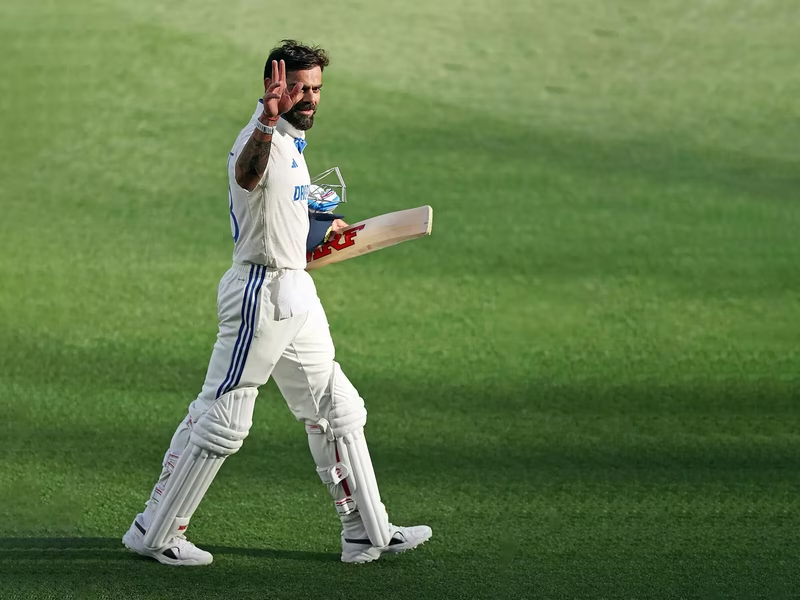
Why Sanjay Manjrekar Is Furious About Kohli’s Test Retirement
When Virat Kohli announced his retirement from Test cricket, many fans braced for an emotional farewell to one of the game’s modern greats. But instead of tributes, a firestorm erupted—led by none other than veteran cricket analyst Sanjay Manjrekar. In a blunt and deeply critical take, Manjrekar declared that Kohli didn’t bow out with grace; he “chose the easiest format” by walking away from red-ball challenges while continuing in ODIs .
This controversial stance has reignited a fierce debate: Was Kohli’s Kohli Test retirement a dignified exit—or a strategic retreat from a format that had recently tested his dominance? And in an era where Joe Root just smashed a defiant century at 35, is quitting at 37 a betrayal of elite potential?
Table of Contents
- Manjrekar’s Full Critique: ‘He Should’ve Fought Harder’
- Kohli’s Test Legacy: Glory, Grit, and the Final Slump
- Joe Root’s Century: A Stark Contrast to Kohli’s Exit?
- Why Continuing in ODIs Feels ‘Perplexing’
- Was Kohli Really Done? The Fitness Factor
- How Fans and Experts Are Reacting
- Conclusion: Legacy or Letdown?
Manjrekar’s Full Critique: ‘He Should’ve Fought Harder’
Speaking on a recent podcast, Sanjay Manjrekar didn’t hold back. “He chose the easiest format,” he said, referring to Kohli’s decision to step away from Tests while still playing limited-overs cricket . Manjrekar argued that Kohli—known for his warrior-like intensity—should have battled through his recent lean patch in red-ball cricket instead of retreating.
“When you’ve built your reputation on fighting spirit, on never giving up, walking away because you’re not scoring big hundreds feels… inconsistent,” Manjrekar added. His biggest point of contention? Kohli’s physical condition. At 37, with elite fitness levels maintained through years of discipline, Manjrekar believes a comeback was not just possible—it was expected from a player of his stature.
Kohli’s Test Legacy: Glory, Grit, and the Final Slump
Let’s be clear: Virat Kohli’s Test record is monumental.
- 8,848 runs at an average of 49.15
- 29 centuries—including match-winning knocks in Australia and England
- Former captain who led India to historic overseas series wins
But his last few years in whites told a different story. After a prolific 2018–2019, Kohli went through a well-documented drought—over 30 innings without a century before his final Test. While he still contributed with crucial 50s and gritty rearguards, the explosive dominance had dimmed.
Some see this as a natural decline. Manjrekar sees it as a challenge a true champion should have embraced.
Joe Root’s Century: A Stark Contrast to Kohli’s Exit?
Manjrekar’s criticism gains even more weight when you look at Joe Root. Just weeks after Kohli’s announcement, the 35-year-old Englishman scored a majestic 153 against a formidable attack—his 34th Test century, tying him with David Gower for England’s all-time lead .
Root’s innings wasn’t just about runs; it was a statement. A statement that age, form slumps, and pressure don’t have to be the end. For Manjrekar, this made Kohli’s timing feel especially off. “If Root can deliver at 35, why couldn’t Kohli push through at 37—especially with his fitness?”
Why Continuing in ODIs Feels ‘Perplexing’
Perhaps the most confounding part of Kohli’s decision, as Manjrekar pointed out, is the choice to continue playing ODIs. “He’s retiring from the ultimate test of skill and temperament—but sticking with the format that’s more forgiving, more flash, and frankly, easier to dominate with experience,” he said .
This sentiment echoes a broader concern in cricket circles. Test cricket is dying in many nations, and every global superstar who abandons it accelerates that decline. By choosing to stay in the high-profile, lucrative ODI circuit—including [INTERNAL_LINK:world-cup-2027-teams]—Kohli may be prioritizing visibility and comfort over the sport’s most demanding format.
Was Kohli Really Done? The Fitness Factor
Manjrekar emphasized one key point: Kohli’s fitness was never in question. Unlike many players who retire due to injury or physical deterioration, Kohli remains one of the fittest athletes in world cricket. His training regimen, diet, and recovery protocols are the stuff of legend.
“If anything, his body was ready for more Tests,” Manjrekar argued. “It was his mind—or his desire—that gave up.” This raises uncomfortable questions about whether modern cricketers, even icons, are losing their appetite for the grueling five-day grind.
How Fans and Experts Are Reacting
Reactions have been split. Many fans defended Kohli, citing his right to choose his path after 15 years of service. “He’s given everything—let him go on his terms,” one Twitter user wrote.
But others sided with Manjrekar. Former players like Aakash Chopra noted that “Test cricket needs its giants to stay longer.” Even neutral observers on platforms like [ESPNcricinfo](https://www.espncricinfo.com) have questioned whether this sets a dangerous precedent for future stars .
Conclusion: Legacy or Letdown?
Virat Kohli’s Kohli Test retirement will be remembered—but how? As the graceful exit of a legend who knew when to step away? Or as a missed opportunity to cement an already immortal legacy by conquering one final challenge?
Sanjay Manjrekar’s harsh words may sting, but they come from a place of deep respect for Test cricket—the format he believes defines true greatness. Whether you agree with him or not, his critique forces us to confront an uncomfortable truth: in an age of T20 billions and ODI spectacles, the soul of cricket may be fading faster than we realize.