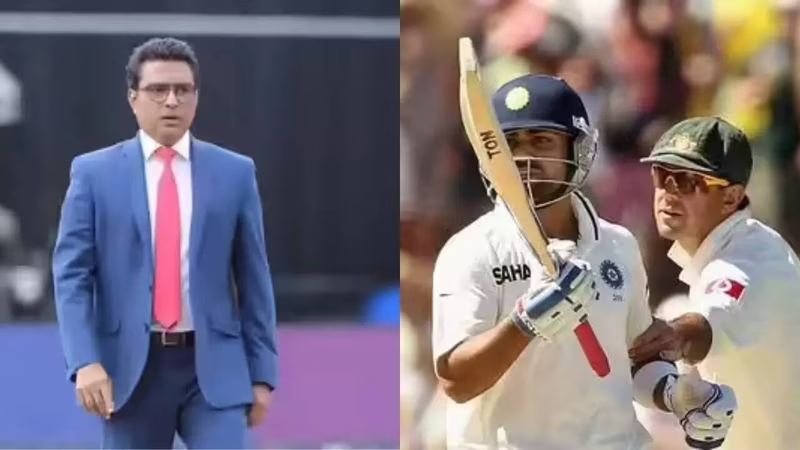
Imagine being 23 years old. You’ve just been thrust into the Indian Test team on one of the toughest tours imaginable—Australia. You’re batting at number six, sandwiched between legends, and the weight of a billion expectations is on your shoulders.
Then, after scoring modestly in two Tests, a respected voice on national television says you “do not belong here.” That’s exactly what happened to **Virat Kohli** in January 2012—and it almost derailed a career that would go on to redefine Indian cricket.
The critic? Former cricketer and commentator **Sanjay Manjrekar**. The moment? A brutal post-mortem of India’s 247-run loss in the second Test in Sydney. The fallout? A fire that would fuel one of the greatest comebacks in sports history.
Table of Contents
- The Context: India’s Rock-Bottom Tour Down Under
- “Manjrekar Questioned Kohli”: The Infamous Remark
- Kohli’s Mindset and His Silent Response
- The Turning Point: Adelaide 2012 and Beyond
- What This Tells Us About Resilience in Sport
The Context: India’s Rock-Bottom Tour Down Under
The 2011-12 Border-Gavaskar Trophy was a nightmare for Indian cricket. Ravaged by spot-fixing scandals, leadership transitions, and an aging core, the team was whitewashed 4-0 . Kohli, making his debut in that series, was one of the few new faces—but his early returns were underwhelming.
In Brisbane, he scored 11 and 15. In Sydney, he made 7 and 23 . Against a ruthless Australian pace attack on bouncy pitches, he looked out of his depth. Critics began circling. And on air, Sanjay Manjrekar voiced what many were thinking.
“Manjrekar questioned Kohli”: The Infamous Remark
Speaking on air after the Sydney Test, Manjrekar didn’t mince words. “Give him one more Test,” he said, “just to be sure that **he does not belong here**.”
The phrase cut deep. It wasn’t just criticism—it was a verdict on his very right to wear the India cap in the longest format. At a time when social media was exploding and every word went viral, this comment became a national talking point.
Importantly, Manjrekar later clarified he was speaking as an analyst, not a detractor—and even admitted years later that he was “glad to be proven wrong” . But in that moment, it felt like a dismissal.
Kohli’s Mindset and His Silent Response
Virat Kohli didn’t fire back on Twitter. He didn’t give a press conference. He did something far more powerful: he let his bat speak.
He later revealed in interviews that moments like this “fuel my hunger.” In his 2018 GQ cover story, he admitted that criticism—especially public doubt from former players—stayed with him and pushed him to train harder, watch more video, and refine his technique against short-pitched bowling .
“I knew I belonged,” he once said. “I just had to prove it.”
The Turning Point: Adelaide 2012 and Beyond
Just months later, in March 2012, Kohli returned to Australia for the CB Series final. He responded with a **match-winning 133* off 154 balls** in Adelaide—a knock laced with cover drives, pulls, and fearless aggression .
But his real redemption came in Test cricket. By the 2012 England tour, he scored his maiden Test century at Trent Bridge. From there, his Test career skyrocketed:
- 7,785+ Test runs at an average of over 49
- 29 Test centuries, including seven against Australia
- Fastest to 10,000 ODI runs—and the highest run-scorer in T20Is
What’s more telling? Kohli went on to dominate in Australia—scoring centuries in Adelaide (2014), Perth (2018), and Melbourne (2018)—the very country where his Test credentials were once doubted .
What This Tells Us About Resilience in Sport
The **Manjrekar questioned Kohli** moment is now a textbook case in sports psychology. It shows that early struggles don’t define a player—how they respond does.
For young cricketers facing pressure today, Kohli’s journey is a masterclass in turning pain into purpose. It also reminds us that even experts can misjudge talent in its raw form. As former Australian captain Ricky Ponting once noted, “Kohli didn’t just adapt—he redefined what was possible for an Indian batter overseas” .
For more on iconic cricket rivalries and turning points, check out our deep dive on [INTERNAL_LINK:greatest-comebacks-in-cricket-history].
Final Thoughts
Sanjay Manjrekar’s comment in 2012 wasn’t just about Virat Kohli’s place in the team—it was a test of his character. And Kohli didn’t just pass that test; he aced it with centuries to spare. Today, when we talk about mental toughness in cricket, this moment stands as a defining chapter. Because sometimes, the harshest doubt is the spark for the greatest legacy.