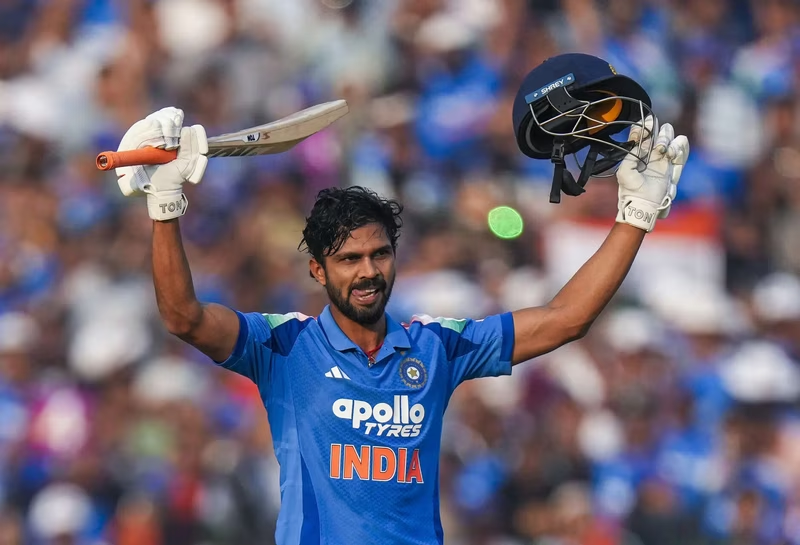
Robin Uthappa Calls Out BCCI’s Bias: Is Ruturaj Gaikwad Being Snubbed?
When Ruturaj Gaikwad was omitted from India’s ODI squad for the New Zealand tour—despite having smashed a century against England just weeks earlier—fans were stunned. But it was former India cricketer Robin Uthappa who turned confusion into controversy with a pointed social media post that’s now gone viral: “If you’re not from Mumbai, Delhi, or Punjab…” .
The comment, though left tantalizingly incomplete, spoke volumes about the long-simmering perception of regional bias in Indian cricket selections. Uthappa’s words have sparked a national debate: is talent from non-traditional cricketing states like Maharashtra (Gaikwad’s home) being systematically overlooked in favor of players from established hubs?
Table of Contents
- The Curious Case of Ruturaj Gaikwad’s Omission
- Robin Uthappa’s Explosive Statement and What It Really Means
- The Persistent Myth—or Reality—of Regional Bias in BCCI Selections
- The Hidden Mental Toll on Players in ‘Survival Mode’
- Historical Context: Who Else Was Overlooked?
- Conclusion: Time for a More Inclusive Selection Process?
The Curious Case of Ruturaj Gaikwad’s Omission
Ruturaj Gaikwad, the current captain of Chennai Super Kings in the IPL and a rising star in Indian cricket, has consistently delivered across formats. His 101* against England in the third ODI in Pune—played just before the New Zealand squad announcement—was supposed to cement his place. Instead, he was left out in favor of players with far less recent form .
This decision baffled experts and fans alike. Gaikwad isn’t just a domestic stalwart—he’s proven himself on the international stage, showing maturity, temperament, and adaptability. His omission raises serious questions about the criteria the national selection committee is using. Is it form? Potential? Or something less transparent?
Robin Uthappa’s Explosive Statement and What It Really Means
In a now-deleted but widely screenshotted Instagram story, Robin Uthappa wrote: “If you’re not from Mumbai, Delhi, or Punjab…”—a line that resonated deeply with fans from states like Tamil Nadu, Karnataka, and Maharashtra, who often feel their players are held to a higher standard .
Uthappa, who hails from Karnataka—a state with a strong cricketing culture but historically less BCCI influence—has long been vocal about mental health and the pressures of Indian cricket. His comment wasn’t just about Gaikwad; it was a critique of a system that, he implies, favors certain geographies over pure merit.
The Persistent Myth—or Reality—of Regional Bias in BCCI Selections
The idea of regional favoritism isn’t new. For decades, critics have pointed to the disproportionate representation of players from Mumbai, Delhi, and Punjab in national squads. Consider this:
- Mumbai has produced legends like Sachin Tendulkar, Sunil Gavaskar, and Rohit Sharma—and continues to dominate headlines.
- Delhi has been home to captains like Virat Kohli and Rishabh Pant.
- Punjab boasts icons like Kapil Dev and more recently, Shubman Gill.
Meanwhile, stellar performers from other regions—like Suresh Raina (Uttar Pradesh), Manish Pandey (Karnataka), or even Gaikwad (Maharashtra, but not from Mumbai)—often face longer waits or repeated snubs despite strong performances .
Is this coincidence? Or does the old-boy network within state associations and the BCCI still hold sway? While the BCCI officially denies any bias, the pattern is hard to ignore.
The Hidden Mental Toll on Players in ‘Survival Mode’
Uthappa didn’t just stop at geography. He also highlighted the intense psychological pressure Indian cricketers face. In his words, players are in “survival mode”—where one bad game can end a career, and consistent excellence is often not enough .
This environment, he argues, demands not just talent but extraordinary resilience—especially for players without the backing of powerful cricketing states. For someone like Gaikwad, who has risen through sheer consistency in domestic cricket and the IPL, being dropped after a century isn’t just unfair—it’s demoralizing.
As mental health becomes a growing focus in elite sports, such inconsistent selection policies only add to the stress. [INTERNAL_LINK:mental-health-in-cricket] could be a critical area for the BCCI to address moving forward.
Historical Context: Who Else Was Overlooked?
Gaikwad isn’t the first. History is littered with examples of brilliant cricketers from non-elite regions who struggled for recognition:
- Manoj Tiwary (Bengal): Scored over 7,000 first-class runs but got only 9 ODIs.
- Abhimanyu Mithun (Karnataka): One of India’s fastest bowlers, yet capped just four times.
- Rishabh Pant’s early struggles: Even Pant, now a Delhi hero, was initially seen as “too raw” compared to established wicketkeepers from more influential zones.
These cases fuel the belief that the system rewards connections as much as runs or wickets.
Conclusion: Time for a More Inclusive Selection Process?
The omission of Ruturaj Gaikwad might seem like a minor squad decision on the surface. But Robin Uthappa’s reaction has peeled back a layer on a much deeper issue: the perceived inequity in Indian cricket’s selection ecosystem.
While the BCCI has made strides in professionalizing the sport—from centralized contracts to data-driven analysis—the shadow of regional influence lingers. For Indian cricket to truly be a meritocracy, every player—whether from Mumbai, Madurai, or Moradabad—must be judged by the same yardstick: performance.
Until then, voices like Uthappa’s will keep asking the uncomfortable questions that need answers.