Introduction: When Diplomacy Meets the Boundary Line
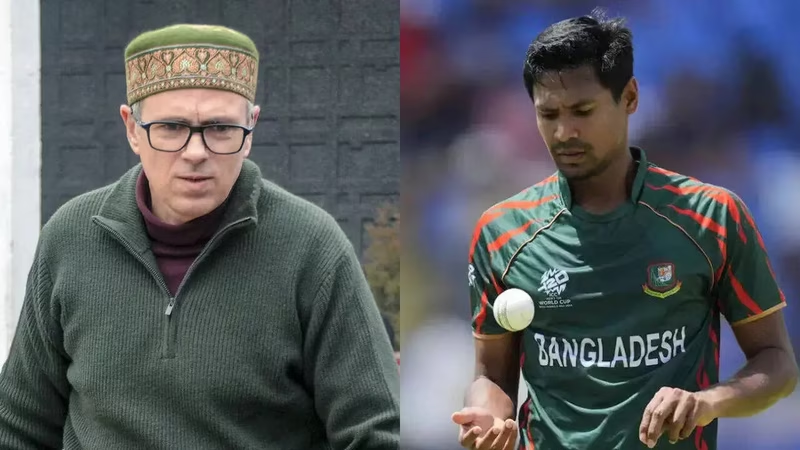
Cricket has long prided itself on being a unifying force—but what happens when geopolitics storms the pitch? The recent Mustafizur Rahman IPL exit has thrown that ideal into chaos, igniting a fierce debate far beyond the boundary ropes. Jammu and Kashmir Chief Minister Omar Abdullah didn’t mince words: “What is the fault of that poor player?” he asked, directly challenging the IPL’s decision to release the Bangladeshi fast bowler.
His comments aren’t just political theater—they cut to the heart of a growing crisis. With India-Bangladesh diplomatic relations under strain, cricket is becoming collateral damage. And now, there are real fears that the upcoming T20 World Cup, co-hosted by the West Indies and the USA but with India as a key participating nation, could face a boycott from Bangladesh. This isn’t just about one player. It’s about the future of the game in an increasingly fractured world.
Table of Contents
- The Controversial Mustafizur Rahman IPL Exit
- Omar Abdullah’s Scathing Response
- How India-Bangladesh Tensions Are Reshaping Cricket
- T20 World Cup 2026: At Risk of a Bangladeshi Boycott?
- Historical Precedents: When Politics Intervened in Cricket
- What This Means for Future IPL Foreign Player Policies
- Conclusion: Keeping Cricket Above Politics
- Sources
The Controversial Mustafizur Rahman IPL Exit
In a move that stunned fans and analysts alike, one of the IPL franchises quietly released Bangladeshi seamer Mustafizur Rahman ahead of the 2026 season. While official statements cited “strategic team composition changes,” insiders and observers widely believe the decision was influenced by the deteriorating political climate between India and Bangladesh.
Mustafizur, a T20 superstar known for his lethal cutters and death-over mastery, has been a consistent performer in the IPL since his debut in 2016. His Mustafizur Rahman IPL exit isn’t just a loss for his team—it’s a symbolic blow to the league’s global ethos. The IPL has always marketed itself as a borderless celebration of cricketing talent. Removing a player based on nationality risks undermining that very identity.
Omar Abdullah’s Scathing Response
Omar Abdullah, known for his sharp political commentary, took to social media to voice his outrage. “What is the fault of that poor player?” he asked pointedly. “He’s a professional athlete doing his job. Punishing him won’t solve diplomatic disputes—it only punishes sport.”
Abdullah emphasized that individual athletes shouldn’t be scapegoats for state-level tensions. His remarks resonated with many who fear the creeping politicization of sports. “If we start excluding players because of their passport, where does it end?” he added, warning of a slippery slope that could fragment international cricket.
How India-Bangladesh Tensions Are Reshaping Cricket
The roots of this controversy lie in a broader diplomatic chill. Recent months have seen disagreements between New Delhi and Dhaka over trade, water sharing, and regional security. While both governments insist sports remain separate, the line is blurring.
Bangladeshi officials have expressed “deep disappointment” over Mustafizur’s exclusion, calling it “unfair and discriminatory.” Meanwhile, Indian cricket administrators remain publicly silent, likely to avoid escalating the issue. But the damage may already be done:
- Franchises may hesitate to pick Bangladeshi players in future auctions.
- Fan sentiment could turn hostile, affecting player morale and performance.
- Team dynamics could suffer if political undercurrents enter the locker room.
T20 World Cup 2026: At Risk of a Bangladeshi Boycott?
The stakes are even higher with the ICC Men’s T20 World Cup 2026 on the horizon. Though primarily hosted by the USA and West Indies, India is expected to play its matches on home soil due to logistical and fan engagement reasons—a practice seen in previous global tournaments.
Abdullah warned that if Bangladesh perceives continued exclusion or hostility, they might refuse to travel to India for their scheduled fixtures. A boycott would be catastrophic for the tournament’s credibility and commercial success. The ICC is already walking a diplomatic tightrope, and the Mustafizur Rahman IPL exit has only tightened the rope.
For context, the ICC has clear guidelines on political neutrality, but enforcement is inconsistent. In 2023, similar tensions between other nations were managed through quiet diplomacy—but Bangladesh’s cricket board has shown less willingness to compromise.
Historical Precedents: When Politics Intervened in Cricket
This isn’t the first time politics has hijacked cricket:
- 1971 India vs. South Africa: India severed cricket ties during apartheid, only resuming in 1991.
- 2008 Mumbai Attacks: India-Pakistan series were suspended for years due to security concerns.
- 2022 Russia-Ukraine War: ICC suspended Russia from international competitions.
Each case shows how quickly sport can become a proxy for national sentiment. But as Abdullah argues, punishing individual athletes rarely resolves the underlying conflict—it only deepens resentment.
What This Means for Future IPL Foreign Player Policies
Going forward, the IPL may need to formalize its stance on geopolitical neutrality. Recommendations for the league include:
- Adopt a transparent player selection policy that explicitly prohibits nationality-based exclusions without performance-related justification.
- Establish a player welfare committee to shield athletes from political fallout.
- Engage with foreign cricket boards proactively to de-escalate tensions before they affect team selections.
Franchises must remember: fans tune in for skill, not passports. Excluding Mustafizur doesn’t send a diplomatic message—it just leaves a hole in the bowling attack. For more on how global tensions affect T20 leagues, see our analysis on [INTERNAL_LINK:impact-of-geopolitics-on-t20-leagues].
Conclusion: Keeping Cricket Above Politics
Omar Abdullah’s question—“What is the fault of the player?”—is one every cricket lover should ask. Mustafizur Rahman didn’t create diplomatic rifts; he bowled yorkers. Punishing him for his nationality sets a dangerous precedent that could Balkanize the sport we love. As the T20 World Cup approaches, the cricketing world must choose: will it be a stage for unity, or a mirror of our divisions? The answer will define the game for generations.
Sources
- Times of India: “What is the fault of that poor player?” Omar Abdullah questions Mustafizur Rahman’s IPL exit
- ESPNcricinfo – Coverage of IPL team changes and international cricket policy
- International Cricket Council (ICC) – Official regulations on international participation
- Board of Control for Cricket in India (BCCI) – Statements on foreign player participation