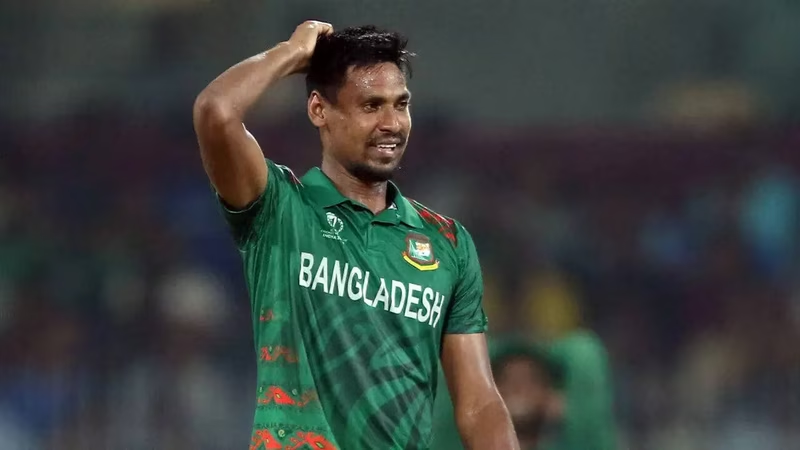
In a move that has intensified scrutiny on cricket’s intersection with geopolitics, the Board of Control for Cricket in India (BCCI) has finally broken its silence on Bangladesh’s T20 World Cup venue request. During a key meeting in Mumbai, BCCI officials confirmed they have no authority to relocate matches for the upcoming ICC Men’s T20 World Cup 2026—emphasizing that the International Cricket Council (ICC) holds exclusive jurisdiction over all scheduling and venue decisions .
This clarification comes amid rising diplomatic friction following reports that star Bangladeshi pacer Mustafizur Rahman faced unexpected delays in securing his Indian visa—a development that reportedly prompted the Bangladesh Cricket Board (BCB) to seek alternative venues for its group-stage fixtures. While the BCCI maintained a neutral, procedural stance, the underlying tension has cast a shadow over what should be a celebration of global cricket.
Table of Contents
- The Mustafizur Visa Controversy Sparks Diplomatic Unease
- BCCI Officially Addresses “Bangladesh T20 World Cup Venue Request”
- Why the ICC Controls All T20 World Cup Logistics
- What This Means for the India vs. Bangladesh T20WC Clash
- BCCI Turns Focus to Domestic Development
- Fan Reactions and the Future of South Asian Cricket
- Conclusion
- Sources
The Mustafizur Visa Controversy Sparks Diplomatic Unease
Mustafizur Rahman, a veteran of the Indian Premier League and a key asset for Bangladesh’s T20 campaign, was reportedly held up in the visa process just weeks before the tournament’s June 2026 kickoff. Given his clean immigration history and prior participation in Indian domestic leagues, the delay raised eyebrows across the cricketing world .
Though neither the Indian Ministry of External Affairs nor the BCB issued an official statement, credible media reports suggest the BCB grew concerned about player safety and logistical reliability. These concerns allegedly led them to approach both the ICC and BCCI with a request to move their matches—particularly those outside major metropolitan centers—to more “neutral” or secure locations .
BCCI Officially Addresses “Bangladesh T20 World Cup Venue Request”
During its Mumbai conclave, the BCCI delivered a clear and concise message: “The matter of match venues for an ICC event is not within the BCCI’s domain. The ICC is the sole authority responsible for such decisions.” This statement effectively distances India from any perceived political interference while reaffirming its role as a compliant co-host .
The board’s position aligns with standard international sports protocol. As a host nation, India is obligated to provide infrastructure, security, and logistical support—but not to unilaterally alter the tournament framework designed by the global governing body.
Why the ICC Controls All T20 World Cup Logistics
To understand why the BCCI can’t simply approve a venue change, it’s essential to recognize the ICC’s centralized control over its flagship events:
- Scheduling Authority: The ICC finalizes all fixtures, venues, and broadcast windows years in advance.
- Security Oversight: Independent risk assessments are conducted by ICC-appointed firms in coordination with host governments.
- Commercial Integrity: Venue changes impact broadcasting rights, sponsor activations, and ticketing revenue—all managed by the ICC.
For transparency, the ICC’s governance documents explicitly state that “all operational decisions for ICC Events rest with the Chief Executive and Event Management Committee” .
What This Means for the India vs. Bangladesh T20WC Clash
Crucially, the high-profile India vs. Bangladesh match—expected to draw massive crowds and global viewership—is highly unlikely to be relocated. Such fixtures are anchor events in the tournament calendar, secured in top-tier stadiums like Eden Gardens or Wankhede with robust security protocols.
However, Bangladesh’s other group games against lower-ranked teams could theoretically be reviewed if the ICC receives formal security advisories. As of now, no such review has been announced.
BCCI Turns Focus to Domestic Development
Notably, the same Mumbai meeting also prioritized long-term cricket growth. Officials discussed accelerating recruitment for vacant technical roles at the National Cricket Academy (now the Centre of Excellence) and planning future tours for India A and U-19 squads .
This dual focus—managing international sensitivities while investing in grassroots talent—reflects the BCCI’s effort to project institutional stability. For more on India’s pipeline, see our coverage on [INTERNAL_LINK:India U-19 Cricket Team].
Fan Reactions and the Future of South Asian Cricket
On social media, Indian fans have largely dismissed the venue request as “overreaction,” while Bangladeshi supporters express anxiety over inconsistent treatment compared to other visiting teams. Political analysts warn that cricket is increasingly becoming a barometer of bilateral relations—a trend that could complicate future tournaments unless boards establish clearer, depoliticized protocols.
Conclusion
The Bangladesh T20 World Cup venue request highlights the delicate balance between sport and statecraft. While the BCCI has rightly deferred to the ICC’s authority, the incident underscores the need for transparent communication channels between cricket boards, governments, and players. As the world gears up for a historic home World Cup, the hope is that the spirit of competition—not suspicion—will define the narrative on the field.
Sources
- The Times of India. “Mustafizur Rahman controversy: BCCI breaks silence on Bangladesh’s request to shift T20 World Cup matches.” January 10, 2026.
- Hindustan Times. “Visa delay for Mustafizur Rahman triggers BCB concerns ahead of T20 World Cup.”
- ESPNcricinfo. “BCB seeks reassurance on security, venue logistics for T20 World Cup in India.”
- International Cricket Council (ICC). “ICC Governance and Event Management Framework.”