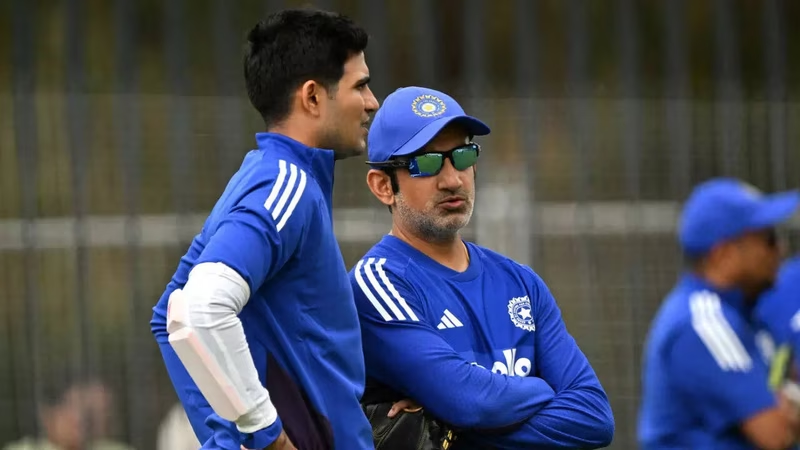
Team India may have escaped with a win in the opening ODI against New Zealand, but victory came with a heavy price tag. Behind the scenes, a growing **injury crisis**—headlined by Washington Sundar’s unavailability—is forcing the team management into emergency mode ahead of the pivotal second ODI in Rajkot on January 17, 2026 .
What looked like a routine home series has suddenly become a high-stakes puzzle. With gaps emerging in both the **new-ball attack** and the **middle-overs spin department**, India’s famed depth is being put to the test. And with New Zealand showing resilience despite losing the first game, the pressure is mounting on the hosts to adapt—fast.
Table of Contents
- The Washington Sundar Blow
- India vs New Zealand ODI: Key Tactical Challenges
- Who Could Replace Sundar in Rajkot?
- New-Ball Woes and Seam Bowling Options
- Can the Batting Lineup Carry the Load?
- Rajkot Pitch and Matchup Dynamics
- Series Context and Stakes
- Conclusion: Adapt or Falter
- Sources
The Washington Sundar Blow
Washington Sundar wasn’t just a spinner—he was India’s **control valve** in the middle overs. His ability to bowl tight lines, contain runs, and break partnerships made him indispensable in ODIs, especially on flat Indian pitches. But after sustaining an injury during the first ODI in Hyderabad, he has been ruled out of the remainder of the series .
This leaves a glaring hole. In the previous match, India’s spinners conceded over 6.5 runs per over between overs 11–40—a worrying trend against a Kiwi batting unit that thrives on accumulation. Without Sundar’s economy (often under 4.5 RPO), the burden shifts to part-timers or untested replacements.
India vs New Zealand ODI: Key Tactical Challenges
The India vs New Zealand ODI series has exposed two critical weaknesses:
- New-Ball Ineffectiveness: Despite having Jasprit Bumrah, India struggled to take early wickets. Mohammed Siraj and Mukesh Kumar offered little swing, allowing New Zealand openers to settle.
- Middle-Overs Drift: Once the fielding restrictions lifted, India lacked a bowler who could consistently build pressure. Kuldeep Yadav showed flashes but was expensive at times.
Now, with Sundar gone, the balance of the XI is thrown into disarray. Do they go in with three seamers and two spinners? Or risk playing an extra batter and relying on Hardik Pandya’s medium pace?
Who Could Replace Sundar in Rajkot?
The selectors have limited time but a few names are in contention:
- Axar Patel: The most likely replacement. A proven ODI performer with better control than Kuldeep in containment phases. He can also contribute valuable runs down the order.
- Ravi Bishnoi: High-risk, high-reward. Offers wicket-taking leg-spin but can be expensive on true tracks like Rajkot.
- Shahbaz Ahmed: A dark horse. Left-arm spin adds variety, and his recent domestic form has been strong—but lacks international ODI experience.
Given the need for stability, **Axar Patel** appears the safest bet to slot in seamlessly.
New-Ball Woes and Seam Bowling Options
Beyond spin, India must address its lack of penetration with the new ball. Bumrah remains world-class, but the support cast faltered. In Rajkot, where the pitch offers minimal seam movement, India might consider:
- Promoting **T Natarajan** for his deceptive yorkers and slower balls, even if he doesn’t swing the ball.
- Giving **Harshit Rana**—a rising star from domestic cricket—a debut if they opt for raw pace over experience.
However, tinkering too much mid-series carries its own risks. Consistency often trumps experimentation in bilateral ODIs.
Can the Batting Lineup Carry the Load?
On the bright side, India’s batting looks formidable. Shubman Gill and Rohit Sharma provided a solid start in Hyderabad, while Shreyas Iyer and KL Rahul are back in form. Suryakumar Yadav’s return adds firepower in the death overs.
If the bowlers leak 300+, India’s top order has the firepower to chase it down—especially on batting-friendly pitches like the Saurashtra Cricket Association Stadium in Rajkot. But relying solely on batters isn’t a sustainable strategy, particularly against a New Zealand side capable of posting 320+.
Rajkot Pitch and Matchup Dynamics
The Rajkot pitch is traditionally **flat, dry, and slow**—ideal for stroke-makers but challenging for fast bowlers seeking bounce or seam. Spinners usually come into play only in the second innings as the surface dries out.
This plays into New Zealand’s strengths: their batters like Kane Williamson and Daryl Mitchell excel in rotating strike on such surfaces. For India, this means **early wickets are non-negotiable**. If the Kiwis get past the 10-over mark unscathed, the game could tilt quickly.
Series Context and Stakes
While it’s “just” a three-match series, the stakes are higher than they appear. With the **2027 ODI World Cup** on the horizon, every game is a dress rehearsal. India’s goal isn’t just to win—but to **stress-test combinations** under pressure.
A loss in Rajkot would not only level the series but expose systemic flaws that could haunt them in bigger tournaments. Conversely, a clinical win would reaffirm their dominance at home and validate their bench strength.
Conclusion: Adapt or Falter
The India vs New Zealand ODI series has evolved from a routine contest into a crucible for India’s tactical flexibility. Washington Sundar’s injury is a setback, but also an opportunity—to test alternatives, refine roles, and build resilience. In Rajkot, expect bold calls, calculated gambles, and a team determined to turn adversity into advantage. Because in modern cricket, the ability to adapt isn’t optional—it’s everything.
Sources
- Times of India: Injuries force India to rethink plans ahead of Rajkot ODI vs New Zealand
- ESPNcricinfo: India vs New Zealand 2026 Series Hub
- BCCI: Official Team India Updates