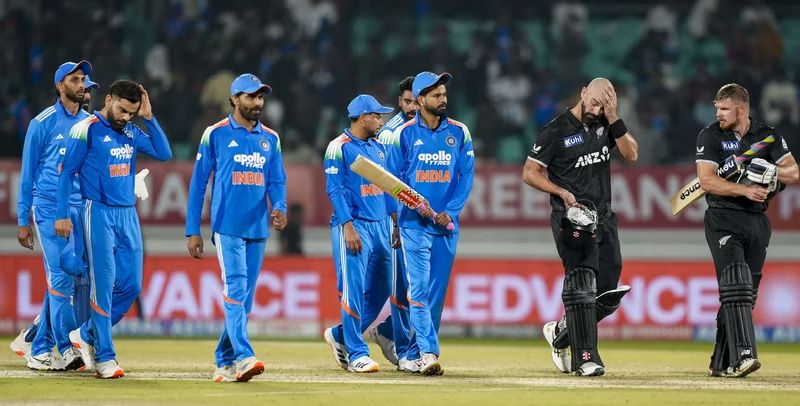
Cricket can be cruel. One man’s masterpiece becomes another’s footnote in a single afternoon. That was the story of the second ODI between India and New Zealand in Rajkot, where KL Rahul’s century—a composed, technically sound 112—was rendered almost irrelevant by a masterclass from across the ditch.
Daryl Mitchell’s unbeaten 131 didn’t just chase down India’s 284—it dismantled it with surgical precision. Backed by a rock-solid 162-run stand with Will Young and a spin attack that outclassed India’s on a sluggish pitch, New Zealand romped home by seven wickets, tying the three-match series at 1-1 heading into the decider.
Table of Contents
- KL Rahul’s Century: A Solo Effort in a Collective Failure
- Daryl Mitchell: The Architect of New Zealand’s Chase
- Spin Battle: Why NZ’s Attack Outshone India’s
- Key Moments That Decided the Match
- What This Means for the Series Decider
- Conclusion: Brilliance on Both Sides—but Only One Winner
- Sources
KL Rahul’s Century: A Solo Effort in a Collective Failure
Batting at No. 3, KL Rahul walked in early after Shubman Gill’s departure and anchored India’s innings with maturity. His 112 came off 121 balls, laced with 9 fours and 2 sixes, and showcased his trademark cover drives and deft touches behind square.
But Rahul’s knock was largely a one-man show. Outside of Shreyas Iyer’s 40 and a late cameo from Washington Sundar (35), the rest of the Indian batting lineup faltered against New Zealand’s disciplined seamers and clever spinners. From 187/3, India collapsed to 284 all out—a total that always felt slightly under par on a flat Rajkot track .
More concerning was the lack of aggression in the middle overs. India managed just 42 runs between overs 31–40, allowing the Kiwis to claw back control. In modern ODI cricket, even a KL Rahul century isn’t enough without support.
Daryl Mitchell: The Architect of New Zealand’s Chase
If Rahul was the poet, Mitchell was the pragmatist—and the more effective one on the day. Opening the batting (a tactical shift by New Zealand), Mitchell batted with calm authority, rotating strike effortlessly and punishing loose deliveries.
His 131* came off just 123 balls, featuring 11 boundaries and 4 maximums. But what stood out was his partnership with Will Young (71). Their 162-run stand for the second wicket drained the tension from the chase and left India’s bowlers searching for answers.
Mitchell’s ability to work the ball into gaps—especially against spin—was key. He rarely looked flustered, even when Kuldeep Yadav struck early. By the time Glenn Phillips joined him, the game was all but over.
Spin Battle: Why NZ’s Attack Outshone India’s
The Rajkot pitch offered subtle turn and variable bounce—ideal for spinners. And while India’s wrist-spin duo of Kuldeep Yadav and Yuzvendra Chahal struggled to contain, New Zealand’s spinners thrived.
Michael Bracewell (2/48) and Mitchell Santner (1/45) were economical and incisive. They bowled tight lines, used the crease intelligently, and broke crucial partnerships. In contrast, India’s spinners went at over 6 runs per over and failed to build sustained pressure.
This disparity highlights a growing trend: New Zealand’s white-ball spinners are no longer just fillers—they’re match-winners. India, meanwhile, must rethink how they deploy their spin resources in subcontinental conditions.
Key Bowling Comparisons
| Bowler | Overs | Runs | Wickets | Economy |
|---|---|---|---|---|
| M. Bracewell (NZ) | 10 | 48 | 2 | 4.80 |
| M. Santner (NZ) | 10 | 45 | 1 | 4.50 |
| K. Yadav (IND) | 10 | 62 | 1 | 6.20 |
| Y. Chahal (IND) | 10 | 65 | 0 | 6.50 |
Key Moments That Decided the Match
- Rahul’s dismissal in the 35th over: Caught at long-on off Santner, ending India’s best chance to push past 300.
- Young-Mitchell partnership: They scored at nearly 6.5 RPO during their stand, never letting the required rate climb.
- Ishan Kishan’s missed stumping: A crucial chance off Bracewell early in Mitchell’s innings went down, proving costly.
What This Means for the Series Decider
With the series tied 1-1, all eyes now turn to the third ODI in Pune. India must address their middle-order fragility and find better balance between spin and pace. New Zealand, riding high on confidence, will look to exploit India’s current vulnerabilities—especially against quality spin.
For KL Rahul, this innings reaffirms his class—but also underscores the need for consistency from others. As one analyst noted, “In ODIs, centuries are only valuable if they lead to wins.”
New Zealand, meanwhile, have shown they can win in India without relying on their pace battery. That’s a dangerous sign for the hosts.
Conclusion: Brilliance on Both Sides—but Only One Winner
The second ODI had everything: a fighting KL Rahul century, a dominant Daryl Mitchell counter, and a tactical battle between spin units. Yet in the end, cricket’s scoreboard doesn’t reward individual heroics—it rewards results.
New Zealand executed their plan flawlessly. India, despite flashes of brilliance, did not. As the teams head to Pune for the decider, one truth remains: in modern ODI cricket, teamwork beats solo acts every time.