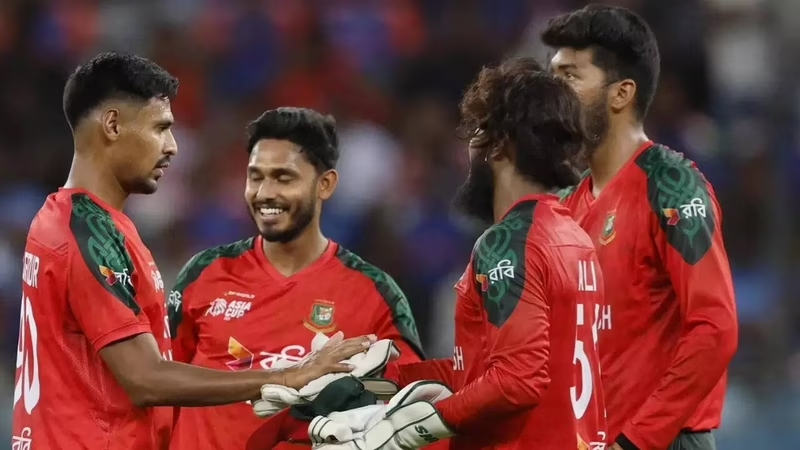
In a move that has reignited tensions between players and administrators, the Bangladesh Cricket Board (BCB) has declared that it would face no financial loss if the national team were to pull out of the upcoming ICC Men’s T20 World Cup 2026. Instead, the board insists, the real financial hit would fall squarely on the players themselves.
The statement, made by BCB’s finance chief during a recent press briefing, comes amid a public standoff involving star left-arm pacer Mustafizur Rahman, who has reportedly expressed frustration over workload management and lack of communication from the board . While no official withdrawal has been announced, the mere suggestion has sent shockwaves through the cricketing world—and raised serious questions about player welfare, governance, and the true economics of international cricket.
Table of Contents
- Why Is Bangladesh Considering T20 World Cup Withdrawal?
- BCB Financial Claims: What They Say and What It Means
- How Players Actually Lose Money in a Withdrawal
- The Mustafizur Rahman Factor
- ICC Rules and Consequences of Pulling Out
- Historical Precedents: Has Any Team Ever Withdrawn?
- Conclusion: A Dangerous Precedent for Player-Board Relations?
- Sources
Why Is Bangladesh Considering T20 World Cup Withdrawal?
While the BCB has not formally proposed withdrawing, speculation intensified after several senior players—including Mustafizur Rahman—voiced concerns about an overloaded international calendar and inadequate rest periods. With back-to-back tours, domestic commitments, and franchise league obligations, burnout is a real risk.
Some insiders suggest that the “withdrawal threat” is less about actual intent and more about leveraging better conditions from the board. But by publicly stating that players would bear the financial brunt, the BCB appears to be calling their bluff—a risky political maneuver that could backfire.
BCB Financial Claims: What They Say and What It Means
According to BCB’s finance head, the board’s revenue is “secured until 2027” through ICC distributions, bilateral broadcast deals, and sponsorship agreements. Therefore, skipping one tournament—even a global event like the T20 World Cup—would not impact its bottom line.
“The board gets its share from the ICC regardless,” he stated. “But players only earn match fees, bonuses, and their portion of ICC prize money if they actually participate.”
This claim hinges on a key detail: ICC Full Members receive annual funding based on a multi-year cycle, not per-tournament participation. So yes, BCB would still get its $10–15 million annual ICC grant even if Bangladesh skips the World Cup .
How Players Actually Lose Money in a Withdrawal
For players, the losses would be significant:
- Match fees: Each T20I pays ~$5,000–$7,000; World Cup games often carry double or triple that.
- ICC prize pool share: Teams reaching the Super 8s can earn $500,000+; players typically receive 30–50% of this.
- Performance bonuses: BCB offers additional rewards for wins and milestones.
- Brand value: Global exposure boosts endorsement opportunities—especially for stars like Mustafizur.
In total, a player could lose $50,000–$100,000+ by missing the tournament—no small sum in Bangladesh’s economic context.
The Mustafizur Rahman Factor
Mustafizur, Bangladesh’s most bankable cricketing asset, has been at the center of this storm. Having played non-stop since the 2025 IPL, he’s reportedly exhausted and seeking clarity on rest protocols. His comments—interpreted by some as advocating for withdrawal—have been amplified by media, though he hasn’t explicitly called for it.
Still, his influence is undeniable. If Mustafizur sits out, the team’s chances plummet—and so does fan interest. The BCB’s financial dismissal may be technically accurate, but it ignores the emotional and sporting cost of sidelining your best player.
ICC Rules and Consequences of Pulling Out
Technically, a team can withdraw—but it comes with penalties:
- Fines: ICC can impose up to $500,000 for last-minute withdrawal without valid reason.
- Ranking points deduction: Automatic drop in T20I rankings.
- Future hosting rights: May be revoked or delayed.
- Reputational damage: Seen as unreliable by global cricketing community.
More critically, consistent non-participation could jeopardize Bangladesh’s Full Member status—a worst-case scenario the BCB surely wants to avoid.
Historical Precedents: Has Any Team Ever Withdrawn?
Since the inaugural T20 World Cup in 2007, no Full Member has ever pulled out voluntarily. Zimbabwe missed the 2024 edition due to ICC suspension, and Namibia withdrew in 2021 citing COVID—but these were exceptional cases.
The closest parallel is Sri Lanka’s near-withdrawal in 2022 amid economic crisis—but they ultimately participated. This underscores how rare—and damaging—such a move would be.
Conclusion: A Dangerous Precedent for Player-Board Relations?
The BCB’s stance on Bangladesh T20 World Cup withdrawal may be fiscally sound, but it’s politically tone-deaf. By framing the issue as “players vs. board finances,” it deepens the rift between athletes and administrators at a time when unity is crucial.
Cricket isn’t just about balance sheets—it’s about trust, respect, and shared purpose. If the BCB truly believes its revenue is secure, perhaps it should use that stability to protect its players, not penalize them. Otherwise, the real loss won’t be financial—it’ll be the erosion of faith in the system itself.