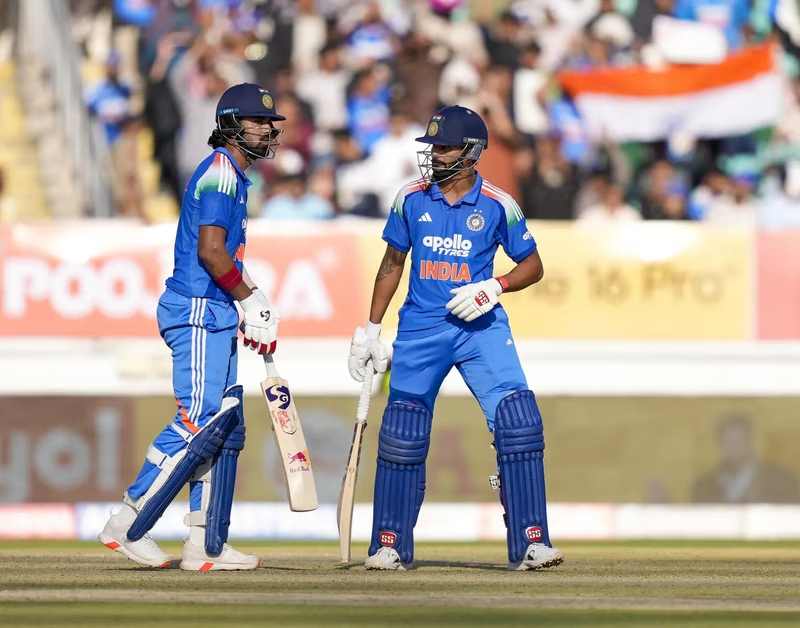
Cricket is a game of fine margins—and even finer judgments. But when those judgments come from the coaching box in stark, unvarnished terms, they can land like a thunderclap. That’s exactly what happened after India’s second ODI against New Zealand, when assistant coach Ryan ten Doeschate made headlines for his unusually direct remarks about young all-rounder Nitish Kumar Reddy.
“He’s not doing a lot,” ten Doeschate said bluntly when asked about Reddy’s contributions—a phrase that quickly ricocheted across social media and sports desks alike. In a culture where coaches typically shield players from public scrutiny, this comment felt like a departure from protocol. So, what’s really going on? And what does it reveal about India’s current team dynamics, selection strategy, and the immense pressure on emerging talents?
Table of Contents
- Who Is Nitish Kumar Reddy? The Rising Star’s Journey
- The Context of the Criticism: What Happened in the Match?
- Nitish Kumar Reddy Under the Microscope
- Broader Team Concerns: From Rohit to Jadeja
- Did India Misjudge the Pitch? The Spinner Question
- What This Means for India’s Future Selection
- Conclusion: Pressure and Potential
- Sources
Who Is Nitish Kumar Reddy? The Rising Star’s Journey
Hailing from Andhra Pradesh, Nitish Kumar Reddy burst onto the national radar with explosive performances in domestic cricket and the IPL. A genuine all-rounder, he bowls brisk medium pace and can clear the boundary with ease—traits that earned him an India cap in white-ball cricket. His selection was seen as part of India’s long-term plan to build depth in the all-rounder department, a role historically difficult to fill consistently .
Yet, transitioning from domestic dominance to international impact is a steep climb. Reddy’s early outings have been marked by promise but also inconsistency—a common challenge for newcomers facing world-class opposition.
The Context of the Criticism: What Happened in the Match?
During the second ODI against New Zealand, Reddy was handed another opportunity to prove his worth. However, his bowling figures were modest, and with the bat, he failed to make a significant contribution. More critically, from the coaching staff’s perspective, he didn’t stand out in the field or bring the kind of game-changing energy expected from a modern all-rounder .
It’s in this context that ten Doeschate’s comment—“not doing a lot”—must be understood. It wasn’t just about runs or wickets; it was about overall impact, intensity, and value in high-stakes cricket.
Nitish Kumar Reddy Under the Microscope
The phrase “not doing a lot” is vague but damning in elite sport. It suggests a lack of presence, urgency, or multi-dimensional contribution. For a player like Reddy, whose value proposition hinges on being more than just a part-timer, this is a serious concern.
Compare this to other emerging all-rounders globally—like Cameron Green or Marco Jansen—who consistently influence games with either bat, ball, or sheer athleticism. The bar is high, and ten Doeschate’s remark implies Reddy hasn’t yet cleared it.
This raises questions:
- Is Reddy getting enough specific guidance to adapt his game?
- Are expectations being managed realistically for a debutant?
- Or is the coaching staff signaling that patience is running thin?
Broader Team Concerns: From Rohit to Jadeja
Ten Doeschate didn’t stop at Reddy. He also noted that captain Rohit Sharma “hasn’t had a lot of match practice recently,” a subtle nod to the skipper’s quiet returns with the bat. Meanwhile, he offered reassurance on Ravindra Jadeja, stating his bowling is “improving” despite a recent drought of wickets—a crucial vote of confidence for a senior player .
Perhaps most encouraging was the praise for KL Rahul, whose strong form provides the batting order with much-needed flexibility. This contrast—between established stars finding rhythm and newcomers struggling—highlights the delicate balance India must strike between nurturing talent and winning now.
Did India Misjudge the Pitch? The Spinner Question
Beyond individual performances, ten Doeschate hinted at a collective oversight: “We probably got the conditions wrong.” The pitch offered more assistance to spinners than anticipated, yet India opted for only one frontline spinner (Kuldeep Yadav), relying heavily on seam-bowling all-rounders .
This tactical miscalculation may have amplified Reddy’s struggles. If the team needed a second spinner instead of a fourth seamer, then his selection itself could be questioned—not just his execution. This shifts the narrative from pure player failure to a broader strategic review.
What This Means for India’s Future Selection
Public criticism from a coach is rare in Indian cricket. When it happens, it often signals a turning point. For Nitish Kumar Reddy, this could mean one of two things:
- A wake-up call: He uses this feedback to train harder, refine his skills, and return with greater impact.
- A warning shot: His place in the squad is on thin ice, and the selectors may look elsewhere if he doesn’t deliver soon.
Either way, the message is clear: potential alone isn’t enough. In today’s hyper-competitive cricket landscape, every player must earn their spot every single day.
Conclusion: Pressure and Potential
The spotlight on Nitish Kumar Reddy is intense—but not unwarranted. Cricket rewards resilience as much as talent. Ten Doeschate’s honesty, while harsh, reflects a coaching philosophy focused on accountability and excellence. For fans, this moment is a reminder that building a world-beating team isn’t just about selecting stars; it’s about demanding consistent, high-impact performances from every member of the squad. Reddy now has a choice: fade into the background or rise to the challenge.
Sources
- Times of India: ‘Not doing a lot’: India coach throws Nitish Kumar Reddy under the bus
- ESPNcricinfo Player Profile: Nitish Kumar Reddy
- ICC Playing Conditions & Team Strategy Guidelines: ICC Official Site [for general context on team composition]