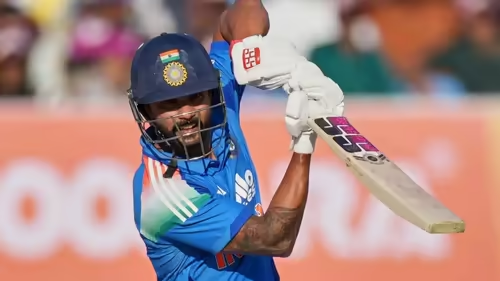
In the high-stakes world of international cricket, finding a reliable all-rounder is like discovering gold. For Team India, Hardik Pandya has been that invaluable asset—a genuine match-winner with both bat and ball. But with his workload management a constant concern and the 2027 ODI World Cup on the horizon, the search for a dependable backup has become a national priority. Enter Nitish Reddy.
On paper, the young seam-bowling all-rounder from Hyderabad fits the bill perfectly. He’s got the pace, the power-hitting ability, and the raw talent that selectors dream of. The BCCI has clearly identified him as a key project, fast-tracking him through age-group teams and into the senior setup. Yet, a growing sense of unease surrounds his development. Despite being handed opportunities, his returns have been meager, and even his own captain, Shubman Gill, seems hesitant to fully integrate him into the team’s core strategy . This raises a critical question: is banking on Nitish Reddy as India’s Plan B for the 2027 World Cup a masterstroke or a massive gamble?
Table of Contents
- The Great Expectation: The Making of a Successor
- Nitish Reddy Performance Under the Microscope
- The Captain’s Dilemma: Gill’s Reluctance to Trust
- Why Selectors Remain Committed Despite the Doubts
- The Path Forward: Can Reddy Silence His Critics?
- Sources
The Great Expectation: The Making of a Successor
The blueprint for Nitish Reddy’s career has been clear from the start. After impressive showings in domestic cricket and for India A, he was seen as the natural heir to the Hardik Pandya throne—a tall, athletic seamer who can clear the ropes in the death overs. His selection in various white-ball squads over the past year was less about immediate impact and more about long-term investment .
The logic is sound. Hardik’s body has been pushed to its limits, and having a like-for-like replacement ready for the home World Cup in 2027 is a strategic necessity. Players like Washington Sundar or Axar Patel offer spin-bowling all-round options, but a genuine pace-bowling all-rounder who can bat in the top seven is a rare commodity. Reddy, at just 21 years old, represents that future potential.
Nitish Reddy Performance Under the Microscope
However, potential doesn’t win matches; performance does. And here’s where the cracks begin to show. In the limited chances he’s had at the international level, Nitish Reddy has struggled to make a telling contribution. His bowling, while quick, has often lacked control in the middle overs, and his batting has been tentative, failing to replicate the explosive power he shows in domestic leagues like the Syed Mushtaq Ali Trophy .
His economy rate in T20Is has hovered around the 9-10 runs per over mark, a figure that is unsustainable in the modern game. With the bat, he’s managed only fleeting cameos, unable to anchor an innings or provide the late flourish that defines a top-tier all-rounder. These “lean returns,” as they’ve been described, are the primary source of the growing skepticism around his readiness for the big stage.
The Captain’s Dilemma: Gill’s Reluctance to Trust
Perhaps the most telling sign of Reddy’s uncertain status is the apparent reluctance of his captain, Shubman Gill, to give him a significant role. In recent series, Gill has often opted to use Reddy as a part-time bowler, saving his overs for the very end or not using his full quota at all. In the batting order, he’s been shuffled around, never given a stable position to build his confidence .
This lack of a defined role from the leadership sends a mixed message. It suggests that while the selectors see long-term promise, the on-field management isn’t yet convinced of his match-winning abilities in high-pressure situations. For a young player trying to establish himself, this ambiguity can be incredibly damaging to his growth and self-belief.
Why Selectors Remain Committed Despite the Doubts
Despite the mounting criticism, the national selection committee, led by Ajit Agarkar, appears steadfast in their belief in Reddy. Their commitment stems from a few key factors:
- Lack of Alternatives: There simply aren’t many other Indian cricketers who fit the specific profile of a fast-bowling, hard-hitting all-rounder. The pool is shallow.
- Long-Term Vision: They are playing the long game, understanding that nurturing such talent takes time and patience, even through periods of poor form.
- Physical Attributes: Reddy’s raw pace and physicality are assets that can’t be taught. They believe these tools, once refined, will make him a formidable force.
Their strategy is to keep him involved in the system, giving him exposure to top-level cricket so he can learn from the likes of Jasprit Bumrah and Virat Kohli, hoping this environment will accelerate his development.
The Path Forward: Can Reddy Silence His Critics?
The next 12-18 months are absolutely critical for Nitish Reddy’s career trajectory. To silence his doubters and justify the selectors’ faith, he needs to deliver consistent performances in the upcoming domestic season and in any India A tours. He must work on his line and length to become a more economical bowler and develop a more robust technique with the bat to handle different match situations.
The 2027 World Cup is still a few years away, but the clock is ticking. If he fails to show significant improvement soon, the selectors may be forced to look elsewhere, potentially derailing a carefully laid succession plan. For now, Nitish Reddy remains a fascinating work in progress—a high-risk, high-reward project that could either solve India’s all-rounder conundrum or leave them scrambling for answers on the eve of a home World Cup. Follow our coverage on [INTERNAL_LINK:india-cricket-team-news] and [INTERNAL_LINK:hardik-pandya-career-update] for more insights.