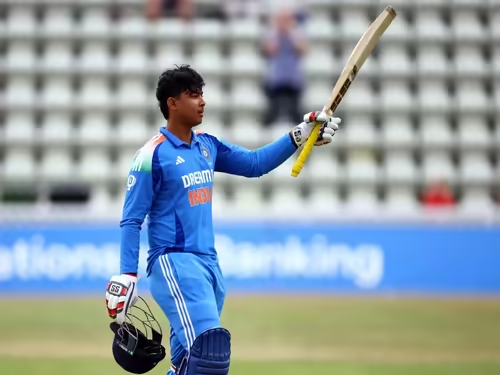
He’s only 14 years old, but Vaibhav Sooryavanshi’s name is already etched in cricketing history. An IPL debut for the Mumbai Indians, a reputation as a batting prodigy, and now a spot in India’s U-19 World Cup squad—his resume reads like a fantasy. Yet, amidst the celebration of his meteoric rise, a serious and sobering question has been raised by one of Indian cricket’s most respected voices. Former India women’s head coach WV Raman has cautioned that the Vaibhav Sooryavanshi U19 World Cup campaign might be “detrimental to his growth,” sparking a crucial debate about how we nurture our youngest talents .
Table of Contents
- The Prodigy and the Pressure
- Raman’s Warning: Prioritizing Long-Term Growth
- The Fine Line Between Opportunity and Overload
- Global Precedents: Lessons from Other Nations
- India’s Opening Win and Sooryavanshi’s Quiet Start
- What Should Be the Path Forward for Vaibhav?
- Conclusion: Balancing Dreams with Development
- Sources
The Prodigy and the Pressure
Vaibhav Sooryavanshi’s journey is the stuff of dreams. His elegant stroke play and calm demeanor at such a tender age have drawn comparisons to the game’s greats. His IPL debut was a landmark moment, not just for him but for Indian cricket, showcasing its ability to spot and promote raw talent. However, with every accolade comes immense pressure. The expectations are no longer just to perform; they are to be a savior, a superstar in the making.
Now, thrust into the high-stakes environment of the ICC U-19 World Cup—a tournament known as a launchpad for future stars like Virat Kohli and Yuvraj Singh—the weight on his young shoulders has grown exponentially. While many see this as the natural next step, WV Raman sees a potential trap.
Raman’s Warning: Prioritizing Long-Term Growth
Raman’s core argument is one of developmental science over immediate gratification. His concern isn’t about Vaibhav’s talent—that is undeniable. It’s about the timing and the level of competition. At 14, competing against players who are often 18 or 19 years old is a massive physical and mental leap. The U-19 game is far more aggressive, physically demanding, and tactically complex than what a 14-year-old typically faces.
“It could be detrimental to his growth,” Raman stated, emphasizing that the focus should be on allowing Vaibhav to develop his skills gradually in age-appropriate settings . The fear is that if he struggles consistently against older, stronger opponents, it could dent his confidence and stunt his technical development. The goal shouldn’t be to rush him to the top, but to build a foundation that ensures he stays there for a decade or more.
The Fine Line Between Opportunity and Overload
This situation highlights a critical dilemma in modern sports: the fine line between providing opportunity and causing overload. On one hand, denying a supremely talented child like Vaibhav a chance to test himself on a global stage seems counterintuitive. These experiences can be invaluable for building mental toughness and learning from the best.
On the other hand, the risk of burnout, both physical and mental, is very real. Young athletes’ bodies are still developing, and their minds are highly impressionable. A series of failures at this level, without the emotional maturity to process them, can have long-lasting negative effects. The Vaibhav Sooryavanshi U19 World Cup experiment is walking this tightrope, and the consequences of a misstep could be severe for the player’s entire career.
Global Precedents: Lessons from Other Nations
Other cricketing nations have grappled with this issue. Australia and England, for instance, have robust age-group systems that are strictly tiered. They are often cautious about promoting players too far beyond their age group, preferring a steady, structured progression. Their philosophy is that a strong base built over time is more valuable than a few early headlines.
In contrast, the Indian system, driven by the intense spotlight of the IPL and massive public expectation, can sometimes accelerate a player’s journey faster than their development can keep up. Raman’s warning is a call to adopt a more measured, globally-informed approach to protect its most precious assets—young talents like Vaibhav.
India’s Opening Win and Sooryavanshi’s Quiet Start
India’s U-19 World Cup campaign began with a comfortable victory over the USA. However, in a twist that lends some credence to Raman’s concerns, Vaibhav had a quiet outing with the bat, failing to make a significant impact . While one match means little in the grand scheme, it does illustrate the challenge he faces. Adapting to the pace, bounce, and pressure of international U-19 cricket is no small feat, especially for someone so young. His performance will be watched closely, not just for runs, but for signs of how he is coping with the immense pressure.
What Should Be the Path Forward for Vaibhav?
The ideal path forward likely lies in a balanced middle ground. Perhaps a limited role in the tournament, where he is used strategically rather than as a frontline batter, could provide him with valuable exposure without overwhelming him. Simultaneously, a dedicated, long-term development plan managed by the BCCI’s National Cricket Academy (NCA) should be his primary focus.
This plan should prioritize skill refinement, physical conditioning appropriate for his age, and, crucially, psychological support to help him navigate fame and expectation. The goal must be to ensure that Vaibhav Sooryavanshi’s story is not just about a sensational start, but about a long, successful, and healthy career at the highest level.
Conclusion: Balancing Dreams with Development
The debate around the Vaibhav Sooryavanshi U19 World Cup participation is not about stifling talent; it’s about nurturing it responsibly. WV Raman’s cautionary note is a vital reminder that in our eagerness to crown the next superstar, we must not lose sight of the human being behind the bat. Protecting his long-term well-being and development is the ultimate act of faith in his future. The true measure of success won’t be his stats in this tournament, but whether he’s still dominating the game a decade from now.
Sources
- Times of India: ‘Detrimental to his growth’: Ex-India coach questions Sooryavanshi playing U19 World Cup
- International Cricket Council (ICC): Official source for U-19 World Cup fixtures, results, and regulations
- Board of Control for Cricket in India (BCCI): Information on player development pathways and the NCA