Table of Contents
- The Kaif Verdict: A Blunt Assessment
- Axar Patel vs Ravindra Jadeja: The White-Ball Stats Don’t Lie
- Beyond the Numbers: Batting Impact and Versatility
- The Nitish Kumar Reddy Factor: A Question of Balance
- What This Means for India’s White-Ball Future
- Conclusion
- Sources
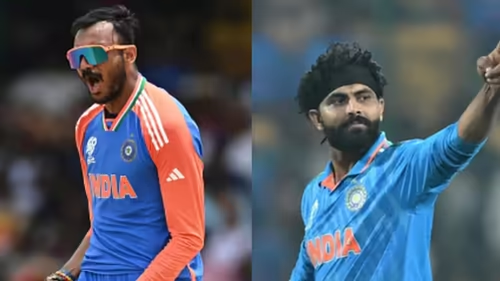
The world of Indian cricket is abuzz with a controversial take that cuts to the heart of the team’s all-rounder conundrum. Former Indian cricketer and astute analyst Mohammad Kaif has issued a stark verdict on the Axar Patel vs Ravindra Jadeja debate, leaving no room for ambiguity. His blunt statement? “Axar is way ahead of Jadeja” in the white-ball arena.
This isn’t just casual banter; it’s a direct challenge to the established hierarchy and a reflection of growing concerns over Jadeja’s recent output. So, what’s behind Kaif’s bold claim, and does the data back him up? Let’s dive deep into the numbers, the nuances, and the implications for Team India’s selection strategy.
The Kaif Verdict: A Blunt Assessment
Mohammad Kaif, known for his candid opinions, didn’t mince words. Speaking on his platform, he pinpointed the core issue: Jadeja’s quiet performances with both bat and ball in ODIs. Kaif’s primary argument hinges on two key areas where he believes Axar holds a clear edge .
First, he lauded Axar Patel’s batting prowess, specifically highlighting his ability to hit big shots and provide crucial lower-order firepower—a skill he feels Jadeja currently lacks . Second, Kaif pointed to Axar’s bowling versatility in the modern game, suggesting his style is more suited to the demands of contemporary white-ball cricket .
But Kaif didn’t stop there. He extended his critique to the team’s selection policy, questioning the choice of young all-rounder Nitish Kumar Reddy over the more experienced and, in his view, more balanced Axar Patel for certain roles . This adds another layer to an already complex selection puzzle.
Axar Patel vs Ravindra Jadeja: The White-Ball Stats Don’t Lie
Let’s ground this debate in hard data from their most recent ODI outings in 2025. The numbers paint a starkly different picture for the two all-rounders.
Ravindra Jadeja’s 2025 ODI Record:
Jadeja’s batting returns in the format have been underwhelming. In 7 matches, he managed just 50 runs across 5 innings, with a highest score of a mere 16 . His strike rate was a pedestrian 30.8, offering little in the way of acceleration or boundary-hitting threat . While his bowling figures against South Africa showed glimpses of his old self (like a 4/62 in Guwahati) , his overall impact with the ball has been inconsistent.
Axar Patel’s 2025 ODI Record:
In contrast, Axar has shown far greater consistency and impact with the bat. In 8 ODI innings, he scored 215 runs, including a crucial half-century . His role as a No. 5 batsman in the Champions Trophy, where he played a match-winning 42 against New Zealand, exemplifies his value as a genuine batting all-rounder . His ability to rotate the strike and find boundaries makes him a more dynamic option in the middle order.
Beyond the Numbers: Batting Impact and Versatility
Kaif’s assessment goes beyond raw statistics. He’s talking about match-winning impact. In today’s high-octane ODI cricket, a lower-order player who can’t clear the ropes or accelerate the scoring is a liability. Axar has repeatedly demonstrated this power-hitting ability, a trait Kaif explicitly noted as missing from Jadeja’s current game .
Furthermore, Axar’s left-arm spin, while perhaps not as penetrative as Jadeja’s at his peak, offers excellent control and is often used more strategically in the middle overs to build pressure. His role as India’s T20I vice-captain also speaks to the trust the management places in his cricketing brain and adaptability .
The Nitish Kumar Reddy Factor: A Question of Balance
Kaif’s criticism wasn’t solely focused on the main duo. He also questioned the selection of Nitish Kumar Reddy over Axar, arguing that it disrupts the team’s balance . Reddy, a talented seam-bowling all-rounder, has been a subject of much debate himself, with critics wondering about his precise role in a squad already packed with specialist bowlers .
By advocating for Axar, Kaif is pushing for a side that has a reliable fifth bowling option who can also contribute a solid 30-40 runs down the order. This kind of balance is often the difference between a good team and a great one in major tournaments. Choosing a player like Reddy, who is still finding his feet at the international level, over a proven performer like Axar in the white-ball format seems, to Kaif, like a missed opportunity .
What This Means for India’s White-Ball Future
This debate is more than just about two players; it’s about the philosophy of India’s white-ball team construction. As the team looks towards the next World Cup cycle, the selectors face a critical choice. Do they stick with the legendary Jadeja, hoping for a return to his dominant best, or do they fully embrace the more modern, batting-centric profile of Axar Patel?
For fans looking to stay ahead of the curve, understanding these dynamics is key. You can track the latest player developments and team strategies on our dedicated [INTERNAL_LINK:players] section. The ongoing competition will undoubtedly push both players to raise their game, which can only be good news for Indian cricket.
Conclusion
Mohammad Kaif’s blunt verdict on the Axar Patel vs Ravindra Jadeja debate has ignited a necessary conversation. While Jadeja’s legacy is secure, the cold, hard stats from 2025 and the evolving demands of the ODI game strongly support Kaif’s stance. Axar Patel’s superior batting contributions and versatile skill-set make him the more valuable asset for India’s current white-ball setup. The selection panel now has a clear, data-backed perspective to consider as they shape the future of the team.
Sources
- Times of India: ‘Axar is way ahead of Jadeja’: Ex-India cricketer’s blunt verdict
- ESPNcricinfo Player Stats: Ravindra Jadeja and Axar Patel Career Records
- ICC Official Website: Player Rankings and Match Archives