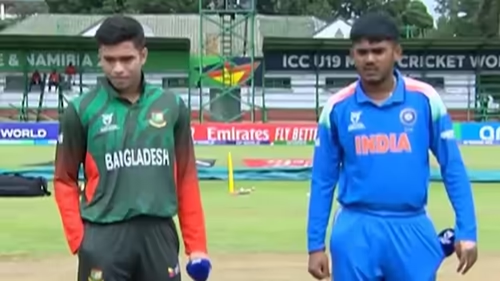
The spirit of the game took a backseat on a tense Saturday in Bulawayo. At the ICC Men’s U-19 Cricket World Cup 2026, a simple gesture of sportsmanship—the pre-toss handshake—was conspicuously absent, igniting a global conversation about where politics ends and sport begins. This incident, centered around the U-19 World Cup handshake, has become far more than just a moment of awkwardness; it’s a stark reflection of the complex realities facing young athletes today.
Table of Contents
- The Handshake That Wasn’t: What Happened?
- The Political Backdrop Fueling the Tension
- A History of Handshake Hesitations in Cricket
- The Weight on Young Shoulders: Impact on U-19 Players
- Fan Fury and Global Reaction
- Conclusion: Can Cricket Stay Above the Fray?
- Sources
The U-19 World Cup Handshake That Wasn’t: What Happened?
On January 17, 2026, at the Queen’s Sports Club in Bulawayo, all eyes were on the captains for the traditional coin toss before the crucial Group A match between India and Bangladesh . However, the expected moment of mutual respect never materialized. India’s captain, Ayush Mhatre, and Bangladesh’s vice-captain, Zawad Abrar (who was deputizing for the official captain), stood side-by-side but pointedly avoided any physical contact or pleasantries [[1], [2]].
The video of the cold, silent interaction quickly went viral, with fans and pundits alike dissecting every second. Traditionally, this handshake is a symbol of the game’s core values: respect, fair play, and camaraderie, regardless of the fierce competition to follow . Its omission on this occasion sent a powerful, albeit unfortunate, message.
The Political Backdrop Fueling the Tension
This on-field snub didn’t happen in a vacuum. It is a direct consequence of the significant deterioration in diplomatic relations between India and Bangladesh over the past year. The political landscape in Bangladesh underwent a dramatic shift in 2025, with the ousting of Prime Minister Sheikh Hasina leading to a period of intense political upheaval and economic hardship .
This change in government has led to a marked downturn in ties with New Delhi. Reports from late 2025 describe the relationship as moving “towards crisis” and being in a state of deep strain following the August 5 political changeover [[13], [14]]. These high-level tensions have inevitably trickled down, creating an atmosphere where even young cricketers, who should be focused solely on their game, feel the weight of national sentiment.
A History of Handshake Hesitations in Cricket
While shocking, this isn’t the first time a handshake has been used as a silent political statement in cricket. The most prominent precedent involves the Indian team and Pakistan. In recent years, especially after major geopolitical events, Indian captains have often opted out of the pre-match handshake with their Pakistani counterparts, a decision that has itself been a source of intense debate.
This new chapter between India and Bangladesh suggests a worrying trend: that bilateral political issues are increasingly dictating the norms of on-field behavior, even at the junior level. The question now is whether this will become a new, unwelcome norm for future encounters between these two cricketing nations.
The Weight on Young Shoulders: Impact on U-19 Players
The players involved, Ayush Mhatre and Zawad Abrar, are barely out of their teens. They are at a formative stage in their careers, learning not just the skills of the game but also its unwritten codes of conduct. Being thrust into the center of an international controversy is a heavy burden for any athlete, let alone a teenager.
It’s highly unlikely this was a personal decision made by the young captains in the moment. Such actions are almost certainly guided by directives from their respective boards or team management, who are themselves responding to the prevailing political climate. This raises serious questions about the role of sports administrators in shielding young talent from external pressures.
Fan Fury and Global Reaction
The reaction on social media has been predictably polarized. Fans from both nations have taken to platforms to defend their team’s stance, with many citing the political situation as justification. Others, however, have expressed deep disappointment, arguing that sport should be a unifying force, a place where political differences are set aside.
Neutral observers and former cricketers have largely lamented the incident, viewing it as a loss for the spirit of the game. The global cricket community is now watching closely to see how the ICC, the sport’s governing body, will respond to this breach of its cherished principles of respect and fair play.
Conclusion: Can Cricket Stay Above the Fray?
The skipped U-19 World Cup handshake is a poignant symbol of our times. It demonstrates that even in the pure, hopeful arena of junior cricket, the shadows of geopolitics can loom large. While national pride is a powerful motivator, it must not eclipse the fundamental values that make sport beautiful and universally loved. The hope is that this incident serves as a wake-up call, reminding everyone involved—from administrators to fans—that protecting the integrity and spirit of the game is a responsibility we all share. For more on the tournament’s schedule, check out our guide to the [INTERNAL_LINK:icc-u-19-world-cup-2026-schedule].
Sources
- Times of India. “Handshake drama returns! India, Bangladesh captains refuse pleasantries at toss – WATCH.” https://timesofindia.indiatimes.com/…
- International Crisis Group. “After the “Golden Era”: Getting Bangladesh-India Ties Back on Track.” https://www.crisisgroup.org/…
- ICC Official Website. “ICC Men’s Under 19 Cricket World Cup, 2026 – Match Centre.” https://www.icc-cricket.com/…