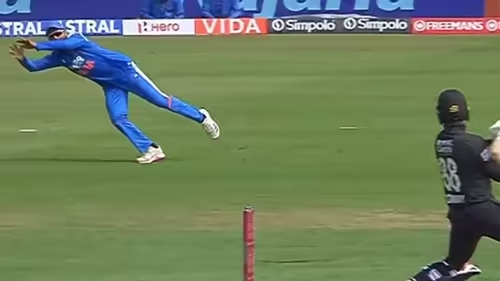
In the high-stakes atmosphere of the final ODI between India and New Zealand on January 18, 2026, a single moment of pure athletic genius can change everything. And that’s exactly what happened at the Holkar Cricket Stadium in Indore. Enter Ravindra Jadeja, who, with a gravity-defying leap, transformed from a mere fielder into a Jadeja flying catch legend, leaving fans and commentators alike utterly speechless.
Table of Contents
- The Pivotal Moment: Jadeja’s Spectacular Take
- Why This Catch Was a Game-Changer
- Harshit Rana’s Crucial Role in the Dismissal
- Breaking Down the Young-Latham Partnership
- Jadeja’s Legacy as a Fielder
- Conclusion: A Moment for the History Books
- Sources
The Pivotal Moment: Jadeja’s Spectacular Take
The third ODI was finely poised. New Zealand, after a strong start, had built a solid platform through their top order. Will Young, looking confident at the crease, was threatening to take the game away from India. Then, in a flash, it was all over. Off a delivery from the young pacer Harshit Rana, Young slashed hard towards the backward point boundary. What followed was pure theatre.
Ravindra Jadeja, stationed at backward point, reacted with lightning speed. He launched himself horizontally to his right, fully extended in mid-air, and plucked the ball out of thin air just before it could cross the rope. The crowd erupted, his teammates mobbed him, and social media instantly exploded with the clip, dubbing it the ‘flying eagle’ catch. This wasn’t just a wicket; it was a statement of intent from one of the game’s greatest all-rounders .
Why This Catch Was a Game-Changer
This dismissal was far more than just a spectacular highlight. It was a critical juncture in the match. Young was well set and forming a dangerous partnership that was putting immense pressure on the Indian bowling attack. His wicket, courtesy of that Jadeja flying catch, didn’t just remove a key batter; it shattered New Zealand’s momentum and injected a massive dose of energy into the Indian camp. Such moments often prove to be the turning point in tightly contested matches, and this was no exception.
Harshit Rana’s Crucial Role in the Dismissal
While Jadeja’s acrobatics stole the show, the foundation for the wicket was laid by Harshit Rana. The young bowler has been a revelation for India in this series, consistently hitting good lines and lengths. In this instance, he forced Young into a false shot with a well-directed delivery outside off stump. Rana’s ability to generate pace and movement has made him a key asset, and his figures in this series have been impressive, underlining his growing importance in India’s ODI setup . Without his disciplined bowling, the opportunity for that iconic catch might never have arisen.
Breaking Down the Young-Latham Partnership
Prior to his dismissal, Will Young was involved in a significant stand with captain Tom Latham. Their partnership was the bedrock of New Zealand’s innings, carefully navigating the Indian bowling and building a score that looked increasingly competitive. The exact runs they put on together were a testament to their resilience and skill. By breaking this crucial alliance, Jadeja’s catch didn’t just claim one wicket—it effectively dismantled the core of New Zealand’s batting effort, leaving the middle order exposed and vulnerable .
Jadeja’s Legacy as a Fielder
Ravindra Jadeja’s reputation as one of the finest fielders in world cricket is well-earned. His agility, anticipation, and electric presence in the inner ring or on the boundary are legendary. This catch in Indore is just the latest chapter in a long book of fielding masterclasses. From saving countless runs with his direct hits to pulling off impossible stops, Jadeja’s impact on the game extends far beyond his batting and bowling. He embodies the modern cricketer, where fielding is a potent weapon. For more on the evolution of fielding standards in international cricket, you can refer to resources from the International Cricket Council (ICC).
His ability to deliver in clutch moments, like this Jadeja flying catch against New Zealand, is what separates the greats from the rest. It’s a skill that cannot be taught but is honed through relentless practice and an innate understanding of the game.
Conclusion: A Moment for the History Books
The third ODI between India and New Zealand on January 18, 2026, will be remembered for many things, but none more vividly than Ravindra Jadeja’s astonishing ‘flying eagle’ catch to dismiss Will Young. It was a perfect blend of athletic brilliance, perfect timing, and game-changing impact. This moment not only swung the match in India’s favor but also served as a powerful reminder of Jadeja’s irreplaceable value to the team. For fans of the sport, it was a piece of magic that will be replayed for years to come—a true testament to the drama and beauty of cricket.
Sources
- Times of India: “IND vs NZ: Jadeja turns flying eagle to dismiss Young – Watch” (https://timesofindia.indiatimes.com/sports/cricket/india-vs-new-zealand/ind-vs-nz-ravindra-jadeja-turns-flying-eagle-to-dismiss-will-young-during-3rd-odi-watch/articleshow/126640947.cms)
- Match Details: India vs New Zealand, 3rd ODI, Holkar Cricket Stadium, Indore, January 18, 2026 [[11], [14]]
- Harshit Rana’s Series Performance
- Context on New Zealand’s Batting Partnership