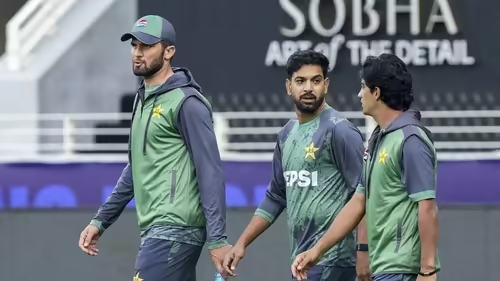
Pakistan cricket fans are in for a shock: Haris Rauf, once considered a linchpin of the national T20 attack, may not feature in the 2026 ICC Men’s T20 World Cup squad. According to multiple reports, the Pakistan Cricket Board (PCB), under the guidance of head coach Mike Hesson, has decided to “go in a different direction” with its pace battery—effectively sidelining one of its most explosive bowlers .
This decision comes despite Rauf’s consistent performances in global T20 leagues, including a standout season in Australia’s Big Bash League. So what’s behind this controversial move? And what does it mean for Pakistan’s title hopes in 2026?
Table of Contents
- Why Haris Rauf Is Being Axed
- The Mike Hesson Effect on PCB Strategy
- Haris Rauf’s Recent Form vs. National Absence
- Who Could Replace Haris Rauf in the T20 WC Squad?
- Fan and Expert Reactions
- Conclusion: A Bold or Risky Move?
- Sources
Why Haris Rauf Is Being Axed
The official line from the PCB is that they’re seeking a “different direction” for their T20 bowling unit. But reading between the lines, several factors appear to be at play:
- Lack of recent international exposure: Rauf hasn’t played a T20I for Pakistan since the 2025 Asia Cup—a gap that selectors seem unwilling to overlook .
- Workload management concerns: After years of constant T20 league participation, PCB may fear burnout or injury risk ahead of a major tournament.
- Tactical evolution: Coach Mike Hesson appears to favor bowlers who can execute slower balls, yorkers, and variations more consistently in high-pressure death overs—something Rauf has occasionally struggled with in international settings.
The Mike Hesson Effect on PCB Strategy
New Zealand’s former head coach Mike Hesson, known for his data-driven and process-oriented approach, has brought a quiet revolution to Pakistan’s setup. Under his watch, the team is shifting from relying on raw pace and individual brilliance to a more structured, role-based system .
Hesson’s philosophy emphasizes:
- Clear bowling roles within the innings (powerplay specialist, middle-over controller, death bowler).
- Consistency over explosiveness in high-stakes matches.
- Youth integration to build a sustainable core for future ICC events.
This cultural shift may explain why a proven match-winner like Rauf—whose style is built on aggression and pace—is being deprioritized in favor of emerging talents who fit the new mold.
Haris Rauf’s Recent Form vs. National Absence
It’s hard to ignore the irony: while Rauf is thriving abroad, he’s frozen out at home. In the 2025–26 Big Bash League, he was among the top wicket-takers for his franchise, consistently delivering at 145+ kph with sharp bouncers and toe-crushing yorkers .
Yet, his last appearance for Pakistan came during the 2025 Asia Cup, where he managed just 4 wickets in 5 games at an economy of 8.92. Selectors appear to have used that performance—and his subsequent absence—as justification for moving on.
Cricket analysts point out that this reflects a growing trend in international cricket: boards are increasingly valuing availability and commitment to national duty over T20 league heroics. As ESPNcricinfo notes, “Franchise stardom no longer guarantees a national jersey” .
Who Could Replace Haris Rauf in the T20 WC Squad?
With Rauf likely out of the picture, the PCB is testing several alternatives to fill the void in the pace department:
- Naseem Shah: The young quick has matured significantly and offers control alongside pace.
- Shaheen Afridi: Expected to lead the attack, but needs reliable support.
- Abbas Afridi: A rising star with excellent death-bowling credentials in domestic T20s.
- Mohammad Wasim Jr.: Back in contention after revamping his action and improving line consistency.
Additionally, uncapped talents like Akif Javed and Ihsanullah are being fast-tracked through Pakistan A tours and domestic circuits, signaling a clear intent to build for the future—even at the cost of short-term experience.
Fan and Expert Reactions
The news has sparked intense debate across social media and sports panels. Many fans argue that dropping a bowler of Rauf’s caliber—especially one in peak form—is reckless ahead of a World Cup. “You don’t fix what isn’t broken,” tweeted a prominent cricket journalist .
Others support the PCB’s long-view strategy. Former Pakistan captain Ramiz Raja commented, “Sometimes you have to make tough calls for long-term gain. Hesson knows what he’s doing” .
Either way, the decision underscores a pivotal moment in Pakistan’s T20 evolution—one that could define their campaign in South Africa and Zimbabwe, the co-hosts of the 2026 tournament.
Conclusion: A Bold or Risky Move?
The exclusion of Haris Rauf T20 WC plans is more than just a selection change—it’s a statement of intent from the PCB. By prioritizing system-fit over star power, Mike Hesson and the selectors are betting on structure over spontaneity. Whether this gamble pays off in 2026 remains to be seen. But one thing is certain: Pakistan’s bowling attack will look dramatically different from the one fans have cheered for years. For more on Pakistan’s evolving T20 strategy, see our deep dive on [INTERNAL_LINK:pakistan-t20-world-cup-preparations].
Sources
- Times of India. “Key Pak bowler to miss; PCB decides to go in different direction.” https://timesofindia.indiatimes.com/…
- ESPNcricinfo. “The rise of role-based bowling in T20 cricket.” https://www.espncricinfo.com
- PCB Official Statements (via press conferences, Jan 2026).
- Big Bash League 2025–26 Stats – Cricket Australia.
- Social media reactions from verified cricket journalists and former players.