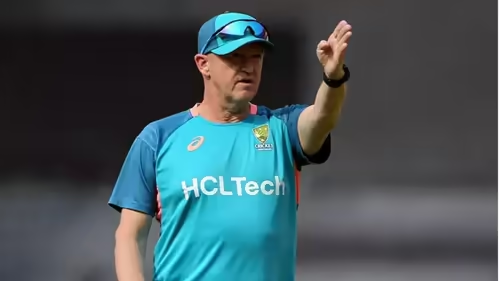
He’s one of the most respected minds in world cricket—a former World Cup-winning coach with England and a master strategist across formats. But even Andy Flower admits there’s a limit to what one coach can handle. In a candid new reflection, the Zimbabwean-born legend has declared that “coaching all three formats is a tough task”—a statement that resonates deeply in today’s hyper-specialized cricketing landscape .
Flower, who recently took on the role of head coach for London Spirit in The Hundred, isn’t just speaking from theory. He’s lived the grind of juggling Test patience, ODI precision, and T20 explosiveness—all while managing player workloads, media scrutiny, and evolving tactics. Now, as he dives into the fast-paced world of franchise cricket, his insights offer a rare glimpse into the future of coaching itself.
Table of Contents
- Why Coaching All Three Formats Is a Tough Task
- Andy Flower’s New Challenge with London Spirit
- The Hundred: More Than Just a Tournament
- The Evolution of the Modern Cricket Coach
- What This Means for India and Other Teams
- Conclusion: Specialization Is the Future
- Sources
Why Coaching All Three Formats Is a Tough Task
Cricket used to be simple: play long, play hard, and adapt within a single rhythm. Today, the game exists in three distinct universes:
- Test Cricket: A five-day chess match demanding patience, technical resilience, and mental fortitude.
- ODI Cricket: A 50-over balancing act between aggression and accumulation.
- T20 Cricket: A 90-minute adrenaline sprint where innovation trumps tradition.
“Each format requires a different mindset, different training methods, and even different language,” Flower explains. “Expecting one person to excel in all three is asking for burnout—for the coach and the players.”
This is why top cricketing nations are increasingly splitting coaching roles. England has separate leads for red-ball and white-ball cricket. Australia and South Africa are moving in the same direction. The era of the “all-format” coach may be coming to an end—not due to lack of talent, but because the game has outgrown the model.
Andy Flower’s New Challenge with London Spirit
Flower’s latest chapter is with London Spirit in The Hundred, England’s bold, city-based franchise league. Far from seeing it as a step down, he calls it “an exciting challenge” that aligns perfectly with his belief in format-specific coaching .
His immediate focus? The upcoming player auction. “Preparation is everything,” he says. “You need to know not just who can hit sixes, but who thrives under pressure, who communicates well, and who fits the team culture.”
London Spirit, despite having star power like Glenn Maxwell and Zak Crawley, has struggled to convert talent into trophies. Flower’s task is to build cohesion, instill clarity, and create a winning identity in a competition where every ball counts.
The Hundred: More Than Just a Tournament
Flower is a vocal supporter of The Hundred—not just as entertainment, but as a social catalyst. He points to its success in attracting new audiences: families, women, and young fans who found traditional county cricket inaccessible or slow-paced.
“It’s brought cricket into city centers, into living rooms, and onto social media in a way we’ve never seen before,” he notes. Stadiums are packed with kids wearing team jerseys, and matches are decided in under three hours—perfect for the modern attention span.
But beyond the glitz, Flower sees strategic value. “The Hundred is a laboratory for innovation. Young players learn to make high-stakes decisions quickly. Coaches experiment with roles and tactics. It’s accelerating player development in ways first-class cricket can’t.”
The Evolution of the Modern Cricket Coach
Gone are the days when a coach was just a tactician with a clipboard. Today’s coach is a psychologist, data analyst, leadership mentor, and media manager rolled into one.
Flower believes the future lies in specialization:
- Red-Ball Coaches: Focus on technique, endurance, and mental resilience.
- White-Ball Coaches: Master data analytics, powerplay strategies, and death-over plans.
- Franchise Coaches (like in The Hundred): Excel at rapid team-building, in-game adaptability, and fan engagement.
This doesn’t mean coaches can’t cross over—but expecting one person to lead a national team across all formats is becoming unsustainable.
What This Means for India and Other Teams
India, under head coach Gautam Gambhir, currently operates with a single coaching structure for all formats. While this ensures message consistency, it risks tactical stagnation—especially in white-ball cricket, where innovation moves fast.
Flower’s comments should serve as a wake-up call. As the T20 World Cup and Champions Trophy cycle intensifies, teams may need dedicated white-ball units to stay competitive. The BCCI has already floated the idea of a separate limited-overs coach—Flower’s experience suggests it’s not just smart, it’s necessary.
Conclusion: Specialization Is the Future
Andy Flower’s admission that coaching all three formats is “a tough task” isn’t a sign of weakness—it’s a mark of wisdom. As cricket fractures into distinct disciplines, the sport must evolve its support structures accordingly.
The Hundred, with its fast, fan-first model, is proving to be the perfect testing ground for this new era. And coaches like Flower aren’t resisting change—they’re leading it. For fans and administrators alike, the message is clear: the future of cricket coaching isn’t about doing everything. It’s about doing the right thing, for the right format, at the right time. Dive deeper into coaching trends in our [INTERNAL_LINK:cricket-coaching-evolution] series.
Sources
- Times of India: Coaching all three formats is a tough task: Andy Flower
- The ECB: Official The Hundred Website
- ESPNcricinfo: Andy Flower appointed London Spirit head coach
- ICC Coaching Guidelines: ICC High-Performance Coaching Framework