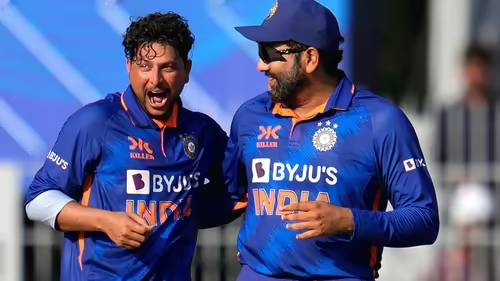
“Ball daal apna chup chap aur peeche ja.”
That’s the no-nonsense advice former India captain Rohit Sharma recently gave to wrist-spinner Kuldeep Yadav as the team gears up for the high-stakes T20 World Cup. Translated, it means: “Just bowl your ball quietly and move back.” No drama. No excessive appeals. No distractions.
On the surface, it sounds like simple fielding etiquette. But in the context of India’s current spin conundrum—and Kuldeep’s battle for a starting spot against mystery spinner Varun Chakaravarthy—it’s a masterclass in mental discipline and role clarity. And coming from Rohit, a leader known for his calm demeanor and tactical acumen, the message carries serious weight.
Table of Contents
- The Context Behind Rohit’s Advice
- Kuldeep Yadav at a Crossroads
- Why Appeals Matter More Than You Think
- T20 World Cup Spin Strategy: India’s Dilemma
- Rohit Sharma’s Leadership Legacy in T20 Cricket
- What This Means for India’s T20 World Cup Campaign
- Conclusion: Focus Over Flair
- Sources
The Context Behind Rohit’s Advice
The exchange between Rohit and Kuldeep reportedly took place during a practice session in Mumbai, just weeks before India’s departure for the T20 World Cup. Video clips from the nets showed Kuldeep appealing vigorously after a delivery that wasn’t close—a habit he’s had since his early days.
Rohit, observing from the sidelines, pulled him aside. His message was clear: in high-pressure T20 games, especially on slow pitches where margins are razor-thin, emotional control is as crucial as line and length. Over-appealing can signal desperation, break rhythm, and even distract the batter—or worse, the umpire.
As one senior coach noted, “Great spinners don’t need to shout. The ball does the talking.”
Kuldeep Yadav at a Crossroads
Kuldeep’s inclusion in the final 15-man squad was never guaranteed. Despite being a proven match-winner in ODIs and Tests, his T20I record has been inconsistent. In contrast, Varun Chakaravarthy has impressed with his economy rate (7.2 in 2025) and ability to contain power-hitters in the middle overs.
With only two frontline spin slots likely available—alongside all-rounder Axar Patel—the selectors are weighing experience against innovation. Kuldeep brings guile and wicket-taking threat; Varun offers control and unpredictability.
Rohit’s advice may be the final nudge Kuldeep needs to refine not just his action, but his entire on-field persona.
Why Appeals Matter More Than You Think
To casual fans, an appeal is just part of the game. But in elite cricket, it’s a psychological tool—and overuse can backfire:
- Umpire Fatigue: Constant loud appeals can desensitize umpires, making them less likely to raise the finger even on genuine shouts.
- Team Energy Drain: Excessive celebration or protest disrupts the bowler’s rhythm and the team’s collective focus.
- Opponent Mind Games: Savvy batters like Kane Williamson or Babar Azam use over-appealing as a sign of insecurity—they’ll milk singles to unsettle the bowler further.
Legendary spinners like Shane Warne and Anil Kumble were famously economical with their appeals—letting the dismissal speak for itself.
T20 World Cup Spin Strategy: India’s Dilemma
The 2026 T20 World Cup will be held across India—a land of turning tracks, low bounce, and dew-laden evenings. Spin will be central to success. But which type?
Kuldeep’s left-arm wrist spin can be devastating on dry surfaces, as seen in his 4/15 against Australia in 2024. Yet, he’s vulnerable on flat decks where batsmen can premeditate sweeps.
Varun, with his carrom balls and slower sliders, thrives in containment mode—ideal for powerplay and death overs in smaller grounds like Chennai or Kolkata.
India’s coaching staff, led by Gautam Gambhir, must decide: do they want a wicket-taker or a dot-ball machine? Rohit’s advice suggests they’re pushing Kuldeep to become both—quietly.
Rohit Sharma’s Leadership Legacy in T20 Cricket
Though no longer captain, Rohit remains a vital voice in the dressing room. As the most successful T20I captain in Indian history (winning 40+ matches), his insights are gold.
His own evolution—from a flamboyant opener to a composed leader—mirrors the maturity he’s now urging in Kuldeep. During India’s 2024 T20 series win in South Africa, Rohit famously told young pacer Arshdeep Singh: “Don’t react to edges. Just reset.” That mindset helped India clinch tight games.
Now, he’s passing that same philosophy to the spin department.
What This Means for India’s T20 World Cup Campaign
If Kuldeep internalizes Rohit’s advice, he could unlock a new level of composure. Imagine him bowling with silent intensity, building pressure without fanfare, and striking when least expected. That’s the version India needs.
Conversely, if he reverts to old habits, Varun may get the nod for crucial matches. Either way, this moment highlights a deeper truth: in modern T20 cricket, mental discipline is as important as skill.
[INTERNAL_LINK:t20-world-cup-2026-india-squad-analysis] will dive deeper into selection scenarios and predicted playing XIs.
Conclusion: Focus Over Flair
Rohit Sharma’s four-word mantra—“Ball daal, chup chap peeche ja”—is more than coaching advice. It’s a philosophy for high-stakes cricket. In the pressure cooker of the T20 World Cup, where every ball can change a match, silence might just be the loudest weapon Kuldeep Yadav has. Whether he embraces it could determine not just his role, but India’s fate on home soil.
Sources
- Times of India: ‘Ball daal apna chup chap aur peeche ja’: Rohit Sharma to Kuldeep Yadav
- ICC Player Statistics Portal: T20I Bowling Rankings and Performance Data
- ESPNcricinfo: Historical analysis of India’s T20 World Cup campaigns