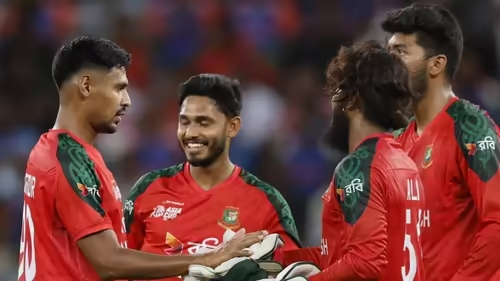
The 2026 ICC Men’s T20 World Cup was supposed to be a celebration of global cricket. Instead, it’s fast becoming a flashpoint for diplomatic tension, security debates, and regional rivalries. In a stunning development, Pakistan has formally offered to host Bangladesh’s scheduled matches after Dhaka declared it would not travel to India due to unresolved security concerns. The move—backed by strong political undertones—has thrown the International Cricket Council (ICC) into a high-stakes dilemma: uphold the original schedule or risk fracturing one of the sport’s most passionate fanbases. Here’s everything you need to know about this unfolding crisis.
Table of Contents
- Why Bangladesh Refuses to Play in India
- Pakistan’s Strategic Offer: Solidarity or Opportunism?
- The ICC’s Impossible Choice
- The IPL Directive That Sparked the Fire
- A History of Cricket and Conflict
- What Happens Next? Scenarios and Implications
- Sources
Why Bangladesh Refuses to Play in India
Bangladesh’s stance isn’t new—but it’s now non-negotiable. Citing “inadequate security assurances” from Indian authorities, the Bangladesh Cricket Board (BCB) has insisted that its team will not participate in matches scheduled on Indian soil . This position stems from long-standing concerns, recently amplified by incidents involving Bangladeshi players during the IPL.
Star pacer Mustafizur Rahman, who plays for Sunrisers Hyderabad, was reportedly subjected to hostile online abuse and even physical intimidation during a recent domestic match in India—allegations the BCB claims were not adequately addressed by local police or the BCCI . For a nation that views its cricketers as national heroes, such incidents are unacceptable. As one BCB official stated anonymously, “We cannot risk our players’ safety for the sake of a tournament.”
Pakistan’s Strategic Offer: Solidarity or Opportunism?
Enter Pakistan. In a rare show of regional solidarity, the Pakistan Cricket Board (PCB) has publicly offered to host all of Bangladesh’s group-stage matches at neutral venues like Lahore or Karachi—both of which have successfully hosted international teams in recent years, including New Zealand and England.
On the surface, it’s a gesture of goodwill. But geopolitically, it’s loaded. Pakistan, which itself has been excluded from hosting World Cup matches due to its strained relations with India, sees an opportunity to reassert its legitimacy as a safe, capable host. It also positions Islamabad as a protector of South Asian Muslim nations—a narrative that resonates domestically and across the region. Whether this is genuine diplomacy or strategic maneuvering remains hotly debated.
The ICC’s Impossible Choice
The ICC now faces a lose-lose scenario:
- Option 1: Force Bangladesh to play in India. Risk boycott, player safety issues, and backlash from fans across South Asia.
- Option 2: Accept Pakistan’s offer. Provoke India—the tournament’s financial backbone—and potentially set a precedent for future venue changes based on political disputes.
- Option 3: Move matches to a truly neutral third country (e.g., UAE or Sri Lanka). Logistically complex and costly, with limited time before the June 2026 start date.
So far, the ICC has maintained that “the current schedule stands,” but behind closed doors, emergency meetings are underway . The clock is ticking.
The IPL Directive That Sparked the Fire
Adding fuel to the fire is a controversial directive issued by the BCCI during the 2025 IPL season. Following a minor on-field altercation between Mustafizur Rahman and an Indian player, the league instructed franchises to “limit media interactions” involving Bangladeshi players—a move widely perceived in Dhaka as discriminatory and isolating .
This wasn’t just about cricket; it was seen as a reflection of deteriorating bilateral relations. With no formal apology or policy reversal, trust eroded further. For Bangladesh, the T20 World Cup became the line in the sand. As one analyst noted, “Cricket is never just cricket in South Asia—it’s identity, politics, and pride wrapped in leather and twine.”
A History of Cricket and Conflict
This isn’t the first time politics has hijacked the T20 World Cup. In 2009, Pakistan lost hosting rights after the Mumbai attacks. In 2016, India refused to travel to Pakistan for the Asia Cup. And in 2022, Afghanistan’s participation was clouded by Taliban rule.
Yet, the Bangladesh-India standoff is uniquely delicate. Unlike India-Pakistan, which is openly adversarial, India-Bangladesh relations have been largely cooperative—until now. A rupture here could destabilize an entire subcontinental sporting ecosystem. For deeper context, see our timeline on [INTERNAL_LINK:south-asia-cricket-politics].
What Happens Next? Scenarios and Implications
Three outcomes seem most likely:
- Last-minute compromise: India provides enhanced security guarantees, and Bangladesh agrees to play—with matches possibly shifted to high-security venues like Ahmedabad or Chennai.
- Partial relocation: Only Bangladesh’s marquee matches (e.g., vs India) are moved to a neutral venue, while others proceed in India.
- Full withdrawal: Bangladesh pulls out entirely, triggering insurance claims, broadcast disruptions, and a major blow to the tournament’s credibility.
Whatever happens, the ICC’s authority will be tested—and the dream of a truly “global” T20 World Cup may take another hit.
Conclusion: More Than Just a Game
At its core, this crisis reveals a hard truth: in today’s world, even the T20 World Cup can’t escape the shadows of geopolitics, security fears, and national pride. While fans hope for sixes and wickets, officials are navigating minefields of diplomacy. One thing is certain—how this unfolds will shape the future of international cricket for years to come.
Sources
- Times of India: Pakistan offers to host Bangladesh’s T20 WC matches amid standoff with India
- ICC Official Statement (January 2026): T20 World Cup 2026 Venue Policy
- ESPNcricinfo: Bangladesh’s Security Concerns Explained