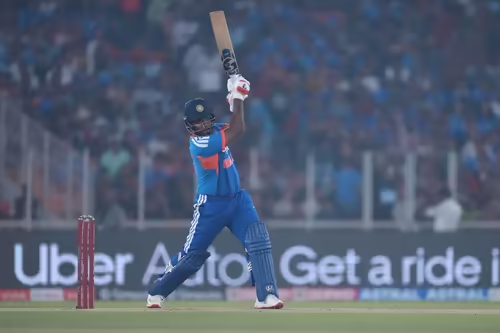
“Pata nahi kab khelne ko milega.” (I don’t know when I’ll get to play again.)
These five words, spoken softly but with heavy emotion by Sanju Samson, cut deeper than any dismissal. In a sport where confidence is currency, this admission reveals the hidden toll of a decade-long battle with inconsistency—not in performance, but in opportunity. As India’s current first-choice wicketkeeper and newly reinstated opener in the T20I setup, Samson stands at the precipice of what could be his defining moment: the 2026 T20 World Cup. Yet, instead of triumph, his voice carries the weight of past betrayals by the system meant to nurture him.
Table of Contents
- A Decade of Uncertainty: Samson’s Rollercoaster Journey
- Why Opening Is His Path to Redemption
- The Suryakumar Yadav Factor: A Captain Who Truly Believes
- Is Samson Finally Secure as India’s No.1 Keeper?
- The Mental Burden of Constant Insecurity
- Conclusion: A Legacy Still Unwritten
- Sources
A Decade of Uncertainty: Samson’s Rollercoaster Journey
Since his international debut in 2015, Sanju Samson has been labeled everything from “the next MS Dhoni” to “India’s most elegant wicketkeeper-batter.” And yet, his career reads like a series of near-misses. He’s been dropped after scores of 9 and 13, recalled after IPL centuries, benched during tours despite strong domestic form, and then suddenly thrust back into the spotlight amid injury crises.
Despite holding the record for the highest individual score by an Indian wicketkeeper in T20Is (111* vs Bangladesh) and averaging over 40 in the format, Samson has rarely enjoyed sustained selection. His emotional confession—“I don’t know when I’ll get another chance”—isn’t just personal; it’s a reflection of a systemic issue in Indian cricket: the treatment of elite talent as disposable .
Why Opening Is His Path to Redemption
Samson’s recent resurgence coincides with his return to his natural position: opening the innings. In both domestic cricket and the IPL, he’s thrived at the top, using his full range of strokes—from cover drives to lofted sixes—without the pressure of middle-order congestion.
Now, given the same freedom in the national side, he’s playing with renewed clarity. “When I open, I play without fear. I know my role, and I trust my game,” he recently shared . This isn’t just about runs—it’s about psychological safety. Opening allows him to set the tone, control tempo, and avoid the chaotic middle overs where indecision often leads to soft dismissals.
The Suryakumar Yadav Factor: A Captain Who Truly Believes
Perhaps the most transformative element of Samson’s current stint is his relationship with captain Suryakumar Yadav (SKY). Both are modern, 360-degree batters who rose through the IPL ranks. But more importantly, SKY understands the mental burden of being in and out of the team.
Samson revealed that SKY’s constant encouragement and transparent communication have given him the confidence to express himself freely. “He tells me, ‘You’re here because you deserve it. Now go play your game,’” Samson said . In a team culture often criticized for its opacity and top-down decision-making, this level of support from the captain is not just refreshing—it’s potentially career-saving.
Is Samson Finally Secure as India’s No.1 Keeper?
For years, India’s wicketkeeper spot has been a revolving door: Dhoni, Pant, KL Rahul, Ishan Kishan, and now Samson. With Rishabh Pant still recovering from his life-threatening accident and KL Rahul aging, the 2026 T20 World Cup appears to be Samson’s window.
Yet, history suggests nothing is guaranteed. If he fails in two matches, the selectors could pivot again. That’s why his current performances carry existential weight. Every run isn’t just for the team—it’s for his own survival. For more on India’s evolving selection philosophy, see our analysis on [INTERNAL_LINK:india-wicketkeeper-evolution].
The Mental Burden of Constant Insecurity
Beyond stats and selections lies a deeper crisis: the psychological toll of perpetual uncertainty. Samson’s confession highlights a systemic flaw in Indian cricket—where even world-class performers live in fear of being discarded after one bad game.
This insecurity breeds risk-averse play, stifles creativity, and erodes self-belief. As former Australian coach John Buchanan once noted, “Consistency in selection breeds consistency in performance.” The International Cricket Council (ICC) has increasingly emphasized player mental health, urging boards to provide stable environments . India’s treatment of Samson stands in stark contrast to that ideal—and it’s time for change.
Conclusion: A Legacy Still Unwritten
Sanju Samson isn’t asking for pity—he’s asking for a fair shot. At 31, he knows time is running out. But if given stability, he has the class, technique, and temperament to become India’s definitive T20 World Cup keeper. His emotional honesty is a wake-up call to selectors: stop treating elite talent as disposable. Let him play. Let him fail. Let him succeed. Because as he poignantly reminds us, “I don’t know when I’ll get another chance.” And neither do we.
Sources
- Times of India: ‘Pata nahi kab khelne ko milega’: Samson breaks silence on missed chances
- International Cricket Council (ICC): Player Wellbeing and Mental Health Initiatives
- ESPNcricinfo Profile: Sanju Samson Career Stats