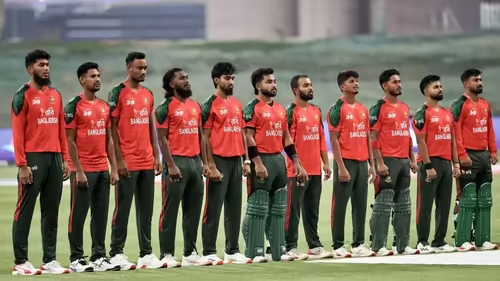
The countdown to the ICC Men’s T20 World Cup 2026 has been overshadowed by a serious geopolitical storm. In an unprecedented and blunt statement, Bangladesh Cricket Board (BCB) president Aminul Islam Bulbul has declared that it is “not safe” for the Bangladesh national team to play in India . This shocking claim has sent shockwaves through the cricketing world, forcing the International Cricket Council (ICC) into a high-stakes position as it scrambles to uphold the integrity of its flagship event.
The BCB has formally urged the ICC to relocate Bangladesh’s scheduled matches from Indian venues to Sri Lanka, citing unspecified but serious security concerns. However, the ICC has stood its ground, confirming that the tournament will proceed exactly as planned across its designated Indian host cities, asserting that independent security assessments have found no credible threat to the visiting team [[1], [2]].
Table of Contents
- The BCB Request: What Did Aminul Islam Bulbul Say?
- ICC Response: Independent Assessments Find No Threat
- Bangladesh refuses to play in India: The Deepening Crisis
- Historical Context of India-Bangladesh Cricket Tensions
- Potential Fallout for the T20 World Cup
- What Happens If Bangladesh Pulls Out?
- Conclusion: A Test of Diplomacy and Cricket Governance
- Sources
The BCB Request: What Did Aminul Islam Bulbul Say?
In a direct and forceful communication, BCB chief Aminul Islam Bulbul made his nation’s position crystal clear. He stated that the prevailing environment in India poses a direct risk to the safety and well-being of the Bangladeshi players and officials. While he did not publicly detail the specific nature of these threats, his language was unequivocal: “Playing in India is not safe” .
This statement goes beyond a mere request; it’s a stark warning that carries significant weight. The BCB’s formal proposal to shift all of Bangladesh’s group stage and potential knockout matches to neutral venues in Sri Lanka is a drastic measure, reflecting the depth of their anxiety. This move suggests that internal discussions within the BCB have concluded that the risks outweigh the benefits of participation in India.
ICC Response: Independent Assessments Find No Threat
The ICC, as the custodian of the game, has a duty to ensure the safety of all participants. In its official response, the council stated that it has been in constant contact with the BCB and has commissioned multiple, independent security agencies to conduct thorough risk assessments .
According to the ICC, these expert evaluations have consistently concluded that there is “no identified threat” to the Bangladesh team during their stay in India for the World Cup. The council emphasized its confidence in the local security apparatus and its own comprehensive event security protocols, which are designed to protect every team, official, and spectator. The ICC’s stance is firm: the tournament schedule will not be altered.
Bangladesh refuses to play in India: The Deepening Crisis
The core of this controversy lies in the stark contradiction between the BCB’s perception of danger and the ICC’s official security clearance. This disconnect has created a dangerous impasse. For the BCB, the safety of its players is non-negotiable. For the ICC, bending to a single board’s demands without concrete evidence could set a perilous precedent and undermine the entire tournament structure.
The phrase Bangladesh refuses to play in India is no longer just speculation; it’s the logical endpoint of the BCB’s current position. If their safety concerns are not addressed to their satisfaction, a withdrawal from the tournament becomes a real possibility—a scenario that would be catastrophic for the event’s credibility and commercial success.
Historical Context of India-Bangladesh Cricket Tensions
This isn’t the first time political and social tensions have spilled onto the cricket pitch between the two nations. Past tours have been marred by crowd trouble, hostile chants, and diplomatic friction. The intense rivalry, while great for fans, has sometimes fostered an atmosphere of animosity that extends beyond the boundary ropes .
The BCB’s current fears may be rooted in this history, amplified by recent geopolitical events or social media vitriol that they believe could manifest in physical threats during the high-pressure environment of a World Cup. Understanding this backdrop is crucial to grasping why the BCB is taking such a hardline stance.
Potential Fallout for the T20 World Cup
A Bangladesh withdrawal would trigger a series of disastrous consequences:
- Group Stage Chaos: Their group would be thrown into disarray, requiring a complete reworking of the points table and fixture list.
- Financial Losses: Broadcasters, sponsors, and ticket holders for Bangladesh’s matches would face massive losses.
- Reputational Damage: The ICC’s ability to manage a global event in a politically complex region would be severely questioned.
- Diplomatic Strain: The incident would further strain the already delicate relationship between the cricket boards and, by extension, the two nations.
What Happens If Bangladesh Pulls Out?
According to ICC regulations, if a team withdraws from the tournament after the official deadline, all their matches are forfeited, and their opponents are awarded the points. This would be a bitter outcome for fans of both teams and a black mark on the tournament’s legacy. The ICC would likely face immense pressure to mediate a last-minute solution, possibly involving high-level government assurances or even a compromise on neutral venues for specific matches, though the latter seems unlikely given their current stance [[INTERNAL_LINK:t20-world-cup-rules-and-regulations]].
Conclusion: A Test of Diplomacy and Cricket Governance
The standoff over whether Bangladesh refuses to play in India is more than a cricketing dispute; it’s a critical test of international sports diplomacy. The ICC must balance its duty of care with the need for a consistent and fair application of its rules. Meanwhile, the BCB is caught between its responsibility to its players and the immense prestige of participating in a World Cup. As the tournament draws closer, the world will be watching to see if cooler heads can prevail or if cricket will become another casualty of a complex geopolitical landscape.
Sources
- Times of India: ‘Playing in India not safe’: Bangladesh’s blunt warning as ICC refuses venue shift
- International Cricket Council (ICC): [EXTERNAL LINK: Official ICC statement on T20 World Cup security]
- ESPNcricinfo: Bangladesh board chief says it is ‘not safe’ to play in India