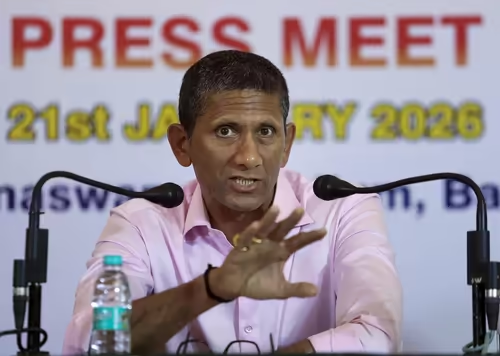
The countdown to IPL 2026 has begun, but one of its most iconic franchises—Royal Challengers Bengaluru (RCB)—still doesn’t have a confirmed home. Despite the Karnataka State Cricket Association (KSCA) securing conditional approval for the M Chinnaswamy Stadium and declaring full readiness, RCB is holding back, citing concerns over the Karnataka government’s controversial crowd management bill. Now, KSCA chief Venkatesh Prasad has issued a clear message: “The ball is in RCB’s court.”
This standoff isn’t just bureaucratic—it threatens to upend fan expectations, local economies, and the very identity of a team whose legacy is deeply tied to Bengaluru’s cricketing heart. So what’s really going on, and could RCB actually play elsewhere?
Table of Contents
- The “KSCA Is Ready” Stance
- Why RCB Is Hesitating
- RCB Home Ground Alternatives on the Table
- The Crowd Management Bill Explained
- What This Means for Fans and Franchise
- Can a Compromise Be Reached?
- Conclusion
- Sources
The “KSCA Is Ready” Stance
Venkatesh Prasad, the former India fast bowler and current KSCA secretary, has been unequivocal: the infrastructure, security protocols, and pitch conditions at the M Chinnaswamy Stadium are all IPL-ready . The Board of Control for Cricket in India (BCCI) has already granted conditional approval—pending final clearance from state authorities on safety and crowd logistics.
“We’ve done everything from our end,” Prasad stated. “Now it’s up to RCB to engage with the state government and resolve the outstanding issue. The association is not the bottleneck here.”
This position underscores a growing frustration within KSCA, which has invested heavily in upgrading facilities, including new floodlights, improved drainage, and enhanced spectator amenities—all aimed at ensuring a world-class experience for the IPL’s most passionate fanbase .
Why RCB Is Hesitating
At the heart of the impasse is the Karnataka government’s proposed crowd management bill, which introduces stricter regulations on stadium capacity, entry-exit protocols, and emergency response during large gatherings. While framed as a public safety measure, RCB reportedly fears the bill could limit ticket sales, increase operational costs, or create legal liabilities in case of incidents .
Unlike other franchises that operate under more flexible state frameworks, RCB appears to be taking a cautious, risk-averse approach—especially after recent global events have heightened scrutiny on mass gatherings. The franchise has not publicly detailed its objections but has quietly begun exploring backup options.
RCB home ground Alternatives on the Table
If talks with the Karnataka government stall, RCB could consider relocating some or all of its home games—a move that would shock fans but isn’t without precedent. Potential alternatives include:
- Holkar Cricket Stadium, Indore: A BCCI-approved venue with excellent facilities and a proven track record of hosting high-profile matches.
- Narendra Modi Stadium, Ahmedabad: Offers massive capacity and top-tier infrastructure, though logistically distant from Bengaluru.
- Other neutral venues: The BCCI may assign a temporary home base if no resolution is reached by the tournament deadline .
However, moving away from Bengaluru would come at a steep cost—not just financially, but emotionally. RCB’s “Ee Saala Cup Namde” (This Year, the Cup is Ours) chant is inseparable from the Chinnaswamy’s electric atmosphere.
The Crowd Management Bill Explained
The Karnataka Public Gatherings (Regulation and Safety) Bill, 2025, mandates that organizers of events with over 10,000 attendees must submit detailed safety plans, coordinate with multiple agencies, and bear partial liability for crowd control failures . While similar laws exist in Maharashtra and Delhi, Karnataka’s version is seen as more prescriptive.
Critics argue it’s well-intentioned but poorly timed, potentially deterring private investment in mega-events. Supporters say it’s necessary after incidents like stampedes at religious gatherings. For RCB—a private franchise—the legal exposure may simply be too great to accept without ironclad indemnities.
What This Means for Fans and Franchise
For RCB fans, the uncertainty is agonizing. Season ticket holders, local vendors, and hospitality businesses all depend on the economic ripple effect of IPL matches at Chinnaswamy. A relocation could mean lost income and diminished matchday experiences.
For the franchise, playing away from home risks alienating its core support base and weakening its brand identity. RCB’s value isn’t just in its players—it’s in its connection to Bengaluru. As noted by sports economists, home advantage in T20 leagues can boost win probability by up to 15% due to crowd energy and familiarity .
Can a Compromise Be Reached?
Experts believe a middle path is possible. The state government could offer RCB-specific exemptions or cap liability under the bill, while KSCA acts as a mediator. Venkatesh Prasad has urged RCB to “open a dialogue” rather than retreat into contingency planning.
With the IPL auction and schedule announcement looming, time is running out. If RCB and the Karnataka government fail to find common ground soon, the unthinkable—a season without RCB at Chinnaswamy—could become reality.
Conclusion
The RCB home ground saga is more than a venue dispute—it’s a test of collaboration between private enterprise, state governance, and sporting tradition. KSCA has done its part. Now, as Venkatesh Prasad insists, the responsibility lies squarely with Royal Challengers Bengaluru to step up and secure their legacy in the city that loves them. Fans across Karnataka are watching closely, hoping their heroes won’t abandon the fortress where dreams—and heartbreaks—are made. For more on IPL 2026 preparations, see our guide on [INTERNAL_LINK:ipl-2026-venue-schedule-preview].
Sources
- Times of India: KSCA is ready, ball in RCB’s court, says chief Venkatesh Prasad
- ESPNCricinfo: IPL 2025: Chinnaswamy Stadium upgrades complete ahead of RCB return
- BCCI: IPL 2026 Venue Guidelines Released
- Karnataka Legislative Assembly: Public Gatherings (Regulation and Safety) Bill, 2025
- Journal of Sports Economics: The Impact of Home Advantage in T20 Leagues