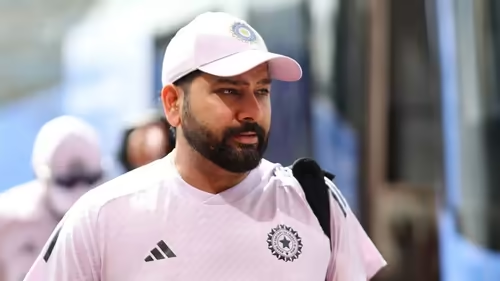
It was supposed to be a quiet evening at the team hotel—but for Rohit Sharma, India’s cricket captain and one of the most recognizable faces in global sport, it turned into an unexpected and emotionally charged moment. A distraught woman, desperate to save her daughter’s life, broke through security barriers, grabbed his arm, and tearfully pleaded: “Please help me.”
The incident, captured on video and widely shared online, has ignited a wave of empathy, debate, and scrutiny—not just about personal security for athletes, but about the crushing burden of rare-disease treatment costs in India. At the heart of the plea? A staggering Rs 9 crore injection that could give her child a fighting chance.
Table of Contents
- The Incident Unfolds
- Rohit Sharma and the Desperate Plea Behind the Grab
- What Is the Rs 9 Crore Injection?
- Security Protocols Under Scrutiny
- Celebrity as a Lifeline: Public Sympathy vs. Boundaries
- How India Can Address Rare Disease Funding
- Conclusion
- Sources
The Incident Unfolds
According to eyewitnesses and hotel staff, the woman managed to approach the Indian team’s private area during a brief window when players were returning from practice. She bypassed initial checkpoints—possibly blending in with service personnel—and made direct contact with Rohit Sharma as he walked toward the elevator .
Visibly shaken but composed, Sharma did not pull away. Instead, he listened as she explained her situation before security personnel swiftly intervened and escorted her out. No harm came to the cricketer, but the emotional weight of the encounter lingered.
Rohit Sharma and the Desperate Plea Behind the Grab
In subsequent statements to authorities, the woman revealed her daughter suffers from spinal muscular atrophy (SMA), a rare genetic disorder that leads to progressive muscle weakness and, often, early death. The only known treatment is a gene therapy drug called Zolgensma—a one-time intravenous infusion priced at approximately $2.1 million (roughly Rs 9 crore in India) .
“I’ve written to hospitals, NGOs, even government officials,” she reportedly said. “No one can help. I saw the cricketers as my last hope—they have the power to move people, to raise funds.” Her choice of Sharma wasn’t random; he’s known for his charitable work and calm public demeanor.
What Is the Rs 9 Crore Injection?
Zolgensma, developed by Novartis, is the world’s most expensive drug. It works by replacing the defective SMN1 gene responsible for SMA, effectively halting disease progression if administered early—ideally before symptoms appear.
While approved in India since 2022, its cost places it far beyond the reach of average families. A few state governments, including Karnataka and Tamil Nadu, have initiated partial subsidies, but nationwide coverage remains patchy . For many parents, crowdfunding or appealing to celebrities becomes the only viable path.
Security Protocols Under Scrutiny
The breach has raised serious questions about athlete safety. The BCCI typically assigns high-level security to national team members, especially during international series. Yet this incident suggests vulnerabilities in hotel perimeter control.
Experts recommend:
- Strict zoning with biometric access for player floors
- Enhanced background checks for all hotel staff during team stays
- Dedicated liaison officers to handle public appeals without compromising safety
Importantly, the BCCI has not penalized the woman, recognizing the humanitarian context of her actions.
Celebrity as a Lifeline: Public Sympathy vs. Boundaries
This isn’t the first time a public figure has been approached in such a manner. From Bollywood stars to politicians, Indians often turn to the famous in moments of crisis—reflecting both deep trust and systemic gaps in social support.
While many admire the woman’s courage, others caution against normalizing physical contact, however well-intentioned. As one sports psychologist noted, “Athletes are human beings, not ATMs. Compassion must be balanced with respect for personal space” .
That said, Sharma’s calm response—listening rather than recoiling—has drawn praise for his empathy.
How India Can Address Rare Disease Funding
The real solution lies beyond individual charity. Advocates are calling for:
- National Rare Disease Policy implementation with clear funding mechanisms
- Price negotiation with pharma companies for essential orphan drugs
- Public-private health trusts modeled after cancer care initiatives
- Tax incentives for corporate donations to verified medical crowdfunding campaigns
Until then, stories like this will keep repeating—heartbreaking reminders of a system that forces parents to beg in hotel lobbies.
Conclusion
The encounter between Rohit Sharma and a grieving mother is more than a security lapse—it’s a mirror held up to India’s healthcare inequities. While Sharma’s personal response was gracious, the burden of saving lives shouldn’t fall on cricketers’ shoulders. This incident must catalyze policy action, not just viral sympathy. In the meantime, fans across the country are rallying behind the family, with several verified crowdfunding efforts now underway. For more on how sports stars are driving social change, see our feature on [INTERNAL_LINK:indian-cricketers-charity-initiatives].
Sources
- Times of India: Woman grabs Rohit at team hotel, cries ‘please help me’
- World Health Organization: Spinal Muscular Atrophy Fact Sheet
- The Hindu: Zolgensma for SMA Approved in India
- BCCI: National Team Security Guidelines
- NCBI: Ethical Dilemmas in Celebrity Philanthropy
- Press Information Bureau: National Policy for Rare Diseases 2021