Table of Contents
- Azharuddin’s Sharp Rebuke to BCB
- Why Bangladesh Wants Out of India Matches
- ICC Stands Firm: No Venue Change Approved
- Is India Really Unsafe for International Cricket?
- The Sporting and Diplomatic Fallout
- Conclusion: A Costly Gamble for Bangladesh Cricket
- Sources
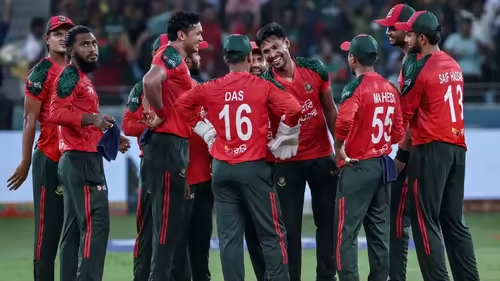
In a world where cricket often transcends sport and becomes a mirror of geopolitics, the T20 World Cup boycott drama involving Bangladesh has taken a sharp turn. Former Indian cricket captain and seasoned administrator **Mohammad Azharuddin** has fired a blistering critique at the Bangladesh Cricket Board (BCB), declaring their refusal to play in India during the upcoming T20 World Cup 2026 as nothing short of “their own loss.” His comments come amid growing controversy over security concerns and the ICC’s firm stance on venue logistics.
Azharuddin’s Sharp Rebuke to BCB
Speaking candidly to the media, Azharuddin didn’t mince words. “It’s Bangladesh’s loss,” he stated flatly, emphasizing that India remains one of the safest and most organized hosts for international cricket . He pointed to the ongoing presence of top-tier teams like New Zealand and South Africa—both currently playing high-profile series in India—as clear evidence that the country poses no extraordinary risk to visiting players .
“If other nations are comfortable playing here, why is Bangladesh making an exception?” Azharuddin questioned, highlighting what he sees as a politically motivated stance rather than a genuine security concern. His remarks have reignited debate across the cricketing community, with many echoing his view that sports should remain above diplomatic friction.
Why Bangladesh Wants Out of India Matches
The roots of this controversy lie in rising bilateral tensions between India and Bangladesh. While the BCB hasn’t publicly cited specific threats, multiple reports suggest internal political pressure and public sentiment in Bangladesh have influenced their position . The board formally requested the ICC to relocate their scheduled matches from India to a neutral venue—a move widely interpreted as a de facto boycott.
Key reasons behind Bangladesh’s stance appear to include:
- Perceived deterioration in India-Bangladesh diplomatic relations
- Domestic political narratives framing travel to India as unsafe
- Lack of direct government clearance for the national team to enter India
However, critics argue these concerns are exaggerated, especially given India’s flawless track record in hosting major ICC events, including the 2023 ODI World Cup and numerous IPL seasons featuring global stars.
ICC Stands Firm: No Venue Change Approved
In a decisive move, the International Cricket Council (ICC) has officially rejected Bangladesh’s request to shift their T20 World Cup 2026 fixtures out of India . The governing body cited logistical complexity, fairness to other participating nations, and the absence of credible security threats as primary reasons for its decision.
Notably, the BCB president himself has confirmed they will abide by the ICC’s ruling—even if it means their team doesn’t participate in those matches. This creates a troubling scenario: Bangladesh could forfeit crucial group-stage games, damaging their tournament prospects and potentially facing financial penalties or ranking repercussions.
Is India Really Unsafe for International Cricket?
Azharuddin’s argument hinges on a simple, observable fact: **India is currently hosting international cricket without incident**. New Zealand recently completed a full white-ball tour, and South Africa is in the middle of a high-stakes Test series—all under tight but routine security protocols .
Moreover, the ICC itself conducts rigorous security assessments before awarding hosting rights. For the T20 World Cup 2026, India’s infrastructure, crowd management, and emergency response systems have all been vetted and approved. Independent experts from organizations like the ICC Security Unit routinely monitor host nations to ensure player safety—a process that has found no red flags for India.
This raises a critical question: if the ICC and multiple cricket boards trust India’s environment, why doesn’t Bangladesh? The answer likely lies beyond the boundary ropes.
The Sporting and Diplomatic Fallout
A boycott—or even a forfeit—would carry severe consequences for Bangladesh cricket:
- ICC Penalties: Potential fines, loss of hosting privileges, or points deductions in future tournaments.
- Team Morale: Players may feel demoralized, missing a chance to compete on the global stage.
- Fan Disappointment: Millions of passionate fans would be denied the thrill of seeing their heroes in a World Cup.
- Reputational Damage: Bangladesh risks being seen as unreliable or politicizing sport excessively.
For context, similar stances in the past—like Zimbabwe’s limited tours or Pakistan’s long exile from home cricket—have led to long-term competitive decline. [INTERNAL_LINK:impact-of-politics-on-cricket] explores how geopolitical decisions can derail sporting progress.
Conclusion: A Costly Gamble for Bangladesh Cricket
Mohammad Azharuddin’s blunt assessment—“It’s Bangladesh’s loss”—may sting, but it reflects a broader truth in international sport: isolation rarely serves athletic interests. By opting out of matches in India, Bangladesh isn’t just skipping games; it’s sidelining its own team from a pinnacle event, weakening its global standing, and potentially alienating fans who live for cricket’s unifying spirit. As the ICC holds the line, the onus now falls on the BCB to decide whether principle outweighs participation—and whether their players will pay the price.
Sources
- Times of India: It’s Bangladesh’s loss; difficult to shift matches: Azharuddin slams BCB
- ICC Official Website – Security Protocols: ICC Security Guidelines