Table of Contents
- The Great Escape: A Match on the Brink
- Hanif Mohammad 337: Deconstructing the Marathon
- The Historical Context: A Young Nation’s Fight
- Legacy and Unbreakable Records
- Conclusion: The Immortal Innings
- Sources
Imagine being asked to bat for over sixteen hours across four days to save your team from a humiliating defeat. Now imagine doing it against one of the most fearsome bowling attacks in cricket history. This wasn’t a hypothetical scenario; it was the reality faced by Pakistan’s Hanif Mohammad in January 1958 at the Kensington Oval in Bridgetown, Barbados. His response? An immortal, unbeaten 337 that remains the longest individual innings in Test cricket history by time.
This wasn’t just a century; it was a masterclass in concentration, patience, and sheer willpower. It was an innings that didn’t just save a match—it defined a career and etched a name into the sport’s folklore forever.
The Great Escape: A Match on the Brink
The stage was set for disaster. In the first Test of their 1958 tour, Pakistan was completely outplayed in the first innings, managing a paltry 106 all out in reply to the West Indies’ colossal 579/9 declared . Following on, Pakistan’s situation looked dire. Another collapse would have meant an embarrassing innings defeat.
But then, something extraordinary happened. Hanif Mohammad, along with his brother Wazir, began to rebuild. While others fell around him, Hanif stood firm. He batted with a discipline that was almost alien for his era, prioritizing survival over spectacle. His goal was singular: to bat long enough to deny the West Indies a victory. Over the next four days, he achieved this with a superhuman effort that has never been matched.
Hanif Mohammad 337: Deconstructing the Marathon
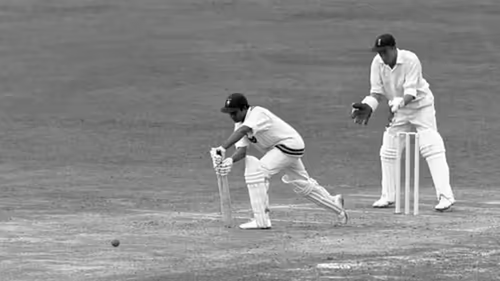
The statistics of Hanif Mohammad’s knock are staggering. He faced an estimated 613 balls over a grueling 970 minutes—that’s 16 hours and 10 minutes at the crease . To put that into perspective, that’s longer than most modern Test matches last! His innings spanned from the third day of the Test well into the sixth, a testament to his incredible physical and mental endurance .
His technique was built on an unshakeable defence. He left the ball with surgical precision and played only the deliveries he absolutely had to. This wasn’t the flamboyant stroke-play we often associate with great innings; this was trench warfare. He accumulated his runs through relentless accumulation, turning ones into twos and punishing the rare loose delivery.
By the time he was finally dismissed—or rather, when the match ended with him still at the crease—Pakistan had posted a mammoth 657/8 in their second innings, securing their first-ever Test draw against the West Indies . His partnership with his brother Wazir (who scored a crucial 109) was the bedrock of this historic recovery.
The Historical Context: A Young Nation’s Fight
This innings was more than just a cricketing feat; it was symbolic. Pakistan, as a nation, was barely a decade old. On the international sporting stage, they were still finding their feet, often seen as underdogs. Facing the mighty West Indies—a team packed with legends like Garry Sobers, Conrad Hunte, and Everton Weekes—was a daunting task .
Hanif’s resilience mirrored the spirit of his young nation. His ability to stand tall against overwhelming odds provided a massive source of national pride. For fans of [INTERNAL_LINK:pakistan-cricket-history], this match is a cornerstone moment, representing the birth of a competitive cricketing identity.
Legacy and Unbreakable Records
Over six decades later, Hanif Mohammad’s record for the longest Test innings by time remains untouched. Modern players, with their focus on high strike rates and T20 conditioning, seem even less likely to challenge this mark. The closest anyone has come is South Africa’s Gary Kirsten, who batted for 878 minutes for his 275 against England in 1999 .
This innings cemented Hanif’s nickname as the ‘Little Master,’ a title later inherited by Sunil Gavaskar, who himself cited Hanif as a major influence. His 337 was also the highest score by a Pakistani in Tests for many years and remains the highest in a second innings after following on.
The sheer scale of his concentration is almost impossible to fathom in today’s game. It stands as a monument to a different era of cricket, one where patience and grit were the ultimate weapons. The International Cricket Council (ICC) and cricket historians consistently rank this among the greatest Test innings of all time .
Conclusion: The Immortal Innings
Hanif Mohammad’s 337 in Bridgetown is not just a statistic; it’s a story. It’s a story of defiance, of national pride, and of an individual’s ability to rise to a challenge that seemed insurmountable. In an age of instant gratification, this marathon knock serves as a powerful reminder of the depth and drama that Test cricket can offer.
While records are made to be broken, some feel truly eternal. Hanif Mohammad’s 970-minute vigil is one such record—a timeless epic that continues to inspire awe and respect from every generation of cricket lovers.
Sources
- Times of India: “The great escape: When Pakistan’s Hanif Mohammad batted four days to save Test”
- ESPNcricinfo Scorecard: West Indies v Pakistan, 1st Test, 1958
- International Cricket Council (ICC) Hall of Fame Profile: Hanif Mohammad
- Various historical cricket archives confirming the 970-minute duration [[10], [11], [12], [13]]