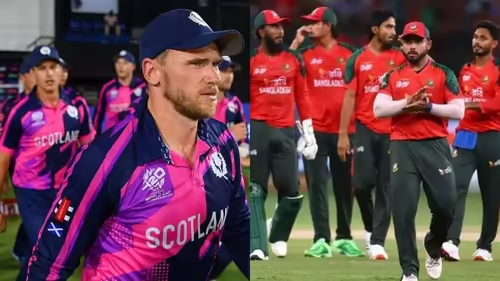
In a historic first, Scotland is heading to the T20 WC 2026—not as a qualifier, but as a direct replacement for a full-member nation. Following the ICC’s unprecedented decision to remove Bangladesh from the tournament after the BCB refused to play in India, the global cricket body turned to Scotland as the logical successor . But what made them the chosen ones? Was it just luck—or years of strategic buildup?
The answer lies in a mix of merit, timing, and the ICC’s own commitment to elevating associate cricket. As ICC CEO Sanjog Gupta confirmed, Scotland wasn’t picked arbitrarily; they were “the most deserving” candidate based on objective criteria—including their current world ranking and consistent performances on the international stage .
Table of Contents
- How Bangladesh Lost Their Spot
- T20 WC 2026: Why Scotland Was the Natural Choice
- Scotland’s Road to Readiness
- What This Means for Group C
- The Bigger Picture for Associate Cricket
- Conclusion: A Milestone for Global Cricket
- Sources
How Bangladesh Lost Their Spot
The door opened for Scotland only after Bangladesh slammed it shut. The Bangladesh Cricket Board (BCB) formally requested that all its matches in the T20 WC 2026 be moved out of India, citing independent security assessments. The ICC, after consulting with international agencies and host authorities, found “no credible threat” and deemed the request incompatible with tournament policy .
When the BCB refused to confirm participation by the deadline, the ICC had no choice but to invoke its contingency clause—removing Bangladesh and inviting the next eligible team. This wasn’t punishment; it was protocol. And at the top of that eligibility list stood Scotland.
T20 WC 2026: Why Scotland Was the Natural Choice
According to ICC CEO Sanjog Gupta, the selection was straightforward: “Scotland are currently ranked 14th in the ICC Men’s T20I rankings and have demonstrated strong performances in recent global qualifiers” . In the ICC’s official replacement hierarchy, associate teams are prioritized based on:
- Official ICC T20I Ranking (as of December 2025)
- Performance in the last two ICC qualifying events
- Administrative readiness and player availability
Scotland topped all three categories among non-qualified teams. They finished second in the 2025 Europe Qualifier behind Ireland and defeated Namibia, UAE, and Nepal in bilateral series throughout 2025—proving they could compete with established sides.
Scotland’s Road to Readiness
This isn’t Scotland’s first rodeo. They’ve participated in four previous T20 World Cups (2007, 2009, 2021, 2024), and their squad features experienced campaigners like captain Richie Berrington (over 100 T20Is) and all-rounder Michael Leask. Crucially, their core group has been stable for years—a rarity among associate teams.
Moreover, Cricket Scotland maintains a professional domestic structure and receives consistent funding from the ICC’s Associate Development Program. Unlike some emerging nations, they didn’t need weeks to assemble a squad; their players were already in training camps preparing for potential call-ups .
As one ICC insider noted, “Scotland didn’t just meet the bar—they were already standing on it.”
What This Means for Group C
Scotland will now join Group C alongside England, West Indies, Nepal, and Italy, with matches scheduled in Kolkata and Mumbai . While they’re underdogs on paper, their inclusion adds thrilling unpredictability:
- They’ve beaten England in a warm-up match before (2021).
- Their pace attack, led by Brad Wheal, thrives in subcontinental conditions.
- With nothing to lose, they’ll play fearless, aggressive cricket—a hallmark of associate teams on the big stage.
For fans, this means more drama. For the ICC, it’s a chance to showcase the depth of global talent beyond the traditional powerhouses.
The Bigger Picture for Associate Cricket
Scotland’s elevation is a win for the entire associate ecosystem. It validates the ICC’s “Pathway to Excellence” model, which rewards consistent performance over political influence or historical status. Teams like Oman, Netherlands, and Namibia now see a clear route: perform, rank high, and you’ll get your shot—even if it comes via extraordinary circumstances.
As ESPNcricinfo’s associate cricket correspondent put it, “This moment proves that meritocracy in cricket isn’t dead—it’s just getting started” .
Conclusion: A Milestone for Global Cricket
Scotland’s entry into the T20 WC 2026 is more than a replacement—it’s a statement. It shows that the ICC is willing to uphold its policies consistently, even when it means sidelining a full member. More importantly, it gives hope to every emerging cricket nation that hard work and results can open the door to the sport’s grandest stage. For Scottish fans, it’s a dream realized. For global cricket, it’s progress in action.
Sources
- Times of India: “Why Scotland are chosen as Bangladesh’s replacement” .
- Cricket Scotland Official Website – Team Structure & Funding: https://www.cricketscotland.com/ .
- ESPNcricinfo – Analysis on Associate Cricket Development .
- ICC Men’s T20I Team Rankings, December 2025.
- [INTERNAL_LINK:icc-associate-member-pathways] – For deeper insights into qualification systems.