Table of Contents
- A World Cup Dream Reborn Overnight
- Why Did Bangladesh Withdraw?
- T20 World Cup: The ICC’s Emergency Protocol
- Scotland’s Rushed Preparations and Travel Plans
- Group Stage Challenges Ahead for Scotland
- Historical Context: Scotland’s World Cup Journey
- Fan and Player Reactions
- Conclusion: An Underdog Story in the Making?
- Sources
A World Cup Dream Reborn Overnight
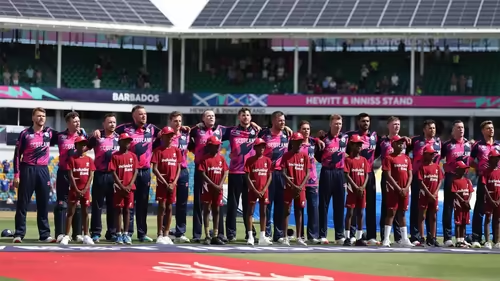
For most teams, qualification for the T20 World Cup is the result of years of planning, grueling qualifiers, and narrow margins. But for Scotland, the dream was reborn in a single phone call. After Bangladesh’s unexpected withdrawal due to security concerns, the International Cricket Council (ICC) turned to Scotland—the next highest-ranked non-qualified team—as a replacement .
Within hours, Cricket Scotland confirmed its acceptance, declaring the squad “ready to play” and preparing for an immediate flight to India. It’s a whirlwind scenario that blends heartbreak for one nation with euphoria for another—all just days before the world’s biggest T20 stage opens its doors.
Why Did Bangladesh Withdraw?
Bangladesh’s decision to pull out of the 2026 T20 World Cup sent shockwaves through the cricketing world. According to official statements, the withdrawal stems from “heightened security concerns” related to the tournament’s host environment in India . While the ICC and BCCI have repeatedly assured all participating nations of robust safety protocols, Bangladesh’s cricket board (BCB) opted for caution, citing duty of care to its players and staff.
This marks a rare instance of a full-member nation exiting a major ICC event at the eleventh hour—a move that not only disrupts the competitive balance but also triggers emergency contingency plans.
T20 World Cup: The ICC’s Emergency Protocol
The ICC has long maintained a clear protocol for such contingencies. When a qualified team withdraws post-deadline, the spot is offered to the highest-ranked team from the most recent global qualifier that didn’t make the final cut. In this case, that team was Scotland, who finished just outside the automatic qualification zone in the 2025 T20 World Cup Qualifier held in Namibia .
This isn’t the first time the ICC has used this rule—but it’s certainly among the most dramatic. The swift decision reflects the governing body’s commitment to maintaining a full 20-team field and ensuring the integrity of the tournament schedule.
Scotland’s Rushed Preparations and Travel Plans
Time is not on Scotland’s side. With the T20 World Cup set to begin imminently, the squad must pack, travel, and acclimatize to Indian conditions—all within 72 hours. Fortunately, many players are already in match-ready form, competing in domestic leagues or training camps across the UK.
Key logistical steps include:
- Chartering a direct flight to their designated Indian city (likely Hyderabad or Chennai, based on group placement).
- Immediate coordination with local authorities for visa fast-tracking and bio-secure bubble entry.
- Rapid gear and kit mobilization, including backup equipment sourced from ICC partners.
- Medical and fitness assessments upon arrival to ensure no jet-lag-related issues.
Despite the chaos, captain Richie Berrington expressed confidence: “We’ve been training as if we’d be playing. This opportunity is what every cricketer dreams of.”
Group Stage Challenges Ahead for Scotland
Scotland is expected to slot into Bangladesh’s original group, which includes heavyweights like India, Australia, and Afghanistan . While the path is daunting, Scotland has a history of punching above its weight:
- In the 2021 T20 World Cup, they stunned Bangladesh in a group-stage thriller.
- They’ve defeated England in ODIs and consistently troubled top-tier sides in ICC events.
- Their core—featuring Berrington, Michael Leask, and Brad Wheal—is experienced in high-pressure scenarios.
Though unlikely to advance deep into the knockout stages, a single upset could redefine their campaign—and reignite global interest in Associate cricket.
Historical Context: Scotland’s World Cup Journey
Scotland’s relationship with the T20 World Cup has been one of near-misses and gritty resilience. They’ve qualified five times since 2007 but have never progressed beyond the first round. Yet, each appearance has built a legacy of professionalism and passion.
Their inclusion in 2026—however unconventional—offers a platform to showcase their growth. With increased funding from the ICC’s Associate development program and regular fixtures against Full Members, Scotland is no longer just a participant; they’re a credible competitor .
Fan and Player Reactions
Social media erupted with support for Scotland’s surprise entry. Fans praised the ICC’s swift action and rallied behind the underdogs. Meanwhile, players from rival teams expressed mixed emotions—some welcomed the change, while others questioned the fairness of last-minute replacements.
Notably, former Australian captain Ricky Ponting commented on ESPNcricinfo: “It’s chaotic, but cricket needs these stories. Scotland deserve their shot.”
Conclusion: An Underdog Story in the Making?
The 2026 T20 World Cup was already poised to be historic. Now, with Scotland’s dramatic late entry, it gains an unexpected narrative thread—one of resilience, opportunity, and the unpredictable beauty of sport. While Bangladesh’s absence is a loss for the tournament, Scotland’s presence injects fresh energy and reminds us why cricket’s global expansion matters. All eyes will be on their opening match: not just to see if they win, but to witness a team playing with nothing to lose and everything to gain.
Sources
- Times of India: After Bangladesh exit, Scotland say ‘ready to play’, prepare immediate India arrival
- ICC Official Website: T20 World Cup 2026 Regulations and Team List
- ESPNcricinfo: Scotland’s T20 World Cup Qualification History
- Cricbuzz: Bangladesh Withdraws from T20 World Cup Over Security Concerns
- Cricket Scotland: Official Statement on ICC Invitation Acceptance