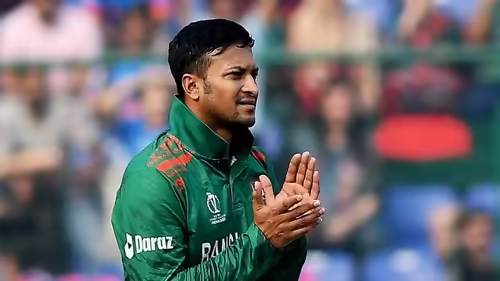
He walked away from the game in frustration. Now, Bangladesh’s greatest cricketer might be walking back—but only if he agrees to play by the board’s rules.
In a dramatic twist, the Bangladesh Cricket Board (BCB) has signaled it’s open to a Shakib Al Hasan comeback—but not without strings attached. Less than a year after the all-rounder announced his international retirement amid public backlash and political scrutiny, the BCB is reportedly ready to welcome him back… provided he meets their “ultimate selection conditions.”
This development comes at a critical juncture: Bangladesh faces possible exclusion from the 2026 ICC Men’s T20 World Cup due to unresolved governance issues, and the team is desperate for leadership, experience, and star power. But can pride—and politics—allow a reconciliation?
Table of Contents
- Why Did Shakib Al Hasan Retire?
- What Are the BCB’s ‘Ultimate Selection Conditions’?
- How the T20 World Cup Crisis Is Driving This Move
- Shakib’s Openness to Return: What He Said
- The Unspoken Role of Politics in His Comeback
- How Fans and Experts Are Reacting
- Conclusion: A High-Stakes Gamble for Bangladesh Cricket
- Sources
Why Did Shakib Al Hasan Retire?
Shakib announced his retirement from international cricket in April 2025, citing “personal reasons” and “mental exhaustion.” But the real catalyst was deeper. He had faced intense criticism following Bangladesh’s early exit from the 2024 T20 World Cup, with fans accusing him of underperforming and lacking commitment.
Compounding the pressure, his alleged ties to former Prime Minister Sheikh Hasina’s political circle drew unwanted media attention, blurring the lines between sport and state . Though never proven, the association fueled public anger during a time of national economic stress, making him a lightning rod for discontent.
What Are the BCB’s ‘Ultimate Selection Conditions’?
While the BCB hasn’t published a formal list, sources close to the board reveal three non-negotiable expectations for a Shakib Al Hasan comeback:
- Public Apology or Statement: A clear acknowledgment of his abrupt retirement and its impact on team morale.
- Commitment to Full Availability: No selective participation—he must be available for all formats and tours, including domestic commitments.
- Zero Political Association: An implicit understanding that he will avoid any public alignment with political figures or parties moving forward.
As one BCB official told reporters: “We will consider [his return] if…”—a phrase that has since become shorthand for the board’s cautious, conditional stance .
How the T20 World Cup Crisis Is Driving This Move
The timing isn’t coincidental. With the ICC threatening to bar Bangladesh from the 2026 T20 World Cup over governance violations, the BCB is scrambling to stabilize the team and project unity. Bringing back Shakib—a global icon with 14,000+ international runs and 600+ wickets—could serve multiple purposes:
- Restore Credibility: His presence signals seriousness to the ICC.
- Boost Morale: Young players look up to him as a mentor.
- Win Public Support: Fans are more likely to rally behind a team featuring their biggest star.
Without him, Bangladesh’s already slim chances of salvaging their World Cup spot look even bleaker.
Shakib’s Openness to Return: What He Said
Despite his retirement, Shakib has kept the door ajar. In a recent interview, he stated, “If the team needs me and the situation is right, I’m always ready to serve Bangladesh cricket.”
He also clarified that his decision to step away was never meant to be permanent—just a pause to “reassess and recharge.” This measured language suggests he’s willing to negotiate, especially if it means helping his country avoid the humiliation of missing a major tournament.
The Unspoken Role of Politics in His Comeback
Though rarely discussed openly, politics looms large over this saga. Shakib’s rumored closeness to Sheikh Hasina’s Awami League made him a target when the opposition gained ground. Now, with a caretaker government in place and elections approaching, the BCB may see his return as a way to depoliticize cricket—or, conversely, to appease certain factions.
Either way, his comeback would be more than a sporting decision—it would be a socio-political statement. As one analyst noted, “In Bangladesh, cricket is never just cricket” .
How Fans and Experts Are Reacting
Public opinion is split:
- Pro-Comeback Camp: “We need his experience! Ego aside, the team is crumbling without him.”
- Anti-Comeback Camp: “He quit when it got tough. Now he wants to return when it’s convenient? No thanks.”
Former players like Mashrafe Mortaza have urged forgiveness, saying, “Great players make mistakes too. What matters is their heart for the jersey.”
For more on Bangladesh’s cricket crisis, read our deep dive on [INTERNAL_LINK:bangladesh-t20-world-cup-exclusion-explained].
Conclusion: A High-Stakes Gamble for Bangladesh Cricket
A Shakib Al Hasan comeback could be the lifeline Bangladesh cricket desperately needs—or the spark that reignites old tensions. The BCB’s conditions are fair but firm, reflecting a desire to balance respect for legacy with accountability. If both sides can set aside pride and politics, this reunion might just save a generation of cricketers from missing their moment on the world stage. But if ego wins, the cost won’t just be a missed tournament—it’ll be the end of an era.
Sources
- Times of India: ‘BCB will consider if … ‘: Bangladesh give Shakib ultimate selection conditions
- ESPNcricinfo: Shakib Al Hasan Open to International Return, Says Source
- Dhaka Tribune: The Politics Behind Shakib’s Potential Return
- ICC Official Statement: ICC Review of Bangladesh Cricket Board Membership