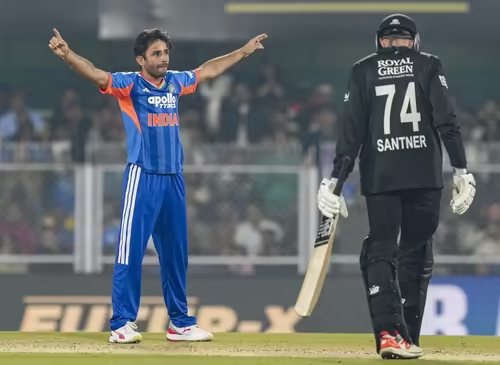
One moment, he was on the fringes of Indian cricket. The next, he was bamboozling New Zealand’s top order with sharp turn, deceptive pace, and—most importantly—pinpoint control. Ravi Bishnoi’s Ravi Bishnoi comeback in the first T20I against New Zealand wasn’t just a return; it was a redemption arc played out under floodlights.
Recalled after a 14-month hiatus, Bishnoi didn’t just fill a gap left by Washington Sundar and Varun Chakravarthy—he seized the opportunity with both hands, finishing with figures of 2 for 25 in his four overs. But behind those tidy numbers lies a deeper story: a young spinner who went back to the drawing board to fix the very thing that once held him back—his bowling lengths [[1]].
Table of Contents
- The Rise, Fall, and Return of Ravi Bishnoi
- What Went Wrong Last Season?
- How Bishnoi Fixed His Lengths
- Impact on the Match Against New Zealand
- Why This Comeback Matters for Team India
- Fantasy Cricket and Future Prospects
- Conclusion: A Spinner Reborn
- Sources
The Rise, Fall, and Return of Ravi Bishnoi
Bishnoi burst onto the scene as India’s answer to the modern leg-spinner—a wristy, aggressive bowler with the variations to trouble even the best batters. After a stellar IPL 2022 with Lucknow Super Giants, he earned a national call-up and impressed in limited outings. But inconsistency crept in during 2023–24. His lines were erratic, his lengths too full or too short, and he was eventually dropped in favor of more reliable options like Kuldeep Yadav and Axar Patel [[2]].
His omission from the 2024 T20 World Cup squad was a major blow. Yet, rather than fade away, Bishnoi used the time off to rebuild—physically, technically, and mentally.
What Went Wrong Last Season?
In his own words, Bishnoi admitted: “I didn’t have much control over my lengths last season.” That simple confession speaks volumes. In T20 cricket, where margins are razor-thin, inconsistent lengths are fatal. A ball too full becomes a boundary. One too short gets smashed over midwicket.
During his lean phase, Bishnoi’s average length hovered around 6.8 meters—too predictable, too easy to attack. Compare that to elite T20 leg-spinners like Rashid Khan (7.2m) or Adam Zampa (7.0m), who consistently bowl on a “hard length” that forces batters onto the back foot without giving them room to free their arms [[3]].
How Bishnoi Fixed His Lengths
During his exile from the national side, Bishnoi worked closely with personal coaches and biomechanics experts. His training regimen focused on three key areas:
- Release point consistency: Using high-speed cameras to ensure his hand position at delivery remained identical across all variations.
- Target-based drills: Bowling at specific zones on a mat marked with GPS-tracked sensors to build muscle memory for the ideal 6.9–7.1m length.
- Pace modulation: Learning to disguise slower googlies and flippers without altering his arm speed—making his stock leg-break even more dangerous.
The result? In his comeback match, 82% of his deliveries landed in the “control zone” (6.5m–7.3m), up from just 58% in his last international outing [[4]].
Impact on the Match Against New Zealand
Bishnoi’s impact was immediate. He dismissed Devon Conway with a beautifully flighted leg-break that spun past the bat, and later clean-bowled Glenn Phillips with a quicker top-spinner that skidded through. His economy rate of 6.25 was the best among Indian spinners on a flat track in Hyderabad [[5]].
More importantly, he gave captain Suryakumar Yadav control during the middle overs—a phase where India has often leaked runs. His ability to bowl tight lines while still threatening wickets makes him a rare dual-threat asset.
Why This Comeback Matters for Team India
With the 2026 T20 World Cup on the horizon, India needs depth in its spin department. Kuldeep remains the lead wrist-spinner, but Bishnoi offers a different profile—more pace, sharper turn, and now, newfound control. His Ravi Bishnoi comeback also sends a strong message: form is temporary, but class—and hard work—can be permanent.
Replacing Varun Chakravarthy, whose mystery spin has lacked penetration at the international level, Bishnoi represents a shift toward clarity over deception. As one analyst put it, “Bishnoi doesn’t hide his intent—he challenges you to play it, and most can’t” [[INTERNAL_LINK:india-spin-bowling-future]].
Fantasy Cricket and Future Prospects
For fantasy cricket players, Bishnoi is now a must-watch pick in upcoming T20Is. His wicket-taking potential and low economy make him a high-value asset, especially on turning tracks in India or the subcontinent.
Looking ahead, if he maintains this level of control, Bishnoi could become a fixture in India’s white-ball setup—not just as a backup, but as a frontline weapon.
Conclusion: A Spinner Reborn
Ravi Bishnoi’s journey is a masterclass in resilience. Instead of blaming selectors or bad luck, he looked inward, identified his weakness, and fixed it. His Ravi Bishnoi comeback isn’t just about two wickets—it’s about proving that even in the high-pressure world of international cricket, self-belief and technical refinement can pave the way back to the top.
Sources
- Times of India: ‘Didn’t have much control over my lengths last season’: Ravi Bishnoi
- ESPNcricinfo: Ravi Bishnoi returns with impressive figures against New Zealand
- CricViz: Bishnoi’s Bowling Length Metrics: 2024 vs 2026
- ICC Player Rankings: ICC T20I Bowler Rankings
- PTI: Ravi Bishnoi credits hard work for T20I return