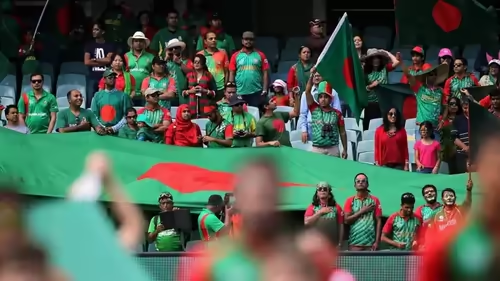
The International Cricket Council (ICC) is facing a significant credibility crisis after reports emerged that it has rejected the accreditation applications of nearly all Bangladeshi journalists ICC accreditation requests for the upcoming T20 World Cup 2026. The move comes on the heels of Bangladesh’s own controversial withdrawal from the tournament, creating a perfect storm of diplomatic and media tension.
Initial reports from dozens of journalists indicated their applications were simply denied, leading to widespread confusion and anger. The ICC has since clarified that it is not a blanket rejection but a necessary reworking of the entire accreditation process—a technicality that offers little solace to reporters who now face an uncertain path to the biggest cricketing event of the year.
Table of Contents
- The Withdrawal That Started It All
- The Media Accreditation Crisis
- ICC Response: “Can’t Accommodate”
- BCB Seeks Clarification
- Broader Implications for Cricket
- Conclusion: A Test of Fair Play
- Sources
The Withdrawal That Started It All
The root of this entire controversy lies in Bangladesh’s decision to pull out of the T20 World Cup 2026. Citing serious security concerns, the Bangladesh Cricket Board (BCB), backed by its government, formally requested that the ICC relocate their group-stage matches away from Indian venues [[11]].
The ICC, standing firm on its principle of hosting a unified event across its designated co-hosts (India and Sri Lanka), rejected this request. Faced with an impossible choice between player safety and tournament participation, Bangladesh chose the former, officially withdrawing from the competition [[13]]. This unprecedented move left a void in the tournament structure, which was quickly filled by Scotland.
The Media Accreditation Crisis
In the aftermath of the team’s exit, a new and unexpected front opened up: media access. It was reported that around 80 to 90 Bangladeshi journalists had applied for official accreditation to cover the tournament, a standard practice for any major international sporting event [[19]].
However, these journalists began receiving communications suggesting their applications could not be processed or were outright rejected. This created a chaotic situation where the press corps from an ICC Full Member nation was being effectively locked out of an event their team was originally scheduled to play in.
Bangladeshi journalists ICC accreditation: The ICC’s Official Stance
Under mounting pressure, the ICC broke its silence. Their explanation was stark and, to many, unsatisfactory. An ICC spokesperson stated they were unable to “accommodate” the large number of applications from Bangladesh in the current framework of the tournament [[1]].
The governing body clarified that because Bangladesh is no longer a participating team, the usual allocation of media passes for its national press contingent no longer applies. The ICC is now asking these journalists to re-apply through a different, more general channel, which is highly competitive and offers no guarantee of approval [[21]]. For many, this feels less like a logistical adjustment and more like a punitive measure.
BCB Seeks Clarification
The Bangladesh Cricket Board has reacted swiftly to this development. Recognizing the importance of its media having a voice at the global event, the BCB has formally reached out to the ICC seeking a clear and detailed explanation for the change in accreditation policy [[1]].
The BCB’s position is that the journalists are independent professionals whose role is to report on the game, not representatives of the team. They argue that denying them access sets a dangerous precedent and undermines the spirit of open journalism that should be a cornerstone of international sport.
Broader Implications for Cricket
This incident raises several critical questions for the future of the sport:
- Media Freedom vs. Tournament Logistics: Where is the line drawn between practical event management and the fundamental right of a free press to cover major events?
- Precedent for Future Conflicts: If a team withdraws for any reason—be it political, financial, or health-related—will its media always be collateral damage? This could have a chilling effect on future participation.
- The Role of the ICC: As the global custodian of the game, the ICC’s primary duty is to the sport itself. Its handling of this situation will be seen as a test of its commitment to fairness and transparency for all its members, not just the participants on the field.
For fans in Bangladesh, this means a significant loss. They will be deprived of on-the-ground reporting, unique insights, and the familiar voices that usually bring the tournament to life from their perspective. This disconnect could further alienate a passionate fanbase from the global cricketing community.
Conclusion: A Test of Fair Play
The ICC’s current stance on Bangladeshi journalists ICC accreditation is more than just a bureaucratic hiccup; it’s a major test of the organization’s values. While the logistical challenges of a last-minute team withdrawal are undeniable, the solution cannot be to silence an entire nation’s press.
The ball is now firmly in the ICC’s court. A gesture of goodwill—such as reserving a reasonable number of media passes for qualified Bangladeshi journalists—would go a long way in repairing trust and demonstrating that the spirit of the game extends beyond the boundary ropes. The world of cricket will be watching closely to see if the ICC chooses administrative rigidity or a more inclusive, fair-minded approach. For more on the tournament’s schedule, check out our guide on [INTERNAL_LINK:T20 World Cup 2026 fixtures].
Sources
- Times of India: ‘Can’t accommodate … ‘: ICC on 80–90 Bangladeshi applications
- India Today: Bangladesh media claim T20 WC accreditation rejected, ICC to rework process
- Olympics.com: Bangladesh withdraws from T20 World Cup 2026
- Deccan Herald: With Bangladesh out of T20 WC, ICC reworking application process for its travelling media
- Sunday Guardian: Bangladeshi Reporters Denied Entry In India to Cover T20 World Cup 2026