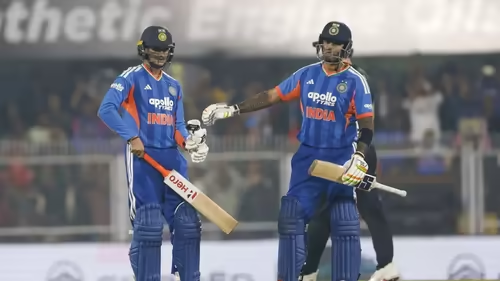
The opening overs of the India vs New Zealand T20 series have felt less like a cricket match and more like a demolition derby. At the heart of this controlled anarchy are three names that have sent shivers down the spines of even the most seasoned Kiwi bowlers: Abhishek Sharma, Suryakumar Yadav, and Ishan Kishan.
New Zealand’s bowling coach, the legendary Jacob Oram, didn’t mince words. He called it what it was: “It’s been chaos.” This isn’t just a frustrated outburst; it’s a stark admission of a new, terrifying reality in modern T20 cricket—one that India is pioneering with ruthless efficiency [[2]].
Table of Contents
- The Chaos Unfolds: A Top-Order Onslaught
- Jacob Oram’s Dilemma: Facing a New Breed of Batsman
- The Sanath Jayasuriya Comparison: A Blast from the Past?
- Breaking Down the Trio: What Makes Them So Dangerous?
- What It Means for New Zealand’s World Cup Hopes
- Conclusion: The Future is Aggressive
- Sources
The Chaos Unfolds: A Top-Order Onslaught
Gone are the days of cautious starts. In the current India vs New Zealand T20 series, the Indian openers and number three have turned the powerplay into their personal playground. Scores like Abhishek Sharma’s blistering 68 off just 20 balls and Suryakumar Yadav’s masterful 57 from 26 deliveries aren’t anomalies; they’re becoming the standard [[7]].
This isn’t just about one player having a good day. As Oram himself pointed out, “He’s (Abhishek) not the only one, Suryakumar has played well, Ishan Kishan…” [[2]]. It’s a collective, multi-pronged assault that has left New Zealand’s bowlers scrambling for answers. The sheer speed of accumulation has compressed the game, forcing the Kiwis into a constant state of damage control from the very first ball.
Jacob Oram’s Dilemma: Facing a New Breed of Batsman
For a coach of Oram’s caliber—a man who was a fearsome all-rounder in his own right—this presents a unique challenge. His task is no longer just about line and length; it’s about solving a complex, high-speed puzzle. The traditional methods of building pressure simply don’t work against batters who can clear the boundary with shots from positions previously deemed impossible.
Oram’s public acknowledgment of the “chaos” is a strategic move in itself. It sets a realistic expectation for his team while also highlighting the extraordinary level of skill he’s up against. He’s urging his players not to be overwhelmed but to embrace the challenge and learn from it, a crucial mindset for a team looking to peak at the upcoming T20 World Cup [[4]].
The Sanath Jayasuriya Comparison: A Blast from the Past?
In trying to make sense of this new-age carnage, Oram reached back into cricket history, comparing the hitting of India’s top order to the legendary Sanath Jayasuriya [[3]]. This is a fascinating parallel. Jayasuriya, along with Romesh Kaluwitharana, revolutionized ODI cricket in the 1996 World Cup by taking on the new fielding restrictions with unprecedented aggression.
However, the comparison, while apt in spirit, undersells the evolution of the game. Jayasuriya’s aggression was a shock tactic in a 50-over format. Today’s Indian trio are executing their brand of chaos as a fundamental strategy in a 20-over game where every ball is a potential six. The 360-degree shot-making, the pre-meditated sweeps and ramps, and the ability to find gaps in a full-circle field are a quantum leap beyond even Jayasuriya’s audacious style. They aren’t just aggressive; they are technically complete and creatively limitless.
Breaking Down the Trio: What Makes Them So Dangerous?
Let’s dissect the individual threats that combine to create this perfect storm:
- Abhishek Sharma: The young left-hander is a walking statement of intent. His ability to dominate the new ball, especially against pace, has given India a platform that is often insurmountable. He doesn’t just hit boundaries; he dismantles bowling plans before they can even begin.
- Suryakumar Yadav: The world’s premier T20 batter brings a calm, calculated fury to the middle order. His unorthodox yet supremely effective strokeplay, particularly through the off-side and over the keeper, is a nightmare for any captain. He can accelerate from a standstill and turn a good start into a colossal total.
- Ishan Kishan: Operating as a wicketkeeper-batter, Kishan provides the perfect bridge between the openers and the established middle order. His clean striking and ability to rotate the strike keep the scoreboard ticking, preventing any lull in the momentum. His presence adds another layer of depth to an already formidable lineup.
What It Means for New Zealand’s World Cup Hopes
This series is more than just a bilateral contest; it’s a high-stakes dress rehearsal for the T20 World Cup. For New Zealand, the “chaos” inflicted by India is a harsh but necessary lesson. It exposes a critical gap in their bowling attack when faced with the absolute pinnacle of modern batting.
Can their bowlers develop new variations, smarter fields, or a more aggressive short-ball plan to counter this? Or will they be forced to rely on their own batting firepower to outscore their opponents? The answers to these questions will define their World Cup campaign. As Oram noted, resilience is key, and they must use these defeats as a springboard for future success [[4]].
Conclusion: The Future is Aggressive
The India vs New Zealand T20 series has become a masterclass in the future of the game. The performances of Abhishek, Surya, and Ishan are not just about winning matches; they are redefining the very parameters of what’s possible in the first six overs. Jacob Oram’s candid “chaos” comment is a testament to their world-beating form. For fans of attacking cricket, it’s a golden era. For bowlers and coaches around the world, it’s a wake-up call. The bar has been set, and it’s soaring high above the stadium lights.
Sources
- Times of India: ‘It’s been chaos’: NZ bowling coach on facing Abhishek, Surya, Ishan
- Sportsyaari: ‘A bit of chaos’: New Zealand bowling coach Jacob Oram leaves stark comment on Indian batters
- Dev Discourse: New Zealand’s Resilience: From T20I Defeats to World Cup Ambitions
- ESPNcricinfo: New Zealand tour of India 2025/26 – Fixtures & Results