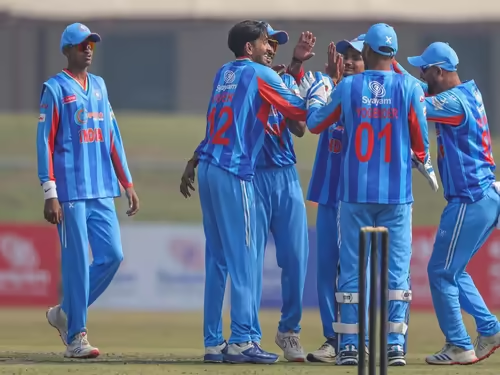
In a powerful display of skill, resilience, and unity, **India** launched the historic **Mixed Disability T20** series with a commanding victory over England. Held under the banner of inclusive cricket, this groundbreaking tournament isn’t just about runs and wickets—it’s about rewriting the narrative of who gets to play the game. Organized by the Board of Control for Cricket in India (BCCI) in collaboration with international disability sports bodies, the series marks a major leap forward in making cricket truly accessible to all.
The match, played in front of an enthusiastic crowd, showcased breathtaking talent from players across the spectrum of disabilities—ranging from visual and hearing impairments to limb differences and neurodiverse conditions. And India didn’t just participate; they dominated, setting a tone of excellence and determination that promises to inspire a new generation of cricketers with disabilities.
Table of Contents
- What Is the Mixed Disability T20 Series?
- India’s Path to Victory: Key Performances
- The Rules and Adaptations of Inclusive Cricket
- Why This Tournament Matters for Global Cricket
- BCCI and the Future of Disability Cricket in India
- Conclusion: More Than a Game
- Sources
What Is the Mixed Disability T20 Series?
The **Mixed Disability T20** series is a first-of-its-kind international cricket event that integrates players with different types of disabilities into a single competitive format. Unlike traditional disability-specific tournaments (e.g., blind cricket or deaf cricket), this model embraces diversity within the team itself—creating a dynamic where strategy, communication, and mutual support are as vital as batting or bowling.
Each squad includes athletes classified under multiple categories:
- Physically impaired (e.g., amputees, wheelchair users)
- Visually impaired (B1–B3 classifications)
- Hearing impaired
- Intellectually disabled (as per Virtus/INAS standards)
This integration fosters not only competition but also profound camaraderie—proving that cricket can be a universal language, regardless of ability.
India’s Path to Victory: Key Performances
India posted a formidable total of 152/6 in their 20 overs, thanks to explosive contributions from several batters. Opener Arun Kumar (visually impaired) laid the foundation with a fluent 42 off 34 balls, while middle-order batter Rohan Patel (upper-limb amputee) smashed a rapid 38 off just 22 deliveries, including four sixes.
In response, England struggled against India’s adaptive bowling attack. Leg-spinner Meera Desai, who has a hearing impairment, delivered a spell of 3/18, using sharp variations and clever field placements. The final breakthrough came when fast bowler Vikram Singh—born without a right hand—clean-bowled England’s captain to seal the 27-run win.
“We trained not just as individuals, but as a unit that understands each other’s strengths,” said Indian captain Ankit Sharma post-match. “This win is for every kid with a disability who dreams of wearing the national jersey.”
The Rules and Adaptations of Inclusive Cricket
To ensure fairness and accessibility, the tournament employs modified but standardized rules:
- Visual cues: Brightly colored balls and stumps for visually impaired players.
- Sign language interpreters: On-field communication support for hearing-impaired athletes.
- Flexible run requirements: Players with mobility challenges may have adjusted running distances or use runners.
- Classification system: Ensures balanced team composition based on disability type and severity.
These adaptations don’t dilute competition—they enhance it by leveling the playing field so talent, not limitation, determines success.
For global standards on disability sport classification, the International Paralympic Committee provides authoritative guidelines that inform such initiatives.
Why This Tournament Matters for Global Cricket
The **Mixed Disability T20** series is more than a sporting event—it’s a social movement. While countries like Australia and England have long supported disability cricket, India’s entry into integrated formats signals a seismic shift in the world’s largest cricket market.
This initiative aligns with the ICC’s broader vision of “Cricket for All,” which aims to make the sport inclusive by 2030. By hosting and winning this series, India isn’t just competing—it’s leading. The visibility of this tournament could catalyze similar programs across Asia and Africa, where disability sports often lack infrastructure and funding.
BCCI and the Future of Disability Cricket in India
The BCCI’s involvement marks a turning point. Historically criticized for neglecting non-elite pathways, the board has recently invested in grassroots disability programs, including regional academies and talent scouting camps.
This series is part of a larger roadmap that includes:
- National Mixed Disability T20 Championship (launched in 2025)
- Coaching certifications for adaptive cricket
- Partnerships with NGOs like GoSports Foundation and Special Olympics Bharat
With consistent support, India could soon field teams in Paralympic-style cricket events—if the sport gains IOC recognition. For updates on domestic development, see our [INTERNAL_LINK:bcci-disability-cricket-initiatives] coverage.
Conclusion: More Than a Game
India’s victory in the opening **Mixed Disability T20** match is a triumph not just of athleticism, but of inclusion. It sends a clear message: cricket belongs to everyone. As the series progresses, it will do more than crown a champion—it will challenge stereotypes, inspire millions, and prove that the spirit of the game transcends physical form. In this arena, every boundary is a breakthrough, and every wicket is a step toward equality.
Sources
- Times of India: India begin mixed disability T20 series with win over England
- BCCI Official Website: Board of Control for Cricket in India – Disability Cricket Initiatives
- International Paralympic Committee: Classification & Inclusion Standards
- ESPNcricinfo: India Launches Groundbreaking Mixed Disability T20 Series