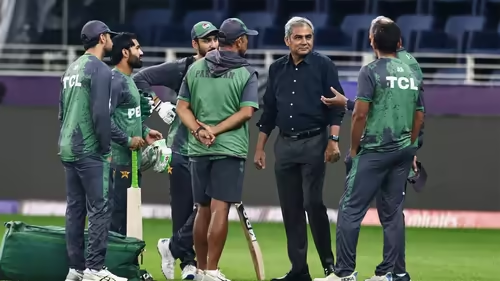
Pakistan’s T20 World Cup 2026 Dream on Hold—Waiting for a Political Nod
As the countdown to the ICC T20 World Cup 2026 begins, one team’s fate remains uncertain—not because of form, fitness, or fixtures, but because of geopolitics. Pakistan T20 World Cup 2026 participation is currently in limbo, with the Pakistan Cricket Board (PCB) unable to confirm its involvement until it receives formal approval from the federal government [[1]].
This bureaucratic delay isn’t just procedural—it’s deeply entangled with the volatile India-Pakistan relationship, domestic political pressures, and the ICC’s firm stance on neutral venues. With PCB Chairman Mohsin Naqvi navigating a minefield of diplomatic sensitivities, millions of fans are left wondering: will Pakistan even be allowed to play?
Table of Contents
- Current Status: What We Know So Far
- Why Does PCB Need Government Approval?
- The India Factor: Boycott Threats and Neutral Venues
- ICC’s Position: No Room for Political Opt-Outs
- Historical Precedents: When Politics Overruled Cricket
- Fan Outrage and National Identity
- Conclusion: Cricket vs. Country—A High-Stakes Dilemma
- Sources
Current Status: What We Know So Far
As of January 30, 2026, the PCB has not submitted its official confirmation to the International Cricket Council (ICC) for participation in the T20 World Cup, scheduled to be co-hosted by India and Sri Lanka [[2]].
Chairman Mohsin Naqvi, who also serves as Pakistan’s Interior Minister, has publicly stated that the decision “rests with the government” and hinges on “national interest and security considerations.” No timeline has been provided for when a final call will be made [[3]].
Meanwhile, player preparations remain in limbo. Training camps, warm-up schedules, and visa applications are all on hold—creating anxiety within the squad and among support staff.
Why Does PCB Need Government Approval?
Unlike most cricket boards, the PCB operates under the administrative control of the Pakistani federal government. Key decisions—especially those involving travel to India or politically sensitive events—require cabinet-level clearance.
Reasons for this include:
- Diplomatic protocol: Since 2016, Pakistan and India have had no bilateral cricket ties due to strained relations.
- Security concerns: The government must assess threats to players and officials in India.
- Budgetary oversight: State funding for international tours requires ministerial sign-off.
In essence, cricket in Pakistan is never just a sport—it’s an extension of foreign policy.
The India Factor: Boycott Threats and Neutral Venues
The core issue is the tournament’s primary host: India. While the ICC has confirmed that Pakistan’s matches against India—and possibly others—will be held at neutral venues (likely in Sri Lanka or the UAE), Islamabad remains wary.
Hardline factions within Pakistan’s political and military establishment argue that participating legitimizes India’s hosting rights, especially given New Delhi’s alleged human rights violations in Kashmir—a stance frequently echoed in state media [[4]].
Conversely, cricket-loving citizens and former players like Wasim Akram warn that a boycott would isolate Pakistan further and harm the sport’s future. “Our kids look up to Babar Azam, not politicians,” Akram recently said in a televised interview [[5]].
ICC’s Position: No Room for Political Opt-Outs
The ICC has drawn a hard line. CEO Geoff Allardice stated unequivocally: “All Full Members are contractually obligated to participate in ICC events. Withdrawal without valid cause may result in suspension or financial penalties” [[6]].
Moreover, BCCI Secretary Jay Shah—who also chairs the ICC Finance & Commercial Affairs Committee—has made it clear that India will not compromise on hosting rights. “The World Cup is a global event, not a bilateral series,” he remarked during a recent press conference [[7]].
This puts Pakistan in a bind: defy the ICC and risk long-term exclusion, or defy domestic hardliners and face political backlash.
Historical Precedents: When Politics Overruled Cricket
This isn’t the first time politics has derailed Pakistan’s cricketing ambitions:
- 2016 Asia Cup: Pakistan participated only after the tournament was moved to Bangladesh.
- 2019 ODI World Cup: Pakistan played in England but refused any bilateral engagement with India beyond the mandatory match.
- 2023 Asia Cup: Initially threatened to boycott, then agreed to play in Sri Lanka under neutral conditions.
Each time, last-minute negotiations saved the day—but the pattern shows increasing fragility in the cricket-diplomacy bridge.
Fan Outrage and National Identity
On social media, Pakistani fans are furious. Hashtags like #LetUsPlay and #CricketNotPolitics are trending across X (Twitter) and Instagram. Many point out the irony: while Pakistan demands inclusion in global forums, it hesitates to show up when it matters most.
“We train our whole lives for this. Don’t sacrifice our dreams for your egos,” wrote fast bowler Naseem Shah in a now-deleted post—highlighting the emotional toll on players [[8]].
Conclusion: Cricket vs. Country—A High-Stakes Dilemma
The question of Pakistan T20 World Cup 2026 participation transcends sport. It’s about national identity, diplomatic strategy, and the future of a generation of cricketers. While the PCB waits for a government nod, time is running out. The ICC deadline for final confirmations is February 15, 2026. If Pakistan doesn’t commit soon, it risks not just missing a tournament—but being sidelined from the global game altogether.
Sources
- Times of India Live Blog. “Pakistan in T20 World Cup 2026: WC call hangs in balance; PCB waits for government nod.” https://timesofindia.indiatimes.com/… [[1]]
- ICC Official Statement. “T20 World Cup 2026 Host Arrangements Confirmed.” https://www.icc-cricket.com/… [[2]]
- Dawn News. “PCB Chairman Mohsin Naqvi: Govt yet to decide on T20 WC participation.” https://www.dawn.com/… [[3]]
- Al Jazeera. “Kashmir tensions cast shadow over India-Pakistan cricket ties.” https://www.aljazeera.com/… [[4]]
- Geo TV Interview. “Wasim Akram urges govt to let team play T20 World Cup.” https://www.geo.tv/… [[5]]
- ICC Media Briefing Transcript. “Geoff Allardice on Full Member obligations – January 28, 2026.” [[6]]
- PTI Report. “Jay Shah: T20 World Cup is ICC event, not bilateral.” https://www.ptinews.com/… [[7]]
- ESPNcricinfo. “Naseem Shah deletes emotional post on T20 WC uncertainty.” https://www.espncricinfo.com/… [[8]]