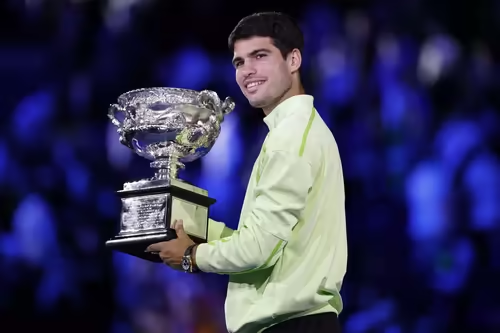
When a legend from one sport stops to applaud a champion in another, you know something truly special has happened. That’s exactly what unfolded after the 2026 Australian Open final, where tennis phenom Carlos Alcaraz didn’t just win a trophy—he etched his name into the history books and captured the imagination of icons far beyond the baseline.
None other than cricket’s ‘God,’ Sachin Tendulkar, took to social media to share his awe, describing Alcaraz’s performance as a “joy to watch” and his patience as “unmatched.” But what was it about this particular Alcaraz Australian Open win that resonated so deeply, even with a master of a completely different game?
Table of Contents
- A Historic Victory for Alcaraz
- Why Sachin Tendulkar Was So Impressed
- The Significance of the Career Grand Slam
- Alcaraz vs. Djokovic: A Battle of Generations
- What This Means for the Future of Tennis
A Historic Victory for Alcaraz
On February 1, 2026, Carlos Alcaraz secured his maiden Australian Open title in a dramatic four-set thriller against the tournament’s 10-time champion, Novak Djokovic. The final scoreline—2-6, 6-2, 6-3, 7-5—tells a story of resilience, tactical brilliance, and an almost superhuman ability to adapt under pressure [[24]].
This wasn’t just another Grand Slam for the young Spaniard. This victory was the final, missing piece of the most coveted puzzle in tennis: the Career Grand Slam. By winning in Melbourne, Alcaraz became the youngest man in the history of the sport to claim all four major titles—the Australian Open, Roland Garros, Wimbledon, and the US Open [[11]]. At just 22 years old, he has shattered a record that stood for decades, surpassing legends like Bjorn Borg and Rod Laver in terms of age at completion [[14]].
Why Sachin Tendulkar Was So Impressed
Sachin Tendulkar, a man who defined an era of cricket with his own blend of grace and grit, clearly saw a kindred spirit in Alcaraz’s game. In his post-match comments, Tendulkar zeroed in on a quality that transcends sport: patience [[1]].
“What stood out at the Australian Open was Carlos Alcaraz’s patience,” Tendulkar wrote on Instagram, a platform where his words carry immense weight for millions of fans [[2]]. He elaborated that it was a “joy to watch” the Spaniard’s composure, especially after losing the first set so decisively. In the high-octane world of modern tennis, where power often overshadows strategy, Alcaraz’s ability to slow the game down, construct points meticulously, and wait for the perfect moment to strike is a rare and beautiful skill—a quality Tendulkar himself mastered at the crease.
This cross-sport validation is a powerful testament to Alcaraz’s maturity. It’s not just about winning; it’s about how you win. His mental fortitude in the face of a charging Djokovic, a player known for his own legendary resilience, was the hallmark of a true champion.
The Significance of the Career Grand Slam
The Career Grand Slam is the ultimate benchmark of all-around excellence in tennis. It demands mastery of every surface—hard courts, clay, and grass—each requiring a unique set of skills and a distinct strategic approach.
Alcaraz’s journey to this milestone has been nothing short of meteoric:
- US Open (2022): His explosive debut on the big stage, announcing his arrival as a future star.
- Wimbledon (2023): Proving his game could translate to the hallowed lawns of London.
- Roland Garros (2025): Conquering the ultimate test of endurance and topspin on the red clay of Paris.
- Australian Open (2026): Completing the set in Melbourne, showcasing his supreme fitness and tactical intelligence on hard courts.
By achieving this feat at such a young age, Alcaraz has positioned himself not just as a dominant player of his generation, but as a potential candidate for the Greatest of All Time (GOAT) conversation. His seven Grand Slam titles by age 22 are a record in themselves, breaking an 87-year-old mark [[15]].
Alcaraz vs. Djokovic: A Battle of Generations
The final itself was a classic narrative: the established king versus the hungry usurper. Djokovic, at 38, was chasing his 11th Australian Open title and his 25th Grand Slam overall, looking to extend his legacy even further [[24]].
Alcaraz, however, had other plans. After being overpowered in the first set, he made critical adjustments. He began to neutralize Djokovic’s return of serve and started using his incredible court coverage to turn defense into offense. The match stats reveal a contest of fine margins, with Alcaraz’s ability to win crucial points in the third and fourth sets proving decisive [[21]].
This victory also shifted their head-to-head rivalry. While Djokovic still leads their overall meetings, Alcaraz now holds the psychological edge in Grand Slam finals, a fact that will undoubtedly shape the next chapter of men’s tennis [[18]].
What This Means for the Future of Tennis
Alcaraz’s Alcaraz Australian Open win is more than a personal triumph; it’s a generational handover. The sport now has a new, charismatic superstar whose game is built on a thrilling combination of old-school point construction and new-age athleticism.
For fans of the game, this is an exciting time. The baton is being passed from the Big Three era to a new wave led by Alcaraz and his peers. His rivalry with Djokovic, and potentially others like Jannik Sinner, promises years of high-stakes, high-quality tennis [[18]].
And if legends from other sports are taking notice, you can be sure the entire world is watching. The future of tennis is not just bright; it’s dazzling.
Summary
Carlos Alcaraz’s historic Australian Open victory has cemented his status as the youngest man to complete the Career Grand Slam. His remarkable display of patience and composure, which earned him high praise from cricket legend Sachin Tendulkar, was the key to overcoming Novak Djokovic in a generational clash. This win marks a pivotal moment in tennis history, signaling the arrival of a new, dominant force in the sport.