Table of Contents
- The Bombshell Announcement
- Pakistan Refuses to Play India: The Official Timeline
- What Does This Mean for the T20 World Cup 2026?
- A History of Rivalry and Politics
- The Road Ahead: ICC and Future Implications
- Conclusion
- Sources
The Bombshell Announcement
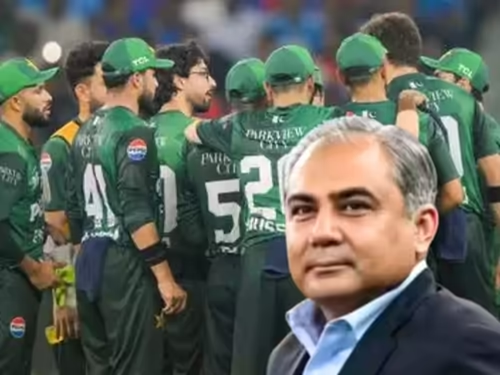
The world of cricket was rocked on Sunday, February 1st, 2026, when the Government of Pakistan made an unprecedented declaration. In a stark political intervention into the sport, they announced that while the Pakistani cricket team would participate in the ICC Men’s T20 World Cup 2026, they would not take the field against their arch-rivals, India. This decision, communicated through an official statement on the government’s social media channels, has sent shockwaves through the global cricketing community just days before the tournament kicks off [[1]].
The specific match in question is the highly anticipated Group A fixture scheduled for February 15th, 2026, at the R. Premadasa Stadium in Colombo, Sri Lanka [[10]]. This isn’t just another game; it’s the most-watched and emotionally charged contest in the sport, a fixture that transcends cricket and captures the attention of billions.
Pakistan Refuses to Play India: The Official Timeline
The sequence of events leading to this dramatic standoff unfolded rapidly over the weekend. Here’s a clear breakdown of the key moments:
- February 1, 2026 (Sunday): The Government of Pakistan issues an official statement declaring, “The Pakistan cricket team shall not take the field in the match scheduled on 15th February 2026 against India” [[1]]. The statement confirmed the team would still travel to Sri Lanka to play its other group matches.
- February 1, 2026 (Later that day): News outlets across the globe, including Al Jazeera, ESPN, and the BBC, report the announcement, confirming the boycott of the specific India match [[1], [2], [4]].
- February 2, 2026 (Monday): The International Cricket Council (ICC) breaks its silence, issuing a formal warning to the Pakistan Cricket Board (PCB). The ICC cautioned that refusing to play the match would have serious consequences, including potential forfeiture of the game, financial penalties, and long-term implications for cricket in Pakistan itself [[7], [9]].
What Does This Mean for the T20 World Cup 2026?
The immediate fallout is a logistical and competitive nightmare for the ICC. According to the official tournament schedule, the India-Pakistan clash is a crucial Group A encounter [[10]]. If Pakistan refuses to play, the ICC’s playing conditions are clear: India will be awarded a walkover, receiving two points for a win, while Pakistan will receive none. This could significantly alter the group standings and the path to the semi-finals for both teams.
For fans, especially those who had booked tickets and travel for the Colombo fixture, this is a devastating blow. The match was expected to be one of the pinnacles of the entire tournament, a spectacle of skill, passion, and intense rivalry. Its cancellation, even if only a forfeit, robs the event of its biggest draw.
The ICC’s Stance
The ICC has been firm in its position. Their statement emphasized that all participating nations agreed to the terms and conditions of the tournament, which include playing all scheduled fixtures. The governing body has warned the PCB that failure to comply will result in “serious sporting and financial sanctions” [[9]]. This puts the PCB in an impossible position, caught between its government’s directive and the rules of the international body that governs the sport.
A History of Rivalry and Politics
This is not the first time politics has cast a shadow over the India-Pakistan cricket rivalry, but it is arguably the most direct government intervention in a World Cup setting. Historically, bilateral series between the two nations have been suspended for long periods due to geopolitical tensions. However, they have always met in ICC tournaments, where the matches are seen as neutral ground.
Their World Cup record is heavily skewed in India’s favor. In 16 previous encounters across ODI and T20 World Cups, India has won 15 times, with one match tied [[21]]. From the iconic 2007 T20 final to the tense 2011 ODI World Cup semi-final, these matches have produced some of cricket’s most unforgettable moments. The refusal to play in 2026 breaks a long-standing, albeit fragile, tradition of keeping this sporting contest alive even during times of political strain.
The Road Ahead: ICC and Future Implications
As of today, Monday, February 2nd, 2026, the situation remains fluid but grim. The ICC has drawn a line in the sand, and the Pakistani government has shown no signs of backing down. The next two weeks will be critical.
The potential consequences extend far beyond this single match. If Pakistan is sanctioned, it could affect their future participation in ICC events and their standing within the global cricketing community. For the sport itself, this incident raises uncomfortable questions about the vulnerability of international cricket to political forces. It also highlights the immense power the India-Pakistan fixture holds, a power that can now be wielded as a political tool.
While Pakistan will continue its campaign in the tournament, playing other teams like Bangladesh and Australia, the absence of the India match will leave a gaping hole in the narrative of the T20 World Cup 2026. Fans can only hope for a last-minute diplomatic resolution, but the current trajectory points towards a historic and deeply disappointing forfeit.
Conclusion
The decision by the Pakistani government for its team to refuse to play India is a watershed moment for cricket. It prioritizes political posturing over sporting integrity and fan expectations. While the team will compete in the T20 World Cup 2026, the missing chapter of their clash with India will be a constant reminder of the complex and often damaging intersection of sports and state politics. The ICC now faces its biggest challenge in ensuring the tournament’s credibility is maintained in the face of this unprecedented boycott.
Sources
- Al Jazeera. “Pakistan to boycott T20 World Cup match against India on February 15.” https://www.aljazeera.com/sports/2026/2/1/pakistan-to-boycott-t20-world-cup-match-against-india-on-february-15
- ESPN. “Pakistan to boycott T20 World Cup group match against India.” https://www.espn.com/cricket/story/_/id/47796975/pakistan-boycott-t20-world-cup-match-india
- BBC Sport. “Pakistan to play at T20 World Cup – but refuse to face India.” https://www.bbc.com/sport/cricket/articles/c1klx44kjr2o
- NDTV Sports. “ICC Breaks Silence On Pakistan Boycotting T20 World Cup 2026 Game Against India.” https://sports.ndtv.com/t20-world-cup-2026/icc-breaks-silence-on-pakistan-boycotting-t20-world-cup-2026-game-against-india-10928003
- ESPNCricinfo. “ICC warns PCB of consequences of boycotting India match at T20 World Cup.” https://www.espncricinfo.com/story/icc-warns-pcb-of-consequences-of-boycotting-india-match-at-t20-world-cup-1521957
- ICC. “India vs. Pakistan – Match 27.” https://www.icc-cricket.com/tournaments/mens-t20-world-cup-2026/matches/268086/india-vs-pakistan
- Wikipedia. “India–Pakistan cricket rivalry.” https://en.wikipedia.org/wiki/India%E2%80%93Pakistan_cricket_rivalry