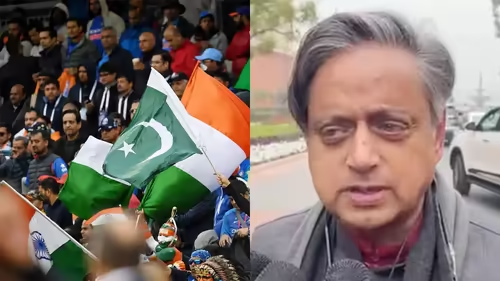
In a world where sport is meant to be the ultimate unifier, a powerful voice from the heart of Indian politics has slammed a move that threatens to shatter that very ideal. Congress MP and renowned intellectual Shashi Tharoor has erupted in criticism over Pakistan’s boycott of India T20 World Cup match, calling the decision nothing short of “disgraceful” and a prime example of the dangerous politicization of cricket.
With the highly anticipated ICC Men’s T20 World Cup 2026 scheduled to kick off soon, the news that Pakistan would not participate in its group-stage fixture against India on February 15th in Colombo has sent shockwaves through the global cricketing community [[8]]. Tharoor’s reaction cuts to the core of a growing crisis: can cricket survive as a pure sport when geopolitical tensions dictate its fate?
Table of Contents
- Tharoor’s Scathing Takedown of the Boycott
- The ICC T20 World Cup 2026: India vs Pakistan Situation
- Beyond Pakistan: Tharoor’s View on the Mustafizur Rahman Row
- Why the Politicization of Cricket is a Deepening Crisis
- Conclusion: A Call for Dialogue and Sporting Spirit
- Sources
Tharoor’s Scathing Takedown of the Boycott
Tharoor didn’t mince his words. In a series of public statements, he described Pakistan’s refusal to play India as “nonsense” and “pretty disgraceful” [[2]]. His central argument is a plea for sanity: sport should transcend political divides, not become their battleground.
“Cricket is being politicised, and this is spiralling out of control,” Tharoor warned, urging for “urgent dialogue” to resolve the escalating row [[4]]. He believes that by boycotting the match, Pakistan isn’t just forfeiting two crucial points in the tournament; it’s forfeiting an opportunity for peaceful engagement and goodwill that only a shared passion for cricket can foster. This stance aligns with his long-held belief in cricket diplomacy as a tool for building bridges between estranged nations.
The ICC T20 World Cup 2026: India vs Pakistan Situation
The official ICC schedule clearly lists the India vs. Pakistan match for February 15, 2026, at the R. Premadasa Stadium in Colombo [[8]]. However, Pakistan’s government has reportedly instructed its cricket board not to send the team for this fixture, citing political reasons. This leaves the International Cricket Council (ICC) in a difficult position, as a boycott would likely result in Pakistan forfeiting the match and receiving zero points—a significant blow to their campaign in a tough group.
This isn’t the first time political tensions have threatened the iconic rivalry, but a full-fledged boycott at a World Cup is a new and alarming low. Fans across the globe are left wondering if they will be robbed of what is often the most-watched cricket match on the planet.
Beyond Pakistan: Tharoor’s View on the Mustafizur Rahman Row
Tharoor’s concerns about the politicization of cricket extend beyond the India-Pakistan rift. He also commented on the separate but equally tense situation with Bangladesh, sparked by the Kolkata Knight Riders’ (KKR) decision to release star pacer Mustafizur Rahman from their IPL 2026 squad following domestic political pressure in India [[23]].
In response, the Bangladesh government took a hard stance, banning the broadcast of the IPL and threatening to withdraw its national team from the T20 World Cup in India [[20]]. Tharoor deemed Bangladesh’s reaction an “overreaction,” suggesting that while the initial decision to drop Mustafizur was regrettable, the subsequent escalation was disproportionate and harmful to the spirit of the game [[6]].
Why the Politicization of Cricket is a Deepening Crisis
The current crises with both Pakistan and Bangladesh highlight a dangerous trend. Here’s why this is so damaging:
- Erosion of Sporting Spirit: The core principle of fair play and competition is replaced by political agendas.
- Loss for Fans: Millions of fans are denied the spectacle of high-stakes matches they have waited years to see.
- Damage to the Game’s Integrity: When boards and governments dictate fixtures, the ICC’s authority and the sport’s global structure are undermined.
- End of an Era: Iconic rivalries like India vs Pakistan could become relics of the past, played only in neutral venues or not at all.
As noted by experts at the BBC Sport, the increasing entanglement of cricket with nationalistic fervor poses an existential threat to its future as a global, unifying sport.
Conclusion: A Call for Dialogue and Sporting Spirit
Shashi Tharoor’s passionate outburst is more than just political commentary; it’s a desperate plea from a lifelong cricket fan. His labeling of the Pakistan boycott India T20 World Cup decision as “disgraceful” is a stark reminder of what we stand to lose. The situations with both Pakistan and Bangladesh are complex, but the solution, as Tharoor suggests, must begin with dialogue. Cricket’s greatest power has always been its ability to bring people together, even when their leaders cannot. It’s a power we cannot afford to let slip away.
Sources
- Times of India: ‘Nonsense … disgraceful’: Tharoor explodes as Pakistan boycotts India
- The Economic Times: ‘Pretty disgraceful’: Shashi Tharoor after Pakistan boycott T20 WC match against India
- ICC Official Website: India vs. Pakistan – ICC Men’s T20 World Cup 2026
- ESPN Cricinfo: Bangladesh bans IPL broadcast over Mustafizur row