Table of Contents
- The Controversial Decision: What Happened?
- Kaneria’s Scathing Critique: “It Projects Fear”
- Why the Pakistan India Boycott Backfires on Pakistan
- The ICC and the Complicated Path to Knockouts
- Conclusion: A Costly Political Statement
- Sources
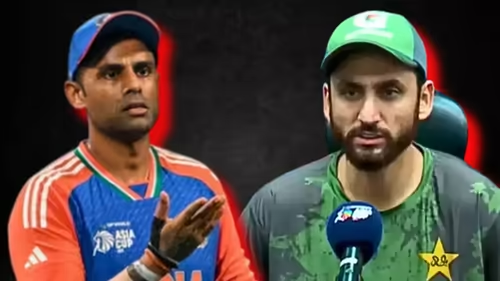
The cricketing world is reeling from a seismic political decision that threatens to overshadow the upcoming ICC Men’s T20 World Cup 2026. The Pakistan India boycott of their scheduled group-stage clash has not only created a logistical headache for the ICC but has also ignited a fierce debate within Pakistan’s own cricketing fraternity. At the heart of this storm is a blistering critique from former star spinner Danish Kaneria, who believes this move is nothing short of a self-inflicted wound for Pakistan cricket.
The Controversial Decision: What Happened?
In a move that has become an unfortunate pattern in recent years, the Pakistan government has directed its national cricket team to boycott its league match against India in the 2026 T20 World Cup [[16]]. This decision stems from the long-standing geopolitical tensions between the two nations, which have effectively halted all bilateral cricket series for over a decade. While the tournament is co-hosted by India and Sri Lanka, the specific match in question was slated to be played in Colombo, Sri Lanka, on February 15, 2026 [[7]]. Despite the neutral venue, Pakistan has chosen to stick to its policy of not playing against India in any tournament where India is a host nation, even if the match itself isn’t on Indian soil [[9]].
Kaneria’s Scathing Critique: “It Projects Fear”
Former Pakistan leg-spinner Danish Kaneria, known for his candid opinions, has been one of the most vocal critics of this decision. He argues that the Pakistan India boycott sends a terrible message to the world and, more importantly, to the players themselves. “People will feel they are scared of facing India,” Kaneria stated bluntly [[3]]. He believes that such a move, driven by emotion and politics rather than sporting spirit, is deeply harmful to the future of cricket in Pakistan.
Kaneria’s primary concern is the psychological impact on the team. By refusing to play, he contends, Pakistan is projecting an image of weakness and fear, which can be demoralizing for a young squad looking to make its mark on the global stage. This sentiment is echoed across various reports, highlighting his view that the boycott “harms Pakistan cricket” at its core [[1]].
Why the Pakistan India Boycott Backfires on Pakistan
Kaneria’s criticism goes beyond just optics; he points to the tangible, negative consequences of this decision for Pakistan’s campaign in the T20 World Cup 2026. Here’s why the boycott is a strategic blunder:
- Complicated Path to Knockouts: By forfeiting the match against India, Pakistan automatically hands over two crucial points to their arch-rivals. In a tightly contested group, these points could be the difference between qualifying for the Super 8s and an early exit. As Kaneria noted, this move “complicates their path to the knockouts” significantly [[5]].
- Loss of Competitive Edge: A high-pressure match against India is the ultimate test for any cricketer. Avoiding it means the Pakistani team misses out on a vital opportunity to gauge its performance against top-tier opposition in a World Cup setting. This lack of a benchmark can be detrimental in later, must-win games.
- Damage to Global Standing: The International Cricket Council (ICC) has already expressed its disappointment and concern over Pakistan’s decision [[10]]. Such actions can strain the relationship between the PCB and the ICC, potentially affecting Pakistan’s standing in future hosting rights or tournament allocations. It paints the nation as a team that places politics above the sport.
The ICC and the Complicated Path to Knockouts
The ICC has confirmed that the T20 World Cup 2026 schedule will remain unchanged despite Pakistan’s withdrawal from the India fixture [[17]]. This means Pakistan will still play all its other group matches, which are scheduled to be held in Sri Lanka [[15]]. However, the forfeit creates a unique and challenging scenario for them.
In Group A, alongside India and Pakistan, are other strong contenders. With a loss on their record before a ball is even bowled, Pakistan will need to win all their remaining matches convincingly to secure a top-two spot. Any slip-up could see them eliminated, making their journey far more precarious than it needed to be. This situation is a direct result of the Pakistan India boycott, a fact that Kaneria and many other former players find illogical and counterproductive [[2]].
For fans looking to understand the full context of this rivalry, our deep dive into the history of the Pakistan-India cricket rivalry provides essential background.
Conclusion: A Costly Political Statement
Danish Kaneria’s passionate plea highlights a growing internal conflict within Pakistan cricket: the struggle between political directives and sporting ambition. While the government’s stance on India is a matter of foreign policy, its application to sports has real and damaging consequences for the athletes and the game’s development in the country. The Pakistan India boycott in the T20 World Cup 2026 is not just a missed match; it’s a missed opportunity for growth, a blow to team morale, and a strategic error that could cost them a place in the latter stages of the tournament. As the cricketing community watches, the hope remains that future decisions will prioritize the spirit of the game over political posturing.
Sources
- News18. “Former Pakistani Hindu Cricketer On T20 World Cup Boycott.” Accessed February 2, 2026. [[1]]
- Times of India. “If Pakistan meet India in final, will they hand over the trophy?” Accessed February 2, 2026. [[5]]
- Al Jazeera. “Pakistan to boycott T20 World Cup match against India on February 15.” Accessed February 2, 2026. [[7]]
- The Independent. “ICC responds to Pakistan pulling out of T20 World Cup match against India.” Accessed February 2, 2026. [[9]]
- SocialNews.XYZ. “‘People will feel they are scared of facing India’, says Kaneria…” Accessed February 2, 2026. [[4]]
- NDTV Sports. “Pakistan’s India Boycott In T20 World Cup Live Updates.” Accessed February 2, 2026. [[8]]
- ICC Official Website. “Matches | ICC Men’s T20 World Cup, 2026.” Accessed February 2, 2026. [[18]]