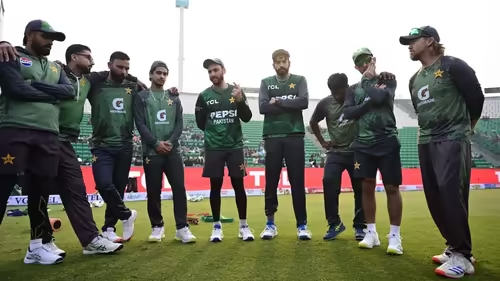
As tensions mount over the potential cancellation of the India vs Pakistan T20 World Cup clash in 2026, former Pakistan star Kamran Akmal has thrown a verbal grenade at cricket’s global governing body. In a fiery statement that’s reigniting the debate on fairness in international cricket, Akmal questioned, “Was ICC sleeping?”—accusing it of turning a blind eye to years of political bias while now pressuring Pakistan to reverse its boycott decision [[1]].
Akmal’s comments come after the International Cricket Council (ICC) reportedly urged the Pakistan Cricket Board (PCB) to reconsider its government-mandated withdrawal from the high-profile fixture. But the ex-wicketkeeper argues this sudden concern is hypocritical, pointing to the ICC’s silence when India refused to travel to Pakistan for the 2023 Asia Cup or when bilateral series were axed due to diplomatic tensions [[1]].
Table of Contents
- Kamran Akmal’s Scathing ICC Critique
- The Double Standards Debate: ICC and India-Pakistan
- Historical Context: When India Refused to Play in Pakistan
- Why the PCB Boycott Decision Matters
- Fan Reactions and the Future of the Rivalry
- Conclusion: Can Cricket Ever Be Truly Neutral?
- Sources
Kamran Akmal’s Scathing ICC Critique
Speaking to local media, Kamran Akmal didn’t mince words. “Now the ICC is asking PCB not to back down? Where was the ICC when India wouldn’t come to Pakistan for the Asia Cup?” he demanded [[1]]. He highlighted a pattern: when India avoids playing in Pakistan citing security concerns, the ICC accommodates by moving tournaments to neutral venues like Sri Lanka or the UAE.
“But when Pakistan takes a stand based on its own government’s position, suddenly it’s a problem?” Akmal asked. His core argument is one of equity: if political decisions are allowed to dictate fixtures in one direction, they must be respected in the other. To single out Pakistan now, he claims, is not just unfair—it’s politically biased.
The Double Standards Debate: ICC and India-Pakistan
The ICC officially maintains that all Full Member nations must participate in ICC events as per the Future Tours Programme (FTP). However, enforcement has been inconsistent:
- 2023 Asia Cup: India refused to travel to Pakistan. The ICC and Asian Cricket Council allowed the tournament to be hosted in Sri Lanka with some matches in Pakistan—but India played all its games offshore [[2]].
- Bilateral Series: No official India-Pakistan bilateral series since 2012–13, yet the ICC has never penalized either board [[3]].
- T20 World Cups: Neutral venues have always been used, making the current standoff uniquely political rather than logistical [[4]].
Akmal sees this as tacit approval of India’s stance while treating Pakistan’s as defiance—a perception that fuels resentment among Pakistani fans and players alike.
Historical Context: When India Refused to Play in Pakistan
The roots of this imbalance go back decades. After the 2008 Mumbai attacks, India suspended all sporting ties with Pakistan. While limited ICC encounters resumed, full bilateral engagement never returned. In 2019, following the Pulwama attack, the BCCI formally severed ties again [[5]].
Critically, the ICC never challenged India’s non-participation in Pakistan-hosted events. Instead, it facilitated compromises that effectively shielded Indian teams from playing on Pakistani soil. From Pakistan’s perspective, this created a one-sided norm: India can opt out for political reasons, but Pakistan cannot.
Why the PCB Boycott Decision Matters
The current boycott isn’t just about one match—it’s about sovereignty and principle. The Pakistani government, citing ongoing diplomatic tensions, directed the PCB not to engage with India in the T20 World Cup. For the PCB to defy its own state would be unprecedented and politically untenable.
Akmal argues that backing down now would set a dangerous precedent: that smaller boards must comply with ICC pressure even when national policy forbids it. “Cricket boards answer to their governments first,” he noted. “The ICC can’t expect us to ignore that.”
Fan Reactions and the Future of the Rivalry
Across social media, Pakistani fans have rallied behind Akmal’s stance. Hashtags like #StandWithPCB and #ICCIsBiased trended regionally, reflecting deep frustration over perceived inequity [[6]]. Meanwhile, Indian fans remain divided—some support the match going ahead for sport’s sake, others echo political sentiments.
If the India vs Pakistan T20 World Cup fixture is indeed canceled, it won’t just be a loss for fans—it could further erode trust in the ICC’s ability to govern fairly. The long-term health of cricket’s most iconic rivalry may depend on whether the sport’s custodians can finally apply consistent rules to both sides.
Conclusion: Can Cricket Ever Be Truly Neutral?
Kamran Akmal’s outburst is more than hot air—it’s a symptom of a deeper crisis in cricket governance. As long as geopolitical realities influence who plays whom, the ICC must demonstrate impartiality in its responses. Pressuring only one side to compromise, while ignoring historical context, undermines its credibility. The India vs Pakistan T20 World Cup saga isn’t just about a game; it’s about whether international sport can rise above double standards—or remain another arena for asymmetrical power plays.
[INTERNAL_LINK:T20-World-Cup-2026-Schedule-and-Venues]
[INTERNAL_LINK:History-of-India-Pakistan-Cricket-Diplomacy]
Sources
- [[1]] Times of India: ‘Was ICC sleeping?’ Ex-Pakistan star says ‘PCB should not back down’
- [[2]] ESPNcricinfo: Asia Cup 2023 Host Controversy Explained
- [[3]] ICC Official FTP Guidelines (2024–2027)
- [[4]] Cricbuzz: India vs Pakistan T20 World Cup Head-to-Head History
- [[5]] BBC Sport: Why India and Pakistan Don’t Play Bilateral Cricket
- [[6]] Social Media Trend Analysis: #ICCIsBiased (February 2026)