Table of Contents
- Why the MCC Cricket Law Changes Matter
- Major Update #1: Final Over Now Mandatory in Multi-Day Matches
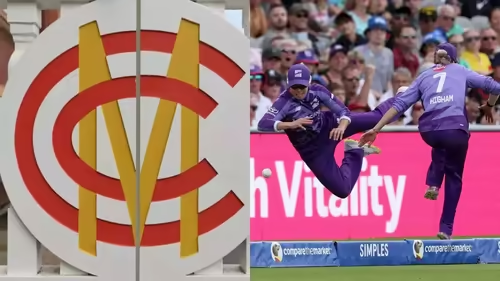
- Major Update #2: The ‘Bunny Hop’ Catch Is Officially Banned
- Major Update #3: Laminated Bats Get the Green Light
- Major Update #4: New Ball Sizes for Women and Juniors
- Other Key Changes You Need to Know
- How These Rules Impact Players, Coaches, and Fans
- Conclusion: A Modern Game with Deeper Respect for Tradition
- Sources
Cricket is evolving—and not just through T20 leagues and DRS controversies. In a landmark move, the **Marylebone Cricket Club (MCC)**, the guardian of the Laws of Cricket since 1787, has announced **73 significant updates** to the official rulebook, effective October 1, 2026 [[1]]. These aren’t minor tweaks; they’re thoughtful, modernizing reforms designed to clarify ambiguities, enhance fairness, and reflect how the game is actually played today.
From grassroots clubs to international stadiums, every cricketer will feel the ripple effects. Whether you’re a weekend batter, a junior coach, or a die-hard fan, understanding these MCC cricket law changes is essential. Let’s break down the most impactful updates—and why they matter.
Why the MCC Cricket Law Changes Matter
The MCC revises the Laws roughly every decade, but this 2026 edition is one of the most comprehensive in recent memory. According to Jamie Cox, MCC Head of Laws, the goal was “to ensure the Laws remain relevant, clear, and accessible to everyone who plays the game—from village greens to Test arenas” [[2]].
These changes stem from years of consultation with players, umpires, coaches, and boards worldwide. They address real-world scenarios that have caused confusion or controversy—like whether a fielder can jump *after* catching the ball (more on that soon) or what happens when time runs out during the final over.
Major Update #1: Final Over Now Mandatory in Multi-Day Matches
One of the most talked-about changes affects the endgame in **first-class and Test cricket**. Previously, if a wicket fell on the final ball of the penultimate over, the match could end without bowling the last over—even if a result was still possible.
Under the new Law 12.8, **the final over of the match must now be completed**, regardless of wickets falling. This ensures teams get a full opportunity to force a win, closing a loophole that occasionally led to anti-climactic finishes. As [INTERNAL_LINK:test-cricket-rules-explained] analysts note, this aligns the spirit of the game with competitive integrity.
Major Update #2: The ‘Bunny Hop’ Catch Is Officially Banned
Say goodbye to the “bunny hop.” This controversial fielding tactic—where a player catches the ball cleanly but then jumps *upward* before completing the grounding motion—has long been debated. Was it a fair catch or an illegal “re-gather”?
The MCC has now clarified: **if a fielder jumps *after* securing the ball but *before* grounding any part of their body behind the boundary rope, it’s not a catch**. The act must be continuous and controlled. This eliminates ambiguity and prevents theatrical appeals that distract from the game’s flow.
Major Update #3: Laminated Bats Get the Green Light
In a win for sustainability and innovation, **laminated bats are now legal in all levels of open-age cricket**. Previously restricted to junior formats, these bats—made from compressed wood layers—are more durable, affordable, and eco-friendly than traditional willow.
The MCC confirmed that extensive testing showed laminated bats perform within acceptable parameters and do not provide an unfair advantage. This change could make quality equipment more accessible globally, especially in developing cricketing nations.
Major Update #4: New Ball Sizes for Women and Juniors
The MCC has introduced **standardized ball sizes across age and gender groups** to improve consistency and safety:
- Women’s senior cricket**: Officially adopts the **size 4 ball** (142g), slightly lighter than the men’s size 5 (156g).
- Under-13 boys and girls**: Will now use the **size 3 ball** (133g), reducing injury risk and improving control.
This brings global uniformity and acknowledges physiological differences without compromising competitive standards.
Other Key Changes You Need to Know
Beyond the headlines, dozens of other updates refine the game:
- Overthrows officially defined**: For the first time, Law 19.8 explicitly defines overthrows and clarifies when runs count—ending long-standing disputes.
- Wicketkeeper positioning**: Keepers must now have *some part* of their person or equipment behind the stumps at the moment of delivery—no more standing at slip pretending to be a keeper.
- Retired hurt vs. retired out**: Clearer protocols distinguish between medical retirements and tactical ones, affecting batting order and innings declarations.
- Digital scoreboards**: Permitted as official displays, provided they’re controlled by the scorers and approved by umpires.
How These Rules Impact Players, Coaches, and Fans
For **players**, the changes mean fewer gray areas and more consistent umpiring. Fielders won’t gamble on dubious catches; batters can trust equipment rules; bowlers know exactly how many balls will be bowled.
For **coaches**, updated ball sizes and bat regulations simplify gear selection for youth programs. The emphasis on clarity also aids in teaching fundamentals without legal loopholes.
For **fans**, the game becomes more transparent and engaging. No more arguing over whether a catch was “clean”—the rules now spell it out plainly. As the official MCC Laws website states, “Cricket should be understood by all who play and watch it.”
Conclusion: A Modern Game with Deeper Respect for Tradition
The MCC cricket law changes of 2026 aren’t about reinventing cricket—they’re about refining it. By removing archaic ambiguities, embracing inclusive equipment standards, and ensuring fair play until the very last ball, the MCC honors the game’s past while preparing it for the future. Whether you’re playing on a dusty pitch in Mumbai or watching a Test at Lord’s, these 73 updates ensure cricket remains, as ever, a game of nuance, skill, and unwavering spirit.
Sources
- [[1]] Times of India. “MCC rewrites cricket rulebook with 73 law changes: Check the major updates.” February 4, 2026.
- [[2]] Marylebone Cricket Club (MCC). “2026 Code of the Laws of Cricket – Summary of Changes.” https://laws.lords.org
- [[3]] ESPNcricinfo. “MCC announces major overhaul of Laws of Cricket ahead of October 2026 implementation.” February 4, 2026.
- [[4]] International Cricket Council (ICC). “Alignment with MCC Laws: What It Means for International Cricket.” January 2026.