Table of Contents
- The Teen Sensation Who Shook the World
- Vaibhav Suryavanshi India Debut: Why Not Yet?
- The ICC Minimum Age Policy Explained
- The BCCI’s ‘One-Tournament’ Rule
- Historical Context: Youngest Indian Cricketers
- What Comes Next for Vaibhav?
- Conclusion: Patience Will Pay Off
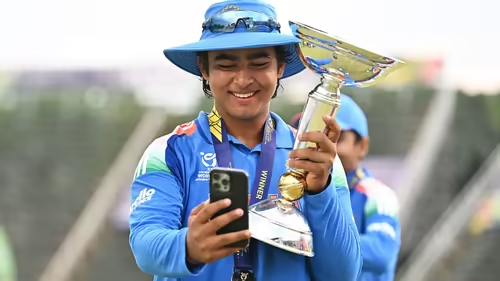
Fourteen-year-old Vaibhav Suryavanshi didn’t just play in the 2026 U19 World Cup—he owned it. His breathtaking, unbeaten 175 against England in the final wasn’t just a match-winning knock; it was a global announcement that a generational talent had arrived [[1]]. Social media exploded. Fans chanted for his immediate inclusion in Team India. But despite the frenzy, there’s a hard truth: Vaibhav Suryavanshi cannot play for India’s senior men’s team right now.
And it’s not because of form, fitness, or selection politics. It’s because of two very specific, non-negotiable rules—one from the ICC and one from the BCCI—that act as legal guardrails for young athletes. Let’s unpack exactly what’s blocking his path and why these rules exist.
The Teen Sensation Who Shook the World
Before diving into the regulations, it’s worth reiterating just how extraordinary Vaibhav’s performance was. At just 14 years and 308 days old, he became the youngest player ever to score a century in a U19 World Cup final [[1]]. His 175 came off only 132 balls, laced with 18 boundaries and 7 sixes, dismantling a seasoned English attack on a high-pressure stage.
His composure, shot selection, and ability to accelerate reminded many of a young Virat Kohli. The cricketing world took notice instantly, with legends like Sachin Tendulkar praising his “mature head on young shoulders.” Naturally, the question on everyone’s lips was: “When will he play for India?”
Vaibhav Suryavanshi India Debut: Why Not Yet?
The short answer? He’s too young—and he hasn’t completed his mandatory U19 tenure. Two key policies stand in the way of his Vaibhav Suryavanshi India debut:
- The ICC’s Minimum Age Policy
- The BCCI’s ‘One-Tournament’ Rule for U19 players
Both are designed to protect young athletes from the immense physical and mental pressures of international cricket before they’re truly ready. Let’s break them down.
The ICC Minimum Age Policy Explained
In 2021, the International Cricket Council (ICC) introduced a global minimum age policy to safeguard the welfare of junior players. The rule states that no player under the age of 15 can participate in any official ICC senior men’s or women’s international match [[5]].
This policy was enacted following medical and psychological research showing that adolescents below 15 are still in critical stages of physical development. The intense travel schedules, media scrutiny, and competitive stress of senior international cricket can lead to burnout, injury, or long-term developmental issues.
Vaibhav, born on April 2, 2011, is currently 14 years old [[1]]. That means he won’t be eligible for a senior India cap until April 2, 2026—his 15th birthday. So even if selectors wanted to pick him tomorrow, the ICC would block his participation.
The BCCI’s ‘One-Tournament’ Rule
Even after he turns 15, there’s another hurdle: the Board of Control for Cricket in India (BCCI) has its own internal guideline. Known informally as the “One-Tournament Rule,” it mandates that a player who represents India in a U19 World Cup must complete at least one full domestic season or age-group tournament cycle before being considered for the senior national team [[1]].
This rule serves two purposes:
- Performance Validation: It ensures the player isn’t a one-tournament wonder and can consistently perform against higher-quality domestic opposition.
- Physical Readiness: It gives the player time to mature physically and adapt to the rigors of first-class or List A cricket, which are significantly more demanding than U19 games.
So, while Vaibhav may turn 15 in April 2026, his earliest realistic window for a senior India call-up would likely be during the 2026–27 domestic season, possibly for the Vijay Hazare Trophy or Ranji Trophy, with an international debut potentially coming in early 2027.
Historical Context: Youngest Indian Cricketers
India has a history of fast-tracking prodigies, but always within legal limits. For perspective:
- Sachin Tendulkar made his debut at 16 years and 205 days in 1989.
- Parthiv Patel debuted at 17 years and 193 days in 2002.
- Yashasvi Jaiswal was 21 when he debuted in Tests in 2023, despite being a teenage sensation in domestic cricket.
No Indian male cricketer has ever debuted before turning 16. Vaibhav’s potential 2027 debut at age 16 would still place him among the youngest ever—a remarkable feat in itself.
What Comes Next for Vaibhav?
Don’t expect Vaibhav to disappear from the spotlight. In fact, his journey is just beginning. Here’s what to watch for:
- Domestic Cricket: He’ll likely be fast-tracked into Bihar’s senior state team for the Syed Mushtaq Ali Trophy (T20) and Vijay Hazare Trophy (List A).
- IPL Interest: While he can’t be auctioned until he’s 18, IPL franchises are already monitoring him closely. An IPL contract in 2029 could be transformative.
- India A Exposure: By late 2027, he could be a candidate for India A tours, the traditional stepping stone to the senior team.
For more on how India nurtures its next-gen stars, see our deep dive on [INTERNAL_LINK:india-u19-to-senior-team-pathway].
Conclusion: Patience Will Pay Off
The barriers preventing Vaibhav Suryavanshi’s immediate Vaibhav Suryavanshi India debut aren’t red tape—they’re protective frameworks designed to ensure his long-term success and well-being. While fans are eager to see him in blue, rushing him could do more harm than good.
History shows that the greatest talents—Tendulkar, Kohli, Dravid—all benefited from measured, structured pathways. Vaibhav is on that same path. And if his U19 World Cup performance is any indication, his senior debut won’t just be a moment—it’ll be an event worth waiting for.
Sources
- Times of India: Vaibhav Sooryavanshi can’t play for India’s men’s team right now – Here’s why [[1]]
- ICC Official Website: ICC introduces minimum age policy for international cricket [[5]]
- ESPNcricinfo: Vaibhav Suryavanshi’s U19 World Cup Final Knock: A Statistical Breakdown
- BCCI Regulations: BCCI Domestic Player Eligibility Guidelines (2023)
- Wisden: Youngest Players in International Cricket History