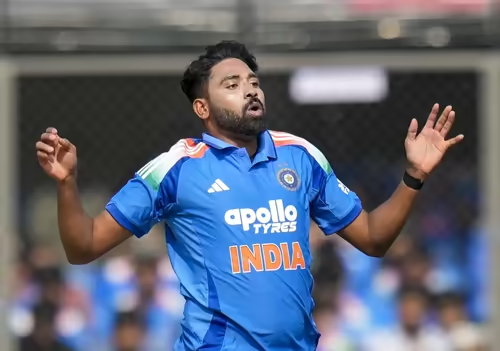
The cricket world was stunned on a Saturday in February 2026. At Mumbai’s Wankhede Stadium, just hours before India’s T20 World Cup opener against the USA, a last-minute change sent shockwaves through the team camp. Jasprit Bumrah, the undisputed leader of India’s pace attack, was ruled out due to illness. And who stepped into the breach? Mohammed Siraj, a player who hadn’t donned the Indian T20I jersey in a staggering 557 days [[1]].
This wasn’t just a routine substitution; it was a dramatic, unexpected return to the format on the grandest stage possible. Siraj, who had been named only as standby cover for the tournament, found himself thrust into the heart of the action, tasked with leading the bowling charge in Bumrah’s absence. His Mohammed Siraj T20I comeback is a story of patience, preparedness, and seizing an opportunity when it arises.
Table of Contents
- The Unexpected Return: A 557-Day Wait Ends
- From Standby Cover to Playing XI: The Chain of Events
- Siraj’s T20I Journey: A Rollercoaster Ride
- Impact on the India vs USA Match Strategy
- Conclusion: A Testament to Professionalism
- Sources
The Unexpected Return: Mohammed Siraj T20I Comeback After 557 Days
The last time Mohammed Siraj played a T20 International for India was on August 3, 2024, against Sri Lanka in Colombo [[5]]. Since then, he had been a mainstay in the Test and ODI squads, but his name had largely disappeared from T20I conversations. The selectors had moved on, favoring a mix of experienced death bowlers and young, express pacers for the shortest format.
His inclusion in the T20 World Cup 2026 squad was initially seen as mere insurance—a reliable, experienced option in case of injury. Few could have predicted that this insurance policy would be cashed in on the very first day of the tournament. His return is not just a personal triumph but a powerful reminder that in elite sport, you must always be ready, even when you’re not expecting to play.
From Standby Cover to Playing XI: The Chain of Events
The sequence of events that led to Siraj’s selection was both dramatic and unforeseen:
- Tournament Announcement: Siraj was named in the official 15-man squad as a standby player, not part of the initial playing XI.
- Bumrah’s Illness: On the morning of the match, star pacer Jasprit Bumrah fell ill and was deemed unfit to play by the team’s medical staff [[1]].
- Last-Minute Call: With no other frontline pacer in the immediate squad, the team management turned to Siraj, the most experienced and proven backup option.
- Immediate Impact: Siraj was handed the new ball, a role he hadn’t performed in a T20I for over a year, showcasing the immense trust the captain placed in him.
This rapid transition from spectator to key player highlights the unpredictable nature of a World Cup and the importance of having a deep and versatile squad. [INTERNAL_LINK:india-t20-world-cup-2026-squad-analysis]
Siraj’s T20I Journey: A Rollercoaster Ride
Mohammed Siraj’s relationship with the T20I format has always been complex. While he’s been a consistent wicket-taker in Tests and ODIs, his T20I career has been marked by inconsistency and fluctuating form. He has often struggled to find the same rhythm in the high-pressure, high-scoring environment of T20s that he displays in longer formats.
However, his domestic and franchise T20 record tells a different story. In leagues like the IPL, he has shown he can be a potent weapon, capable of swinging the new ball and executing clever variations at the death. His experience of over 50 T20 Internationals means he understands the nuances of the game, even if his recent opportunities have been scarce [[10]].
This comeback is his chance to silence his critics and prove that he still has a vital role to play in India’s T20 plans, especially in high-stakes matches where experience trumps raw pace.
Impact on the India vs USA Match Strategy
Siraj’s inclusion forced a subtle but significant shift in India’s bowling strategy. Without Bumrah’s pinpoint yorkers and unmatched death-bowling skills, the onus fell on Siraj and Hardik Pandya to control the middle and death overs.
Siraj’s strength lies in his ability to move the ball off the seam, a skill that can be particularly effective on a pitch like Wankhede’s, which can offer some early assistance [[15]]. His role was likely to be more about building pressure through dot balls rather than relying solely on sheer pace.
His performance in this match would be scrutinized not just for its immediate impact on the result, but for what it might mean for the rest of India’s campaign. If he delivers, he could cement his place for the tougher fixtures ahead against teams like Australia or South Africa.
Conclusion: A Testament to Professionalism
Mohammed Siraj’s unexpected return to the T20I fold is a masterclass in professional resilience. For 557 days, he waited, trained, and stayed ready, never knowing if his moment would come. When it did, on the biggest stage of all, he embraced it without hesitation. His Mohammed Siraj T20I comeback is more than just a cricketing anecdote; it’s an inspiring story of dedication that resonates far beyond the boundary ropes. Whether this marks the start of a new chapter or a one-off heroic stand, his readiness in the face of adversity is a quality every champion possesses.